Technical Specifications
| Brand | Citroen |
| Model | C5 |
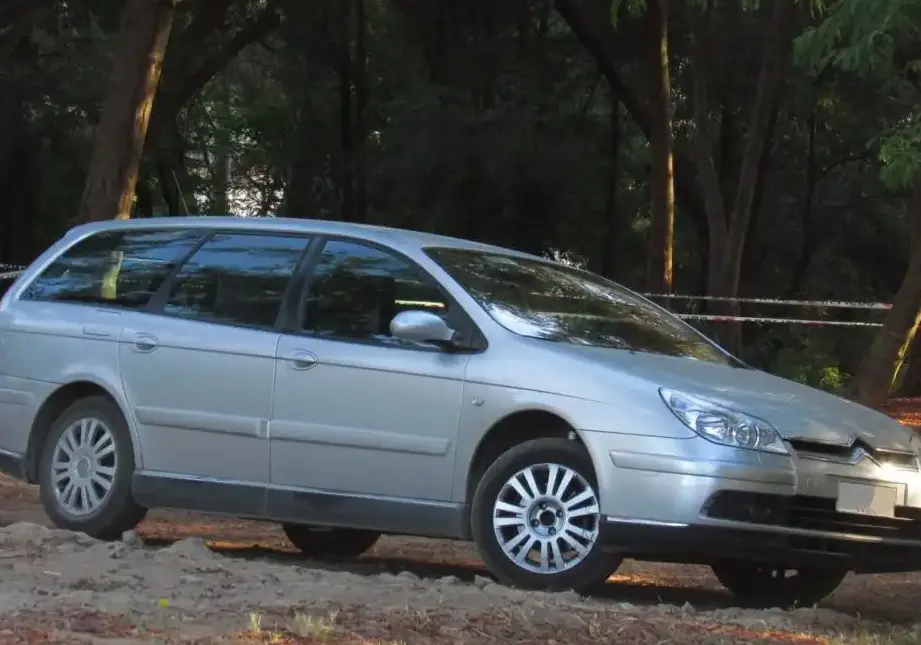
| Generation | C5 I Break (Phase II, 2004) |
| Type (Engine) | 2.0 HDi (136 Hp) FAP Automatic |
| Start of production | 2005 |
| End of production | 2008 |
| Powertrain Architecture | Internal Combustion engine |
| Body type | Station wagon (estate) |
| Seats | 5 |
| Doors | 5 |
| Fuel consumption (urban) | 10 l/100 km (23.5 US mpg, 28.2 UK mpg, 10 km/l) |
| Fuel consumption (extra urban) | 5.5 l/100 km (42.8 US mpg, 51.4 UK mpg, 18.2 km/l) |
| Fuel consumption (combined) | 7.1 l/100 km (33.1 US mpg, 39.8 UK mpg, 14.1 km/l) |
| Fuel Type | Diesel |
| Acceleration 0 – 100 km/h | 10.6 sec |
| Acceleration 0 – 62 mph | 10.6 sec |
| Acceleration 0 – 60 mph | 10.1 sec |
| Maximum speed | 201 km/h (124.9 mph) |
| Emission standard | Euro 4 |
| Weight-to-power ratio | 11.6 kg/Hp, 86.4 Hp/tonne |
| Weight-to-torque ratio | 4.6 kg/Nm, 216 Nm/tonne |
| Power | 136 Hp @ 4000 rpm |
| Power per litre | 68.1 Hp/l |
| Torque | 340 Nm @ 2000 rpm (250.77 lb.-ft. @ 2000 rpm) |
| Engine layout | Front, Transverse |
| Engine Model/Code | RHR DW10BTED4 |
| Engine displacement | 1997 cm3 (121.86 cu. in.) |
| Number of cylinders | 4 |
| Engine configuration | Inline |
| Cylinder Bore | 85 mm (3.35 in.) |
| Piston Stroke | 88 mm (3.46 in.) |
| Compression ratio | 17.6:1 |
| Number of valves per cylinder | 4 |
| Fuel injection system | Diesel Commonrail |
| Engine aspiration | Turbocharger, Intercooler |
| Valvetrain | DOHC |
| Engine oil capacity | 5.25 l (5.55 US qt, 4.62 UK qt) |
| Coolant | 10.7 l (11.31 US qt, 9.41 UK qt) |
| Kerb Weight | 1574 kg (3470.08 lbs.) |
| Max. weight | 2160 kg (4761.98 lbs.) |
| Max load | 586 kg (1291.91 lbs.) |
| Trunk (boot) space – minimum | 563 l (19.88 cu. ft.) |
| Trunk (boot) space – maximum | 1658 l (58.55 cu. ft.) |
| Fuel tank capacity | 67 l (17.7 US gal, 14.74 UK gal) |
| Max. roof load | 75 kg (165.35 lbs.) |
| Permitted towbar download | 75 kg (165.35 lbs.) |
| Length | 4839 mm (190.51 in.) |
| Width | 1780 mm (70.08 in.) |
| Height | 1511 mm (59.49 in.) |
| Wheelbase | 2750 mm (108.27 in.) |
| Front track | 1528 mm (60.16 in.) |
| Rear track | 1495 mm (58.86 in.) |
| Front overhang | 1033 mm (40.67 in.) |
| Rear overhang | 1056 mm (41.57 in.) |
| Minimum turning circle | 12.43 m (40.78 ft.) |
| Drivetrain Architecture | Front wheel drive |
| Number of gears | 6 |
| Gearbox type | Automatic transmission |
| Front suspension | Independent, McPherson with coil spring and anti-roll bar |
| Rear suspension | Semi-independent, coil spring |
| Front brakes | Ventilated discs |
| Rear brakes | Disc |
| Assisting systems | ABS (Anti-lock braking system) |
| Tires size | 215/55 R16 |
| Wheel rims size | 16 |
The Citroën C5 I Break (Phase II), specifically the 2.0 HDi 136 hp FAP Automatic variant produced between 2005 and 2008, represents a compelling blend of comfort, practicality, and fuel efficiency within the mid-size station wagon segment. Positioned as a mid-range offering in the C5 Break lineup, it aimed to provide a more refined and economical alternative to the petrol-powered versions and the higher-output HDi models. This variant was primarily marketed in Europe, where station wagons remained a popular body style, catering to families and individuals needing ample cargo space and long-distance comfort. It built upon the foundation of the X7 platform (also known as the 1HX0/A3 platform), shared with the Peugeot 607, offering a sophisticated suspension system and a spacious interior.
Powertrain & Engine Architecture
The heart of this C5 Break variant is the DW10BTED4 engine, a 2.0-liter inline-four cylinder diesel engine. This engine, commonly found in PSA Group (Peugeot and Citroën) vehicles of the era, utilizes a common rail direct injection system, delivering fuel at extremely high pressure for optimized combustion. The ‘RHR’ engine code specifically denotes a version equipped with a Diesel Particulate Filter (DPF), or FAP in French (Filtre à Particules), designed to reduce particulate matter emissions and meet Euro 4 standards. The engine features a single turbocharger with an intercooler, boosting power output to 136 horsepower at 4000 rpm and 340 Nm (250.77 lb-ft) of torque at 2000 rpm. The automatic transmission is a six-speed unit, providing smooth gear changes and contributing to relaxed cruising. While not a particularly advanced transmission by modern standards, it was well-regarded for its reliability and suitability for long-distance driving.
Driving Characteristics
The 2.0 HDi 136 hp Automatic C5 Break offers a comfortable and composed driving experience. Acceleration is adequate, with a 0-60 mph time of around 10.1 seconds, but it’s not designed for sporty performance. The automatic transmission prioritizes smooth shifts and fuel efficiency over aggressive downshifts. Compared to the manual transmission version of the same engine, the automatic feels slightly less responsive, and the higher-output 163 hp HDi variants offer noticeably quicker acceleration. The gear ratios are tuned for relaxed highway cruising, making it an excellent choice for long journeys. The C5’s renowned hydropneumatic suspension (depending on the specific trim level – some later models switched to conventional suspension) provides a remarkably smooth ride, absorbing bumps and imperfections in the road with ease.
Equipment & Trim Levels
The 2.0 HDi 136 hp Automatic typically came equipped with a reasonable level of standard features. These included air conditioning, power windows, central locking, and an RDS stereo system. Higher trim levels, such as Exclusive, added features like leather upholstery, automatic climate control, rain-sensing wipers, and parking sensors. Interior upholstery was generally cloth on the base models, with leather options available. The dashboard layout was functional and ergonomically designed, with a focus on ease of use. Optional extras included a navigation system, a panoramic sunroof, and upgraded audio systems.
Chassis & Braking
The C5 Break features an independent front suspension with McPherson struts and a coil spring and anti-roll bar. The rear suspension is a semi-independent torsion beam setup with coil springs. Braking is handled by ventilated discs at the front and solid discs at the rear. Anti-lock Braking System (ABS) is standard. The suspension setup prioritizes ride comfort over sharp handling, but the C5 still offers predictable and stable cornering. The steering is power-assisted and provides a reasonable level of feedback.
Market Reception & Comparison
The Citroën C5 I Break 2.0 HDi 136 hp Automatic was generally well-received by automotive critics. It was praised for its comfortable ride, spacious interior, and fuel efficiency. However, some critics noted that the engine lacked the outright performance of some of its rivals, and the automatic transmission could feel a little sluggish at times. Compared to the 1.8 petrol versions, the HDi offered significantly better fuel economy. Against the higher-output HDi models, it represented a more affordable option, albeit with a compromise in performance. Reliability was generally good, although the DPF could be a potential source of issues if the vehicle was primarily used for short journeys.
Legacy
The DW10BTED4 engine, in its various iterations, proved to be a durable and reliable powerplant. The 2.0 HDi 136 hp Automatic C5 Break remains a popular choice in the used car market, particularly for those seeking a comfortable and economical long-distance cruiser. While the DPF requires periodic maintenance, the engine itself is generally robust. The C5’s reputation for comfort and practicality has ensured its continued appeal to families and individuals who prioritize these qualities over outright performance. The model represents a significant step forward in diesel technology and a testament to Citroën’s commitment to providing comfortable and refined vehicles.