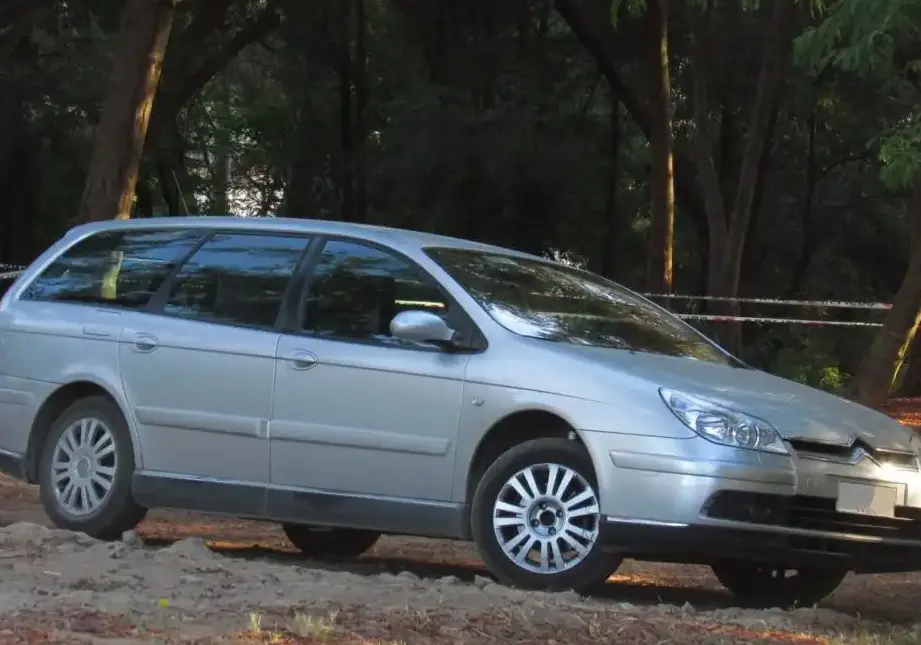
The Citroën C5 I Break (Phase II), specifically the 3.0i V6 24V variant produced between 2004 and 2008, represents a sophisticated offering in the large family car segment. This model, part of the first generation (X7) C5 Break range, aimed to combine comfort, practicality, and performance within a stylish station wagon body. Positioned as a premium trim level, it catered to buyers seeking a more refined driving experience and greater power than the base engine options. The Phase II update brought cosmetic and technological improvements to the original C5, solidifying its position as a competitor to vehicles like the Ford Mondeo Estate, Peugeot 607 SW, and Volkswagen Passat Variant.
Technical Specifications
| Brand | Citroen |
| Model | C5 |
| Generation | C5 I Break (Phase II, 2004) |
| Type (Engine) | 3.0i V6 24V (207 Hp) Automatic |
| Start of production | 2004 |
| End of production | 2008 |
| Powertrain Architecture | Internal Combustion engine |
| Body type | Station wagon (estate) |
| Seats | 5 |
| Doors | 5 |
| Fuel consumption (urban) | 14.6 l/100 km (16.1 US mpg, 19.3 UK mpg, 6.8 km/l) |
| Fuel consumption (extra urban) | 7.2 l/100 km (32.7 US mpg, 39.2 UK mpg, 13.9 km/l) |
| Fuel consumption (combined) | 10 l/100 km (23.5 US mpg, 28.2 UK mpg, 10 km/l) |
| Fuel Type | Petrol (Gasoline) |
| Acceleration 0 – 100 km/h | 8.8 sec |
| Acceleration 0 – 62 mph | 8.8 sec |
| Acceleration 0 – 60 mph | 8.4 sec |
| Maximum speed | 227 km/h (141.05 mph) |
| Emission standard | Euro 4 |
| Weight-to-power ratio | 7.8 kg/Hp, 127.8 Hp/tonne |
| Weight-to-torque ratio | 5.7 kg/Nm, 175.9 Nm/tonne |
| Power | 207 Hp @ 6000 rpm |
| Power per litre | 70.3 Hp/l |
| Torque | 285 Nm @ 3750 rpm (210.21 lb.-ft. @ 3750 rpm) |
| Engine layout | Front, Transverse |
| Engine Model/Code | XFU ES9A |
| Engine displacement | 2946 cm3 (179.78 cu. in.) |
| Number of cylinders | 6 |
| Engine configuration | V-engine |
| Cylinder Bore | 87 mm (3.43 in.) |
| Piston Stroke | 82.6 mm (3.25 in.) |
| Compression ratio | 10.9:1 |
| Number of valves per cylinder | 4 |
| Fuel injection system | Multi-port manifold injection |
| Engine aspiration | Naturally aspirated engine |
| Engine oil capacity | 5.3 l (5.6 US qt | 4.66 UK qt) |
| Coolant | 14 l (14.79 US qt | 12.32 UK qt) |
| Kerb Weight | 1620 kg (3571.49 lbs.) |
| Max. weight | 2180 kg (4806.08 lbs.) |
| Max load | 560 kg (1234.59 lbs.) |
| Trunk (boot) space – minimum | 563 l (19.88 cu. ft.) |
| Trunk (boot) space – maximum | 1658 l (58.55 cu. ft.) |
| Fuel tank capacity | 66 l (17.44 US gal | 14.52 UK gal) |
| Max. roof load | 75 kg (165.35 lbs.) |
| Permitted towbar download | 75 kg (165.35 lbs.) |
| Length | 4839 mm (190.51 in.) |
| Width | 1780 mm (70.08 in.) |
| Height | 1511 mm (59.49 in.) |
| Wheelbase | 2750 mm (108.27 in.) |
| Front track | 1528 mm (60.16 in.) |
| Rear (Back) track | 1495 mm (58.86 in.) |
| Front overhang | 1033 mm (40.67 in.) |
| Rear overhang | 1056 mm (41.57 in.) |
| Minimum turning circle | 12.43 m (40.78 ft.) |
| Drivetrain Architecture | Front wheel drive |
| Drive wheel | Front wheel drive |
| Number of gears | 6 |
| Gearbox type | automatic transmission |
| Front suspension | Independent, type McPherson with coil spring and anti-roll bar |
| Rear suspension | Semi-independent, coil spring |
| Front brakes | Ventilated discs |
| Rear brakes | Disc |
| Assisting systems | ABS (Anti-lock braking system) |
| Tires size | 215/55 R16 |
| Wheel rims size | 16 |
Powertrain & Engine Architecture
The heart of the C5 I Break 3.0i is the ES9A engine, a 2.9-liter naturally aspirated V6. This engine, part of Citroën/Peugeot’s ES family, features a 60-degree V-angle and utilizes a cast iron block with aluminum cylinder heads. It employs multi-point fuel injection and a dual overhead camshaft (DOHC) valvetrain with four valves per cylinder. The engine’s design prioritizes smooth power delivery and refinement over outright performance. The automatic transmission is a six-speed unit, offering relatively smooth shifts but not the responsiveness of a manual gearbox. This transmission was chosen to enhance the comfort-oriented nature of the C5, providing effortless cruising and ease of driving.
Driving Characteristics
The 3.0i V6 automatic C5 Break delivers a comfortable and composed driving experience. The engine provides ample power for relaxed highway cruising and confident overtaking. While the 0-60 mph time of around 8.4 seconds isn’t particularly quick by modern standards, the engine’s torque output of 285 Nm (210 lb-ft) provides good mid-range acceleration. The automatic transmission, while smooth, can feel somewhat hesitant during quick downshifts. The gear ratios are tuned for fuel efficiency and comfort rather than sporty performance. Compared to the 1.8L and 2.0L petrol variants, the V6 offers significantly more power and refinement, but at the cost of increased fuel consumption.
Equipment & Trim Levels
The 3.0i V6 typically came equipped with a generous level of standard features. These included automatic climate control, power windows and mirrors, a CD stereo system, and alloy wheels. Higher trim levels often added leather upholstery, a sunroof, and parking sensors. The interior design focused on comfort and ergonomics, with supportive seats and a well-laid-out dashboard. Optional extras included a navigation system and premium audio equipment.
Chassis & Braking
The C5 I Break features a McPherson strut front suspension and a semi-independent torsion beam rear suspension. This setup provides a good balance between ride comfort and handling. The car is equipped with ventilated disc brakes at the front and solid discs at the rear, providing adequate stopping power. Anti-lock Braking System (ABS) is standard, enhancing safety. The suspension is tuned for comfort, absorbing bumps and imperfections in the road surface effectively. Stabilizer bars are fitted to both axles to reduce body roll during cornering.
Market Reception & Comparison
The C5 I Break 3.0i V6 was generally well-received by automotive critics, who praised its comfortable ride, spacious interior, and refined engine. However, some criticized its relatively high fuel consumption and the somewhat sluggish response of the automatic transmission. Compared to the 1.8L and 2.0L petrol versions, the V6 offered a significant performance upgrade but came at a higher price point and with increased running costs. The 2.2 HDi diesel variant offered comparable performance with significantly better fuel economy, making it a popular alternative for those covering long distances.
Legacy
The Citroën C5 I Break 3.0i V6, while not a high-volume seller, remains a desirable used car for those seeking a comfortable and well-equipped station wagon. The ES9A V6 engine is generally considered reliable, although regular maintenance is essential. Common issues include oil leaks and occasional problems with the automatic transmission. Today, these cars represent a good value proposition for buyers looking for a spacious, comfortable, and relatively affordable family car with a touch of French flair. The Hydractive suspension (available on some models) is particularly sought after for its exceptional ride quality.