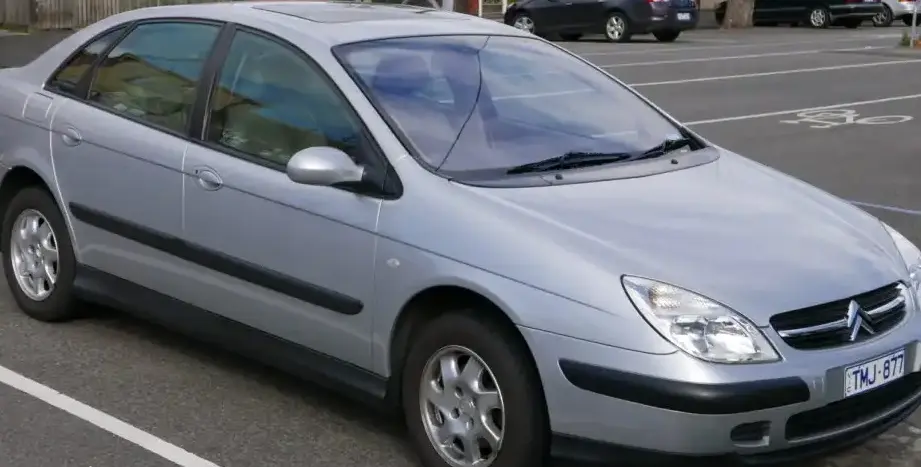
Technical Specifications
| Brand | Citroen |
| Model | C5 |
| Generation | C5 I (Phase I, 2000) |
| Type (Engine) | 2.0 HDi (109 Hp) FAP |
| Start of production | 2000 year |
| End of production | 2004 year |
| Powertrain Architecture | Internal Combustion engine |
| Body type | Sedan |
| Seats | 5 |
| Doors | 4 |
| Fuel consumption (urban) | 7.4 l/100 km (31.8 US mpg, 38.2 UK mpg, 13.5 km/l) |
| Fuel consumption (extra urban) | 4.6 l/100 km (51.1 US mpg, 61.4 UK mpg, 21.7 km/l) |
| Fuel consumption (combined) | 5.6 l/100 km (42 US mpg, 50.4 UK mpg, 17.9 km/l) |
| CO2 emissions | 147 g/km |
| Fuel Type | Diesel |
| Maximum speed | 191 km/h (118.68 mph) |
| Emission standard | Euro 3 |
| Weight-to-power ratio | 12.8 kg/Hp, 77.9 Hp/tonne |
| Weight-to-torque ratio | 4.5 kg/Nm, 224.4 Nm/tonne |
| Power | 109 Hp @ 4000 rpm |
| Power per litre | 54.6 Hp/l |
| Torque | 314 Nm @ 2000 rpm (231.59 lb.-ft. @ 2000 rpm) |
| Engine layout | Front, Transverse |
| Engine Model/Code | RHS DW10ATED |
| Engine displacement | 1996 cm3 (121.8 cu. in.) |
| Number of cylinders | 4 |
| Engine configuration | Inline |
| Cylinder Bore | 85 mm (3.35 in.) |
| Piston Stroke | 88 mm (3.46 in.) |
| Compression ratio | 17.6:1 |
| Number of valves per cylinder | 2 |
| Fuel injection system | Diesel Commonrail |
| Engine aspiration | Turbocharger, Intercooler |
| Valvetrain | DOHC |
| Engine oil capacity | 4.8 l (5.07 US qt | 4.22 UK qt) |
| Coolant | 10.7 l (11.31 US qt | 9.41 UK qt) |
| Kerb Weight | 1399 kg (3084.27 lbs.) |
| Max. weight | 1905 kg (4199.81 lbs.) |
| Max load | 506 kg (1115.54 lbs.) |
| Trunk (boot) space – minimum | 456 l (16.1 cu. ft.) |
| Fuel tank capacity | 68 l (17.96 US gal | 14.96 UK gal) |
| Max. roof load | 75 kg (165.35 lbs.) |
| Permitted trailer load with brakes (8%) | 1600 kg (3527.4 lbs.) |
| Permitted trailer load with brakes (12%) | 1500 kg (3306.93 lbs.) |
| Permitted trailer load without brakes | 730 kg (1609.37 lbs.) |
| Permitted towbar download | 75 kg (165.35 lbs.) |
| Length | 4618 mm (181.81 in.) |
| Width | 1770 mm (69.69 in.) |
| Width including mirrors | 2100 mm (82.68 in.) |
| Height | 1476 mm (58.11 in.) |
| Wheelbase | 2750 mm (108.27 in.) |
| Front track | 1544 mm (60.79 in.) |
| Rear (Back) track | 1509 mm (59.41 in.) |
| Front overhang | 971 mm (38.23 in.) |
| Rear overhang | 897 mm (35.31 in.) |
| Minimum turning circle (turning diameter) | 11.39 m (37.37 ft.) |
| Drivetrain Architecture | The Internal combustion engine (ICE) drives the front wheels of the vehicle. |
| Drive wheel | Front wheel drive |
| Number of gears and type of gearbox | 5 gears, manual transmission |
| Front suspension | Independent, type McPherson with coil spring and anti-roll bar |
| Rear suspension | Semi-independent, coil spring |
| Front brakes | Ventilated discs |
| Rear brakes | Disc |
| Assisting systems | ABS (Anti-lock braking system) |
| Steering type | Steering rack and pinion |
| Power steering | Hydraulic Steering |
| Tires size | 195/65 R15 |
| Wheel rims size | 6J x 15 |
The Citroën C5 I, launched in 2000, marked a significant evolution for the French automaker, designed to compete with mainstream mid-size family cars such as the Ford Mondeo and Volkswagen Passat. The first generation C5 (designated X10) prioritized comfort, technology, and practicality. The 2.0 HDi 109 hp variant, produced between 2000 and 2004, was a key model in the range, offering a balance of fuel efficiency and affordability, appealing to buyers who valued economy and long-distance comfort. Notably, this version was equipped with a Diesel Particulate Filter (FAP), a relatively new emissions control technology at the time. It was positioned as a mid-range offering, sitting below the more powerful HDi models and above the base petrol engines.
Powertrain & Engine Architecture
The 2.0 HDi 109 hp C5 I is powered by the RHS DW10ATED engine, a 2.0-liter inline-four cylinder diesel. This engine is part of the DW10 family developed by PSA Peugeot Citroën, known for its robustness and efficiency. The ‘DW10ATED’ designation indicates the inclusion of a Diesel Particulate Filter (FAP) to reduce emissions. The engine employs a common rail direct injection system, delivering fuel at high pressure for optimized combustion. A turbocharger with an intercooler further boosts performance by increasing air intake. The engine features a double overhead camshaft (DOHC) valvetrain with two valves per cylinder. A 5-speed manual transmission was standard, chosen for its cost-effectiveness and contribution to fuel economy. The transmission’s gear ratios were optimized for fuel efficiency and relaxed cruising, rather than sporty acceleration.
Driving Characteristics
The 109 hp 2.0 HDi engine in the C5 I delivered adequate, but not particularly exciting, performance. Acceleration was sufficient for daily driving, but overtaking required careful planning. The engine’s 314 Nm (231.59 lb-ft) of torque, available from 2000 rpm, provided good pulling power in higher gears, making it suitable for highway driving and carrying passengers or luggage. Compared to the 136 hp HDi version, this variant felt noticeably slower, especially during acceleration. The manual transmission, while not sporty, offered precise shifts and contributed to the car’s fuel efficiency. The C5’s suspension, renowned for its comfort, effectively absorbed road imperfections, providing a smooth and relaxed ride.
Equipment & Trim Levels
The 2.0 HDi 109 hp C5 I typically came with a reasonable level of standard equipment. This included power steering, central locking, electric front windows, and an RDS radio. Air conditioning was often an optional extra. Interior upholstery was typically cloth, prioritizing durability and comfort. Higher trim levels offered features like alloy wheels, rear electric windows, and an upgraded audio system. The dashboard layout was functional and ergonomically designed for ease of use. Safety features included ABS brakes and driver and passenger airbags.
Chassis & Braking
The C5 I utilized a McPherson strut front suspension and a semi-independent torsion beam rear suspension. This setup prioritized ride comfort over sharp handling. The front brakes were ventilated discs, providing good stopping power, while the rear brakes were solid discs. The steering was hydraulically assisted, offering a light and easy driving experience. The car’s relatively modest weight (1399 kg / 3084.27 lbs) helped to offset the engine’s limited power.
Market Reception & Comparison
The Citroën C5 I 2.0 HDi 109 hp was generally well-received by automotive critics as a comfortable, practical, and fuel-efficient family car. It was praised for its ride quality and spacious interior. However, some reviewers noted that the engine lacked the power of its more potent counterparts. Compared to the 136 hp HDi version, the 109 hp model offered better fuel economy but at the cost of performance. It also represented a more affordable entry point into the C5 range. Against competitors like the Ford Mondeo and Volkswagen Passat, the C5 offered a distinctive combination of French comfort and practicality.
Legacy
The DW10ATED engine proved to be remarkably durable, and many examples of the C5 I 2.0 HDi remain on the road today. The FAP system, while innovative, could require maintenance if not properly cared for. Regular servicing, including oil changes and FAP regeneration, is essential for long-term reliability. In the used car market, this variant offers good value for buyers seeking a comfortable and economical family car. Its relatively simple mechanicals and readily available parts make it reasonably affordable to maintain. However, potential buyers should be aware of the possibility of FAP-related issues and ensure the car has been regularly serviced.