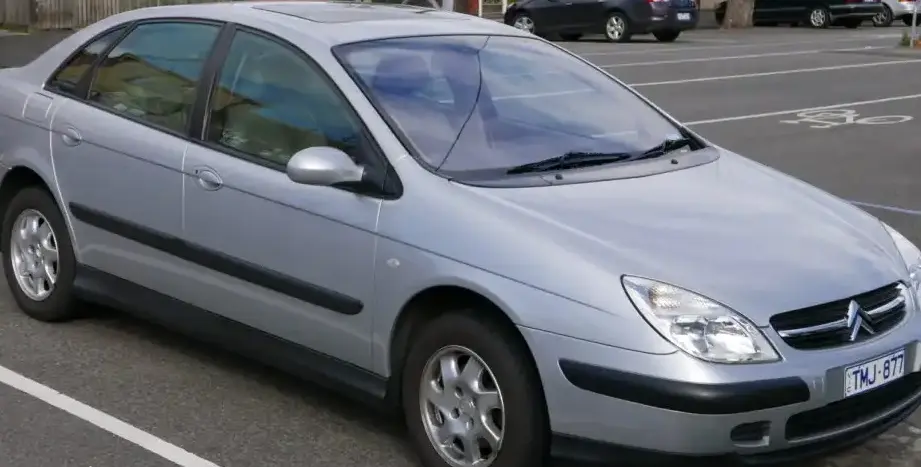
The Citroën C5 I, launched in 2000, represented a significant step forward for the French automaker, aiming to compete directly with established mid-size family cars like the Ford Mondeo and Volkswagen Passat. The first generation C5 (designated X10) offered a blend of comfort, technology, and distinctive styling. Within the C5 I range, the 2.0 HPi variant, producing 140 horsepower, occupied a middle ground in the lineup, positioned as a more refined and powerful alternative to the base 1.8-liter engine, while remaining more accessible than the flagship 3.0-liter V6. Production of this specific configuration ran from 2000 to 2003, coinciding with the initial phase (Phase I) of the C5 I’s lifecycle.
Technical Specifications
| Brand | Citroen |
| Model | C5 |
| Generation | C5 I (Phase I, 2000) |
| Type (Engine) | 2.0 HPi (140 Hp) |
| Start of production | 2000 year |
| End of production | 2003 year |
| Powertrain Architecture | Internal Combustion engine |
| Body type | Sedan |
| Seats | 5 |
| Doors | 4 |
| Fuel consumption (economy) – urban | 10.3 l/100 km (22.8 US mpg, 27.4 UK mpg, 9.7 km/l) |
| Fuel consumption (economy) – extra urban | 6 l/100 km (39.2 US mpg, 47.1 UK mpg, 16.7 km/l) |
| Fuel consumption (economy) – combined | 7.5 l/100 km (31.4 US mpg, 37.7 UK mpg, 13.3 km/l) |
| CO2 emissions | 177 g/km |
| Fuel Type | Petrol (Gasoline) |
| Acceleration 0 – 100 km/h | 10.6 sec |
| Acceleration 0 – 62 mph | 10.6 sec |
| Acceleration 0 – 60 mph | 10.1 sec |
| Maximum speed | 210 km/h (130.49 mph) |
| Emission standard | Euro 3 |
| Weight-to-power ratio | 9.5 kg/Hp, 105.7 Hp/tonne |
| Weight-to-torque ratio | 6.9 kg/Nm, 144.9 Nm/tonne |
| Power | 140 Hp @ 6000 rpm |
| Power per litre | 70.1 Hp/l |
| Torque | 192 Nm @ 4000 rpm (141.61 lb.-ft. @ 4000 rpm) |
| Engine layout | Front, Transverse |
| Engine Model/Code | RLZ EW10D |
| Engine displacement | 1997 cm3 (121.86 cu. in.) |
| Number of cylinders | 4 |
| Engine configuration | Inline |
| Cylinder Bore | 85 mm (3.35 in.) |
| Piston Stroke | 88 mm (3.46 in.) |
| Compression ratio | 11.4:1 |
| Number of valves per cylinder | 4 |
| Fuel injection system | Direct injection |
| Engine aspiration | Naturally aspirated engine |
| Valvetrain | DOHC |
| Engine oil capacity | 4.3 l (4.54 US qt | 3.78 UK qt) |
| Coolant | 8.8 l (9.3 US qt | 7.74 UK qt) |
| Kerb Weight | 1325 kg (2921.12 lbs.) |
| Max. weight | 1845 kg (4067.53 lbs.) |
| Max load | 520 kg (1146.4 lbs.) |
| Trunk (boot) space – minimum | 456 l (16.1 cu. ft.) |
| Fuel tank capacity | 66 l (17.44 US gal | 14.52 UK gal) |
| Max. roof load | 75 kg (165.35 lbs.) |
| Permitted trailer load with brakes (8%) | 1600 kg (3527.4 lbs.) |
| Permitted trailer load with brakes (12%) | 1500 kg (3306.93 lbs.) |
| Permitted trailer load without brakes | 700 kg (1543.24 lbs.) |
| Permitted towbar download | 75 kg (165.35 lbs.) |
| Length | 4618 mm (181.81 in.) |
| Width | 1770 mm (69.69 in.) |
| Width including mirrors | 2100 mm (82.68 in.) |
| Height | 1476 mm (58.11 in.) |
| Wheelbase | 2750 mm (108.27 in.) |
| Front track | 1544 mm (60.79 in.) |
| Rear (Back) track | 1509 mm (59.41 in.) |
| Front overhang | 971 mm (38.23 in.) |
| Rear overhang | 897 mm (35.31 in.) |
| Minimum turning circle (turning diameter) | 11.39 m (37.37 ft.) |
| Drivetrain Architecture | The Internal combustion engine (ICE) drives the front wheels of the vehicle. |
| Drive wheel | Front wheel drive |
| Number of gears and type of gearbox | 5 gears, manual transmission |
| Front suspension | Independent, type McPherson with coil spring and anti-roll bar |
| Rear suspension | Semi-independent, coil spring |
| Front brakes | Ventilated discs |
| Rear brakes | Disc |
| Assisting systems | ABS (Anti-lock braking system) |
| Steering type | Steering rack and pinion |
| Power steering | Hydraulic Steering |
| Tires size | 195/65 R15 |
| Wheel rims size | 6J x 15 |
INTRODUCTION
The Citroën C5 I 2.0 HPi, introduced in 2000, was a key component of Citroën’s strategy to modernize its image and offer a compelling alternative in the competitive D-segment. Built on the PSA Group’s 1HX0 platform (also shared with the Peugeot 406), the C5 aimed to deliver a unique blend of comfort and technology. The 2.0 HPi engine, a naturally aspirated four-cylinder, provided a balance between performance and fuel efficiency, making it a popular choice for drivers seeking a more engaging experience than the base models, but without the higher running costs of the V6. This variant was available in both sedan and station wagon (Tourer) body styles.
Powertrain & Engine Architecture
The heart of the C5 2.0 HPi is the EW10D engine, a 1997cc inline-four cylinder powerplant. This engine, designated RLZ in some markets, featured direct fuel injection (HPi stands for High Pressure Injection), a technology that improved combustion efficiency and power output compared to traditional port fuel injection. The engine utilized a double overhead camshaft (DOHC) valvetrain with four valves per cylinder, contributing to its responsive nature. The 2.0 HPi produced 140 horsepower at 6000 rpm and 192 Nm (141.61 lb-ft) of torque at 4000 rpm. The engine was transversely mounted in the front of the vehicle. The C5 2.0 HPi was typically paired with a five-speed manual transmission, although a four-speed automatic transmission was also offered, impacting acceleration and fuel economy. The automatic transmission, while providing convenience, was known for being less efficient and offering slower gear changes compared to contemporary automatic gearboxes.
Driving Characteristics
The C5 2.0 HPi offered a comfortable and refined driving experience. The 140 hp engine provided adequate power for everyday driving and highway cruising, with a 0-60 mph time of around 10.1 seconds. However, it wasn’t a particularly sporty car. The automatic transmission, when equipped, dulled the responsiveness somewhat, with noticeable delays during gear changes. The suspension, a hallmark of Citroën vehicles, prioritized ride comfort, absorbing bumps and imperfections in the road effectively. The steering was light and precise, making it easy to maneuver in urban environments. Compared to the 1.8-liter version, the 2.0 HPi offered noticeably more power and torque, resulting in quicker acceleration and more confident overtaking. The higher-output V6 models provided significantly more performance, but at the expense of fuel economy and increased running costs.
Equipment & Trim Levels
The C5 2.0 HPi was generally offered in well-equipped trim levels, often positioned as a mid-range option. Standard features typically included air conditioning, power windows, central locking, and an RDS stereo. Higher trim levels added features such as alloy wheels, a sunroof, leather upholstery, and automatic climate control. Safety features included ABS brakes, front airbags, and, on some models, side airbags. The interior design was functional and modern for its time, with a focus on ergonomics and ease of use. Dashboard materials were generally of good quality, although some plastics felt less premium than those found in German competitors.
Chassis & Braking
The C5 I utilized a McPherson strut front suspension and a semi-independent torsion beam rear suspension. This setup prioritized ride comfort and stability. The front suspension featured a coil spring and anti-roll bar to reduce body roll during cornering. Braking duties were handled by ventilated discs at the front and solid discs at the rear. ABS (Anti-lock Braking System) was standard, enhancing braking performance and safety. The C5’s chassis was designed to provide a comfortable and stable ride, rather than outright sporty handling.
Market Reception & Comparison
The Citroën C5 I 2.0 HPi was generally well-received by automotive critics. It was praised for its comfortable ride, spacious interior, and refined engine. However, some critics noted that the styling was somewhat conservative and that the automatic transmission was not as responsive as those offered by competitors. Compared to the 1.8-liter version, the 2.0 HPi offered a significant improvement in performance, making it a more appealing option for drivers who frequently traveled on highways or carried passengers. Fuel economy was comparable to other 2.0-liter gasoline engines of the time, averaging around 31.4 US mpg in combined driving. Reliability was generally good, although some owners reported issues with the electronic systems.
Legacy
The Citroën C5 I 2.0 HPi remains a relatively affordable and practical used car today. The EW10D engine is known for its durability and relatively low maintenance costs, provided it is properly serviced. However, potential buyers should be aware of the possibility of age-related issues, such as worn suspension components and corrosion. The automatic transmission, if equipped, should be inspected carefully for smooth operation. The C5 I 2.0 HPi represents a solid choice for buyers seeking a comfortable, spacious, and reliable family car with a touch of French flair. Its blend of comfort, technology, and reasonable running costs has ensured its continued presence on roads today.