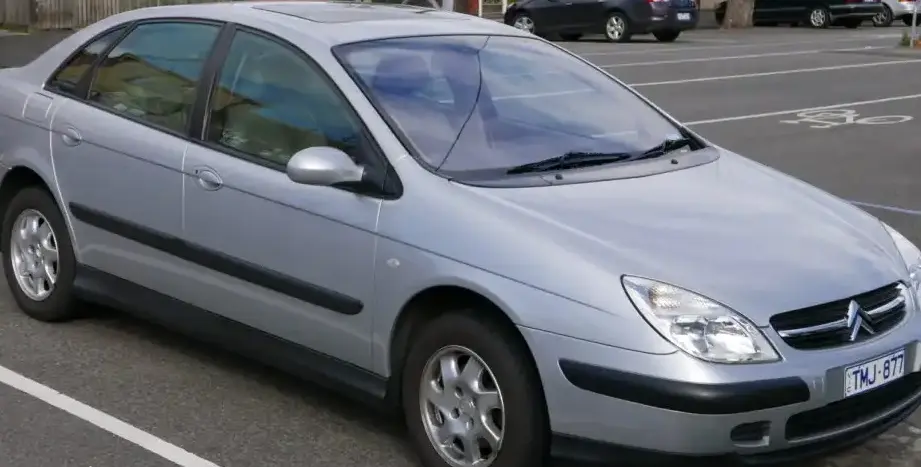
The Citroën C5 I (Phase I), produced between 2000 and 2004, represented a significant step forward for the French automaker, aiming to compete directly with established mid-size family cars like the Ford Mondeo and Volkswagen Passat. The 2.2 HDi 136 hp variant, equipped with a five-speed manual transmission, occupied a middle ground within the C5 lineup, offering a balance between fuel efficiency, performance, and refinement. This model was particularly popular in Europe, where diesel engines held a dominant market share, and was positioned as a comfortable and practical choice for long-distance travel and everyday commuting.
Technical Specifications
| Brand | Citroën |
| Model | C5 |
| Generation | C5 I (Phase I, 2000) |
| Type (Engine) | 2.2 HDi (136 Hp) FAP |
| Start of production | 2000 |
| End of production | 2004 |
| Powertrain Architecture | Internal Combustion engine |
| Body type | Sedan |
| Seats | 5 |
| Doors | 4 |
| Fuel consumption (urban) | 8.7 l/100 km (27 US mpg, 32.5 UK mpg, 11.5 km/l) |
| Fuel consumption (extra urban) | 4.8 l/100 km (49 US mpg, 58.9 UK mpg, 20.8 km/l) |
| Fuel consumption (combined) | 6.3 l/100 km (37.3 US mpg, 44.8 UK mpg, 15.9 km/l) |
| CO2 emissions | 167 g/km |
| Fuel Type | Diesel |
| Acceleration 0 – 100 km/h | 10.9 sec |
| Acceleration 0 – 62 mph | 10.9 sec |
| Acceleration 0 – 60 mph | 10.4 sec |
| Maximum speed | 205 km/h (127.38 mph) |
| Emission standard | Euro 3 |
| Weight-to-power ratio | 10.9 kg/Hp, 91.6 Hp/tonne |
| Weight-to-torque ratio | 4.6 kg/Nm, 215.5 Nm/tonne |
| Power | 136 Hp @ 4000 rpm |
| Torque | 320 Nm @ 2000 rpm (236.02 lb.-ft. @ 2000 rpm) |
| Engine layout | Front, Transverse |
| Engine Model/Code | 4HX DW12TED4 |
| Engine displacement | 2179 cm3 (132.97 cu. in.) |
| Number of cylinders | 4 |
| Engine configuration | Inline |
| Cylinder Bore | 85 mm (3.35 in.) |
| Piston Stroke | 96 mm (3.78 in.) |
| Compression ratio | 18:1 |
| Number of valves per cylinder | 4 |
| Fuel injection system | Diesel Commonrail |
| Engine aspiration | Turbocharger |
| Valvetrain | DOHC |
| Engine oil capacity | 4.8 l (5.07 US qt, 4.22 UK qt) |
| Coolant | 8.8 l (9.3 US qt, 7.74 UK qt) |
| Kerb Weight | 1485 kg (3273.86 lbs.) |
| Max. weight | 1985 kg (4376.18 lbs.) |
| Max load | 500 kg (1102.31 lbs.) |
| Trunk (boot) space – minimum | 456 l (16.1 cu. ft.) |
| Fuel tank capacity | 68 l (17.96 US gal, 14.96 UK gal) |
| Max. roof load | 75 kg (165.35 lbs.) |
| Permitted trailer load with brakes (8%) | 1700 kg (3747.86 lbs.) |
| Permitted trailer load with brakes (12%) | 1500 kg (3306.93 lbs.) |
| Permitted trailer load without brakes | 750 kg (1653.47 lbs.) |
| Permitted towbar download | 75 kg (165.35 lbs.) |
| Length | 4618 mm (181.81 in.) |
| Width | 1770 mm (69.69 in.) |
| Width including mirrors | 2100 mm (82.68 in.) |
| Height | 1476 mm (58.11 in.) |
| Wheelbase | 2750 mm (108.27 in.) |
| Front track | 1544 mm (60.79 in.) |
| Rear (Back) track | 1509 mm (59.41 in.) |
| Front overhang | 971 mm (38.23 in.) |
| Rear overhang | 897 mm (35.31 in.) |
| Minimum turning circle | 12.46 m (40.88 ft.) |
| Drivetrain Architecture | Front wheel drive |
| Number of gears and type of gearbox | 5 gears, manual transmission |
| Front suspension | Independent, type McPherson with coil spring and anti-roll bar |
| Rear suspension | Semi-independent, coil spring |
| Front brakes | Ventilated discs |
| Rear brakes | Disc |
| Assisting systems | ABS (Anti-lock braking system) |
| Steering type | Steering rack and pinion |
| Power steering | Hydraulic Steering |
| Tires size | 205/65 R15; 215/65 R16 |
| Wheel rims size | 6.5J x 15; 6.5J x 16 |
Powertrain & Engine Architecture
The heart of the C5 2.2 HDi was the DW12TED4 engine, a 2.2-liter inline-four diesel engine. This engine was a product of Peugeot-Citroën’s collaboration with PSA, and it represented a significant advancement in diesel technology. The DW12 featured a common rail direct injection system, delivering fuel at extremely high pressure for improved combustion efficiency and reduced emissions. A turbocharger with variable geometry (VGT) further enhanced performance, providing increased power and torque across a wider rev range. The engine utilized a double overhead camshaft (DOHC) valvetrain with four valves per cylinder, optimizing gas flow for better power output. The inclusion of a Diesel Particulate Filter (DPF), denoted by the “FAP” in the model name, was a key feature aimed at reducing particulate matter emissions, complying with increasingly stringent European emission standards. The five-speed manual transmission offered precise gear changes and contributed to the car’s overall efficiency.
Driving Characteristics
The 2.2 HDi engine provided a good balance of performance and economy. While not a sports car, the 136 horsepower and 320 Nm (236 lb-ft) of torque delivered respectable acceleration, with a 0-60 mph time of around 10.4 seconds. The engine’s torque curve was relatively flat, meaning that strong pulling power was available from low engine speeds, making it well-suited for overtaking and driving on hilly roads. Compared to the lower-powered 1.8-liter petrol versions, the 2.2 HDi offered significantly more torque and better fuel economy. However, it wasn’t as responsive as the higher-output 2.0 HDi or the petrol V6 options. The five-speed manual transmission was well-matched to the engine, providing smooth and precise gear changes. The gear ratios were optimized for both fuel efficiency and relaxed cruising.
Equipment & Trim Levels
The C5 2.2 HDi typically came with a reasonable level of standard equipment. This included power steering, central locking, electric front windows, and an RDS stereo. Higher trim levels, such as Exclusive, added features like automatic climate control, alloy wheels, rear parking sensors, and upgraded interior trim. Interior upholstery was typically cloth, with leather options available as an extra. The dashboard layout was functional and ergonomically designed, with clear instrumentation and easy-to-use controls. Optional extras included a sunroof, navigation system, and upgraded audio systems.
Chassis & Braking
The C5 I featured a comfortable and compliant suspension setup. The front suspension utilized McPherson struts with coil springs and an anti-roll bar, while the rear suspension was a semi-independent torsion beam arrangement. This setup prioritized ride comfort over outright handling sharpness. The braking system consisted of ventilated discs on the front wheels and solid discs on the rear, providing adequate stopping power. Anti-lock Braking System (ABS) was standard, enhancing safety during emergency braking situations.
Market Reception & Comparison
The Citroën C5 2.2 HDi was generally well-received by automotive critics. It was praised for its comfortable ride, spacious interior, and fuel-efficient engine. However, some critics noted that the handling wasn’t as engaging as some of its rivals, such as the Ford Mondeo. Compared to the petrol-powered C5 variants, the 2.2 HDi offered significantly better fuel economy, making it a popular choice for high-mileage drivers. The 2.0 HDi offered slightly more power, but the 2.2 HDi provided a more refined driving experience. Reliability was generally good, although the DPF could be prone to clogging if the car was primarily used for short journeys.
Legacy
The Citroën C5 I 2.2 HDi remains a relatively common sight on European roads today. The DW12TED4 engine is known for its durability and longevity, provided it has been properly maintained. The DPF can be a potential weak point, requiring periodic cleaning or replacement. In the used car market, these C5s represent a good value proposition, offering a comfortable and practical mode of transport at an affordable price. The model helped establish Citroën as a key player in the mid-size family car segment and paved the way for future generations of the C5.