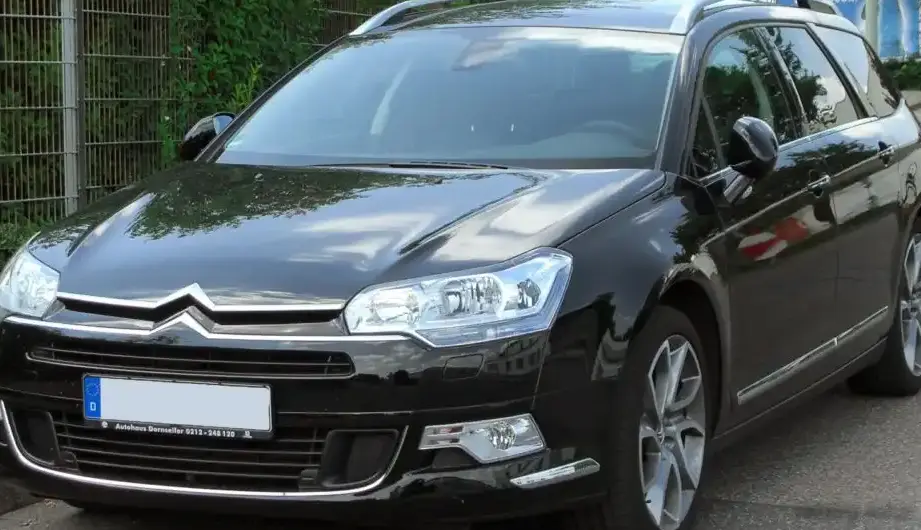
The Citroën C5 II Tourer 2.7 HDi Biturbo, produced between 2008 and 2009, represented a high-end offering within the second generation (X7) C5 Tourer range. Positioned as a premium estate car, it aimed to combine comfort, practicality, and performance, appealing to buyers seeking a sophisticated and capable long-distance cruiser. This variant, equipped with the 2.7-liter V6 turbodiesel engine and a six-speed automatic transmission, was a flagship model, sitting above the more common 1.6 and 2.0-liter diesel and petrol options. It was part of the Phase I refresh of the C5 II, building upon the platform initially launched in 2004.
Technical Specifications
| Brand | Citroen |
| Model | C5 |
| Generation | C5 II Tourer (Phase I, 2008) |
| Type (Engine) | 2.7 HDi Biturbo V6 (204 Hp) FAP Automatic |
| Start of production | 2008 |
| End of production | 2009 |
| Powertrain Architecture | Internal Combustion engine |
| Body type | Station wagon (estate) |
| Seats | 5 |
| Doors | 5 |
| Fuel consumption (urban) | 11.9 l/100 km (19.8 US mpg, 23.7 UK mpg, 8.4 km/l) |
| Fuel consumption (extra urban) | 6.5 l/100 km (36.2 US mpg, 43.5 UK mpg, 15.4 km/l) |
| Fuel consumption (combined) | 8.5 l/100 km (27.7 US mpg, 33.2 UK mpg, 11.8 km/l) |
| CO2 emissions | 225 g/km |
| Fuel Type | Diesel |
| Acceleration 0 – 100 km/h | 9.9 sec |
| Acceleration 0 – 62 mph | 9.9 sec |
| Acceleration 0 – 60 mph | 9.4 sec |
| Maximum speed | 222 km/h (137.94 mph) |
| Emission standard | Euro 4 |
| Weight-to-power ratio | 8.8 kg/Hp, 113.2 Hp/tonne |
| Weight-to-torque ratio | 4.1 kg/Nm, 244.2 Nm/tonne |
| Power | 204 Hp @ 4000 rpm |
| Power per litre | 75 Hp/l |
| Torque | 440 Nm @ 1900 rpm (324.53 lb.-ft. @ 1900 rpm) |
| Engine layout | Front, Transverse |
| Engine Model/Code | DT17ED4 |
| Engine displacement | 2720 cm3 (165.98 cu. in.) |
| Number of cylinders | 6 |
| Engine configuration | V-engine |
| Cylinder Bore | 81 mm (3.19 in.) |
| Piston Stroke | 88 mm (3.46 in.) |
| Compression ratio | 17.3:1 |
| Number of valves per cylinder | 4 |
| Fuel injection system | Diesel Commonrail |
| Engine aspiration | BiTurbo, Intercooler |
| Valvetrain | DOHC |
| Engine oil capacity | 5.5 l (5.81 US qt | 4.84 UK qt) |
| Coolant | 10.6 l (11.2 US qt | 9.33 UK qt) |
| Kerb Weight | 1802 kg (3972.73 lbs.) |
| Max. weight | 2373 kg (5231.57 lbs.) |
| Max load | 571 kg (1258.84 lbs.) |
| Trunk (boot) space – minimum | 505 l (17.83 cu. ft.) |
| Trunk (boot) space – maximum | 1462 l (51.63 cu. ft.) |
| Fuel tank capacity | 71 l (18.76 US gal | 15.62 UK gal) |
| Max. roof load | 80 kg (176.37 lbs.) |
| Permitted trailer load with brakes (12%) | 1300 kg (2866.01 lbs.) |
| Permitted trailer load without brakes | 750 kg (1653.47 lbs.) |
| Permitted towbar download | 64 kg (141.1 lbs.) |
| Length | 4829 mm (190.12 in.) |
| Width | 1860 mm (73.23 in.) |
| Width including mirrors | 2096 mm (82.52 in.) |
| Height | 1491-1495 mm (58.7 – 58.86 in.) |
| Wheelbase | 2815 mm (110.83 in.) |
| Front track | 1586 mm (62.44 in.) |
| Rear (Back) track | 1557 mm (61.3 in.) |
| Front overhang | 1054 mm (41.5 in.) |
| Rear overhang | 960 mm (37.8 in.) |
| Minimum turning circle | 11.7 m (38.39 ft.) |
| Drivetrain Architecture | Front wheel drive |
| Number of gears and type of gearbox | 6 gears, automatic transmission |
| Front suspension | Double wishbone |
| Rear suspension | Independent multi-link suspension |
| Front brakes | Ventilated discs |
| Rear brakes | Disc |
| Assisting systems | ABS (Anti-lock braking system) |
| Steering type | Steering rack and pinion |
| Power steering | Hydraulic Steering |
| Tires size | 245/45 R18 |
| Wheel rims size | 18 |
INTRODUCTION
The Citroën C5 II Tourer 2.7 HDi Biturbo, launched in 2008 as part of the Phase I facelift, was a sophisticated estate car designed for long-distance comfort and performance. Built on the PSA Group’s 0HX/A3 platform, shared with the Peugeot 607, it aimed to provide a premium alternative to mainstream offerings. The ‘Tourer’ designation signified the estate body style, offering increased practicality compared to the saloon version. This particular variant, with its powerful V6 diesel engine and automatic transmission, was positioned at the top of the C5 Tourer range, offering a blend of refinement and capability.
Powertrain & Engine Architecture
The heart of this C5 Tourer is the DT17ED4, a 2.7-liter V6 turbodiesel engine. This engine is notable for its biturbo configuration, employing two turbochargers – one smaller unit for immediate response and a larger one for peak power. This setup, combined with an intercooler, helps to mitigate turbo lag and deliver a broad torque curve. The engine utilizes a common rail direct injection system, operating at a high compression ratio of 17.3:1. The six-speed automatic transmission, sourced from Aisin, was chosen for its smoothness and ability to handle the engine’s substantial torque output of 440 Nm (324.53 lb.-ft.). This transmission featured adaptive shift programming, adjusting to driving style and conditions. The engine also incorporated a Diesel Particulate Filter (DPF), adhering to Euro 4 emissions standards.
Driving Characteristics
The 2.7 HDi Biturbo offered a distinctly different driving experience compared to the lower-powered C5 Tourer variants. The biturbo setup provided strong acceleration, with a 0-60 mph time of around 9.4 seconds and a top speed of 137.94 mph. While not a sports car, the engine delivered ample power for effortless overtaking and comfortable cruising. The automatic transmission, while smooth, wasn’t particularly quick to shift, prioritizing comfort over outright performance. The gear ratios were tuned for relaxed highway driving, with a focus on maximizing fuel efficiency at cruising speeds. Compared to the manual transmission options, the automatic offered greater convenience, but at the expense of some driver engagement. The 2.0L HDi models, while more economical, felt significantly less powerful, while the petrol engines lacked the low-end torque of the V6 diesel.
Equipment & Trim Levels
The 2.7 HDi Biturbo typically came with a high level of standard equipment. This included features like leather upholstery, automatic climate control, a premium audio system, and parking sensors. Higher trim levels added options such as a navigation system, xenon headlights, and electrically adjustable seats with memory function. The interior was designed with comfort in mind, featuring supportive seats and a well-laid-out dashboard. The C5 II was also known for its innovative Hydractive suspension system (depending on the specific configuration), which provided a remarkably smooth and controlled ride.
Chassis & Braking
The C5 II Tourer featured a double wishbone front suspension and an independent multi-link rear suspension, designed to provide a comfortable and stable ride. The 2.7 HDi variant, due to its increased weight, often benefited from slightly stiffer spring rates and dampers compared to the lower-powered models. Braking was handled by ventilated discs at the front and solid discs at the rear, equipped with ABS. The steering utilized a hydraulic power steering system, offering a good balance of assistance and feel.
Market Reception & Comparison
The C5 II Tourer 2.7 HDi Biturbo was generally well-received by automotive critics, who praised its comfortable ride, spacious interior, and powerful engine. However, some reviewers noted the relatively high fuel consumption and the somewhat dated interior design compared to some of its German rivals. Compared to competitors like the Audi A6 Avant and BMW 5 Series Touring, the C5 offered a more affordable price point, but lacked the same level of brand prestige. The 2.0L HDi models were more popular due to their superior fuel economy, but the V6 offered a significantly more refined and enjoyable driving experience.
Legacy
The 2.7 HDi Biturbo engine, while powerful, has a reputation for potential maintenance issues, particularly related to the DPF and turbochargers. Regular servicing and preventative maintenance are crucial for ensuring long-term reliability. In the used car market, these C5 Tourers represent a relatively affordable way to acquire a spacious and comfortable estate car with a powerful engine. However, potential buyers should be aware of the potential maintenance costs associated with the engine and transmission. Despite these potential issues, the C5 II Tourer 2.7 HDi Biturbo remains a capable and comfortable vehicle, appreciated by those seeking a distinctive and practical estate car.