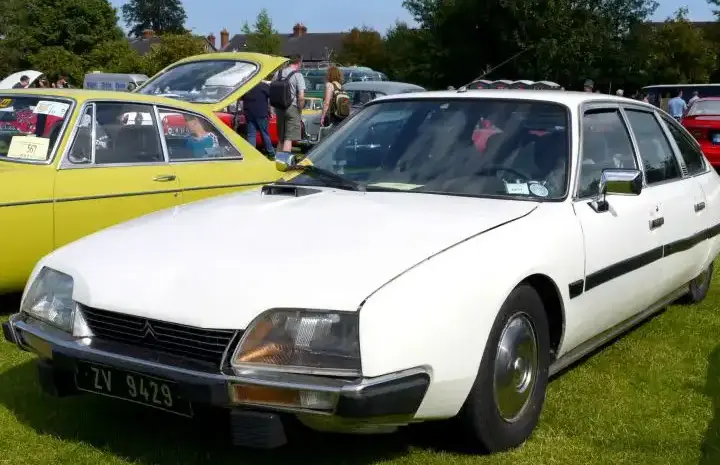
The Citroën CX I Break 25, produced between 1983 and 1985, represented a significant evolution of Citroën’s flagship executive car, the CX series. As a Phase I model, it benefited from initial refinements to the groundbreaking hydropneumatic suspension system that defined the CX. The “Break” designation signified the estate (station wagon) body style, offering increased practicality without sacrificing the CX’s renowned comfort and distinctive styling. This 25 variant, equipped with a 2.5-liter engine producing 138 horsepower, occupied a mid-range position within the CX Break lineup, offering a balance between performance and fuel economy. It was positioned above the lower-powered 2.0-liter models and below the more potent 2.9-liter and turbocharged variants.
Technical Specifications
| Brand | Citroen |
| Model | CX |
| Generation | CX I Break (Phase I, 1982) |
| Type (Engine) | 25 (138 Hp) |
| Start of production | 1983 |
| End of production | 1985 |
| Powertrain Architecture | Internal Combustion engine |
| Body type | Station wagon (estate) |
| Seats | 5 |
| Doors | 5 |
| Fuel Type | Petrol (Gasoline) |
| Acceleration 0 – 100 km/h | 10.2 sec |
| Acceleration 0 – 62 mph | 10.2 sec |
| Acceleration 0 – 60 mph | 9.7 sec |
| Maximum speed | 194 km/h (120.55 mph) |
| Weight-to-power ratio | 10.6 kg/Hp, 94.2 Hp/tonne |
| Weight-to-torque ratio | 6.9 kg/Nm, 144 Nm/tonne |
| Power | 138 Hp @ 5000 rpm |
| Power per litre | 55.2 Hp/l |
| Torque | 211 Nm @ 4000 rpm (155.63 lb.-ft. @ 4000 rpm) |
| Maximum engine speed | 6000 rpm |
| Engine layout | Front, Transverse |
| Engine Model/Code | M25.659 |
| Engine displacement | 2499 cm3 (152.5 cu. in.) |
| Number of cylinders | 4 |
| Engine configuration | Inline |
| Cylinder Bore | 93 mm (3.66 in.) |
| Piston Stroke | 92 mm (3.62 in.) |
| Compression ratio | 8.75:1 |
| Number of valves per cylinder | 2 |
| Fuel injection system | Multi-port manifold injection |
| Engine aspiration | Naturally aspirated engine |
| Engine oil capacity | 5 l (5.28 US qt | 4.4 UK qt) |
| Coolant | 9.6 l (10.14 US qt | 8.45 UK qt) |
| Kerb Weight | 1465 kg (3229.77 lbs.) |
| Max. weight | 2165 kg (4773.01 lbs.) |
| Max load | 700 kg (1543.24 lbs.) |
| Fuel tank capacity | 68 l (17.96 US gal | 14.96 UK gal) |
| Length | 4950 mm (194.88 in.) |
| Width | 1770 mm (69.69 in.) |
| Height | 1465 mm (57.68 in.) |
| Wheelbase | 3095 mm (121.85 in.) |
| Front track | 1514 mm (59.61 in.) |
| Rear (Back) track | 1390 mm (54.72 in.) |
| Drag coefficient (Cd) | 0.40 |
| Minimum turning circle | 12.5 m (41.01 ft.) |
| Drivetrain Architecture | The Internal combustion engine (ICE) drives the front wheels of the vehicle. |
| Drive wheel | Front wheel drive |
| Number of gears | 5 gears, manual transmission |
| Front brakes | Ventilated discs |
| Rear brakes | Disc |
| Steering type | Steering rack and pinion |
Powertrain & Engine Architecture
The CX 25 Break utilized Citroën’s M25.659 engine, a 2.5-liter inline-four cylinder gasoline engine. This engine featured a cast iron block and an aluminum cylinder head, a common configuration for the era. It employed multi-port fuel injection, a significant upgrade over the carburetors found in earlier Citroën models, contributing to improved fuel efficiency and smoother power delivery. The engine’s valvetrain consisted of two valves per cylinder, operated by a single overhead camshaft. The engine produced 138 horsepower at 5000 rpm and 211 Nm (155.63 lb-ft) of torque at 4000 rpm. The engine was transversely mounted, driving the front wheels. The transmission was a five-speed manual gearbox, providing a good balance of acceleration and cruising ability.
Driving Characteristics
The CX 25 Break with the manual transmission offered a reasonably spirited driving experience for its time. While not a sports car, the 138 hp engine provided adequate power for highway cruising and overtaking. The five-speed gearbox allowed drivers to keep the engine in its optimal power band. Compared to the lower-powered 2.0-liter versions, the 25 offered noticeably more punch, especially when fully loaded. However, it lacked the outright performance of the 2.9-liter and turbocharged models. The CX’s defining characteristic, its hydropneumatic suspension, provided an exceptionally smooth and comfortable ride, absorbing bumps and imperfections in the road with remarkable ease. The steering was light and precise, although it lacked significant feedback.
Equipment & Trim Levels
The CX 25 Break was generally well-equipped for its price point. Standard features typically included power steering, central locking, and comfortable cloth upholstery. The dashboard layout was characteristically Citroën, featuring a unique combination of analog gauges and switches. Optional extras included leather upholstery, air conditioning, and a sunroof. The Break body style itself added to the practicality, offering a large cargo area accessible through a rear tailgate. The interior trim level was generally considered to be a step up from the base models, with higher-quality materials and more attention to detail.
Chassis & Braking
The CX Break featured an independent suspension system on all four wheels, utilizing Citroën’s innovative hydropneumatic technology. This system allowed for self-leveling and adjustable ride height, further enhancing the car’s comfort and handling. The front suspension employed double wishbones, while the rear utilized trailing arms. Braking was provided by ventilated discs on the front wheels and solid discs on the rear. The braking system was generally effective, although it lacked the anti-lock braking system (ABS) that was becoming increasingly common on other executive cars of the era.
Market Reception & Comparison
The Citroën CX 25 Break was generally well-received by automotive critics. It was praised for its exceptional ride comfort, distinctive styling, and spacious interior. However, some critics noted that the engine, while adequate, was not as refined or powerful as those found in some of its German competitors. Compared to the 2.0-liter CX Break, the 25 offered a noticeable performance improvement, making it a more appealing option for drivers who frequently carried passengers or luggage. Fuel economy was reasonable for a car of its size and engine displacement. Reliability was generally good, although the complex hydropneumatic suspension system required regular maintenance and could be expensive to repair if neglected.
Legacy
The Citroën CX, and particularly the Break estate version, remains a beloved classic among Citroën enthusiasts. The 25 variant, while not the most sought-after model, offers a good balance of performance, comfort, and affordability. The M25 engine, while not known for being particularly high-revving or powerful, proved to be relatively durable and reliable when properly maintained. Today, well-maintained CX 25 Breaks are becoming increasingly collectible, representing a unique and stylish alternative to more mainstream executive cars of the 1980s. The hydropneumatic suspension, while requiring specialized knowledge to service, continues to be admired for its innovative design and exceptional ride quality.