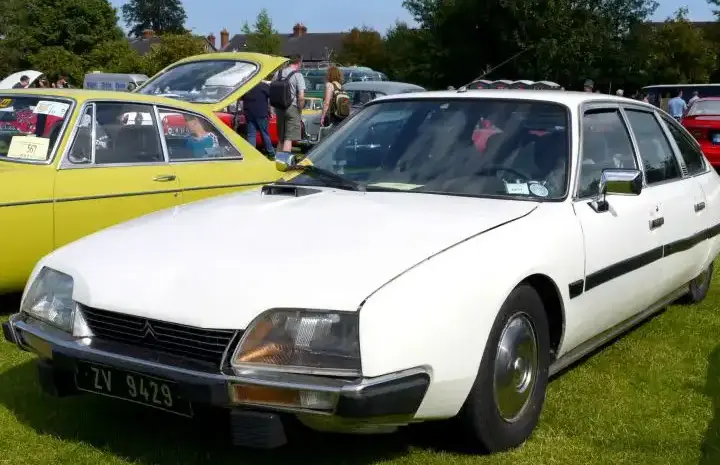
The Citroën CX 2500 D, produced between 1982 and 1983, represents an early iteration of the CX series, Citroën’s flagship saloon intended to replace the venerable DS. This variant, powered by a 2.5-liter diesel engine producing 75 horsepower, occupied the entry-level position within the CX range during its initial phase (Phase I, designated 1HX0). It aimed to offer the CX’s advanced engineering and comfort at a more accessible price point, appealing to buyers prioritizing fuel economy and long-distance cruising over outright performance. The CX, as a whole, was a significant vehicle for Citroën, embodying their commitment to innovative technology, particularly in suspension design, and aerodynamic efficiency.
Technical Specifications
| Brand | Citroen |
| Model | CX |
| Generation | CX I (Phase I, 1982) |
| Type (Engine) | Limousine 2500 D (75 Hp) |
| Start of production | 1982 |
| End of production | 1983 |
| Powertrain Architecture | Internal Combustion engine |
| Body type | Hatchback |
| Seats | 5 |
| Doors | 5 |
| Fuel Type | Diesel |
| Acceleration 0 – 100 km/h | 17.3 sec |
| Acceleration 0 – 62 mph | 17.3 sec |
| Acceleration 0 – 60 mph | 16.4 sec |
| Maximum speed | 154 km/h (95.69 mph) |
| Weight-to-power ratio | 18.3 kg/Hp, 54.5 Hp/tonne |
| Weight-to-torque ratio | 9.2 kg/Nm, 109 Nm/tonne |
| Power | 75 Hp @ 4250 rpm |
| Power per litre | 30 Hp/l |
| Torque | 150 Nm @ 2000 rpm (110.63 lb.-ft. @ 2000 rpm) |
| Engine layout | Front, Transverse |
| Engine Model/Code | M25-629 |
| Engine displacement | 2499 cm3 (152.5 cu. in.) |
| Number of cylinders | 4 |
| Engine configuration | Inline |
| Cylinder Bore | 93 mm (3.66 in.) |
| Piston Stroke | 92 mm (3.62 in.) |
| Compression ratio | 22.25:1 |
| Number of valves per cylinder | 2 |
| Fuel injection system | Precombustion chamber injection |
| Engine aspiration | Naturally aspirated engine |
| Engine oil capacity | 5.3 l (5.6 US qt | 4.66 UK qt) |
| Coolant | 12.3 l (13 US qt | 10.82 UK qt) |
| Kerb Weight | 1376 kg (3033.56 lbs) |
| Max. weight | 1910 kg (4210.83 lbs) |
| Max load | 534 kg (1177.27 lbs) |
| Trunk (boot) space – minimum | 325 l (11.48 cu. ft.) |
| Fuel tank capacity | 68 l (17.96 US gal | 14.96 UK gal) |
| Permitted trailer load with brakes (12%) | 1300 kg (2866.01 lbs) |
| Permitted trailer load without brakes | 720 kg (1587.33 lbs) |
| Length | 4916 mm (193.54 in.) |
| Width | 1734 mm (68.27 in.) |
| Height | 1357 mm (53.43 in.) |
| Wheelbase | 3095 mm (121.85 in.) |
| Front track | 1474 mm (58.03 in.) |
| Rear (Back) track | 1360 mm (53.54 in.) |
| Front overhang | 1057 mm (41.61 in.) |
| Rear overhang | 764 mm (30.08 in.) |
| Drag coefficient (Cd) | 0.40 |
| Minimum turning circle (turning diameter) | 11.80 m (38.71 ft.) |
| Drivetrain Architecture | The Internal combustion engine (ICE) drives the front wheels of the vehicle. |
| Drive wheel | Front wheel drive |
| Number of gears and type of gearbox | 5 gears, manual transmission |
| Front brakes | Ventilated discs |
| Rear brakes | Disc |
| Steering type | Steering rack and pinion |
| Wheel rims size | 5.5J x 14 |
Powertrain & Engine Architecture
The CX 2500 D was powered by the M25-629 engine, a 2.5-liter inline-four diesel. This engine utilized precombustion chamber injection, a system common in European diesel engines of the era. This system involved injecting fuel into a small precombustion chamber connected to the main cylinder, where it ignited before entering the main combustion chamber, promoting more complete combustion and reducing engine noise. The engine produced 75 horsepower at 4250 rpm and 150 Nm (110.63 lb-ft) of torque at 2000 rpm. The engine’s relatively low compression ratio of 22.25:1 was typical for diesel engines of the time, balancing efficiency and durability. The engine was transversely mounted, a layout that maximized cabin space and contributed to the CX’s front-wheel-drive configuration. The transmission was a five-speed manual, chosen for its efficiency and suitability for long-distance driving.
Driving Characteristics
The CX 2500 D’s driving experience was defined by its emphasis on comfort and refinement rather than outright performance. The 75 horsepower engine, while adequate for cruising, provided leisurely acceleration. The 0-60 mph time of around 16.4 seconds and a top speed of 95.69 mph reflected this. The five-speed manual transmission allowed drivers to keep the engine in its optimal torque band, but required frequent shifting for brisk acceleration. Compared to the later and more powerful CX 2500 GTI (with its gasoline engine), the diesel variant felt significantly slower. However, the diesel offered superior fuel economy and a more relaxed driving experience, making it ideal for long journeys. The CX’s legendary hydropneumatic suspension, a Citroën hallmark, provided an exceptionally smooth and comfortable ride, absorbing bumps and imperfections in the road with ease.
Equipment & Trim Levels
The CX 2500 D, as the entry-level model, was equipped with a relatively basic level of standard features. Interior upholstery was typically cloth, and the dashboard featured a functional, if somewhat austere, design. Standard equipment included power steering, but air conditioning and other luxury features were often optional extras. The CX’s distinctive dashboard, with its satellite controls for various functions, was a defining feature of the model. Optional extras included upgraded audio systems, sunroofs, and more luxurious interior trim options. The overall interior ambiance prioritized practicality and durability over lavishness.
Chassis & Braking
The CX featured a monocoque chassis construction, providing a strong and rigid platform. The front suspension utilized Citroën’s innovative hydropneumatic system, offering self-leveling and adjustable ride height. The rear suspension also employed hydropneumatic elements, although it was simpler in design than the front. Braking was provided by ventilated discs at the front and solid discs at the rear, offering adequate stopping power for the vehicle’s weight and performance. The steering system was a rack and pinion setup, providing precise and responsive steering feel. The CX’s aerodynamic design, with a drag coefficient of 0.40, contributed to its stability at higher speeds and improved fuel efficiency.
Market Reception & Comparison
The CX 2500 D was generally well-received by critics for its comfort, refinement, and fuel economy. However, its relatively low power output was a common criticism. Compared to other diesel-powered saloons of the time, the CX 2500 D offered a unique combination of advanced technology and comfortable ride quality. Against its gasoline-powered siblings, such as the CX 2000 or 2500 GTI, it lacked the performance to truly compete, but it appealed to a different segment of buyers who prioritized economy and practicality. The CX’s complex hydropneumatic suspension system required specialized maintenance, which could be a deterrent for some buyers.
Legacy
The Citroën CX 2500 D, while not the most powerful or sought-after variant of the CX range, remains a significant vehicle in automotive history. Its innovative technology, particularly the hydropneumatic suspension, set it apart from its competitors. The M25-629 diesel engine proved to be relatively durable, and well-maintained examples continue to be found on the road today. In the used car market, the CX 2500 D is appreciated by enthusiasts for its unique character and comfortable ride. However, finding parts and qualified mechanics to service the hydropneumatic suspension can be challenging. The CX, as a whole, is remembered as a bold and innovative vehicle that pushed the boundaries of automotive engineering and design.