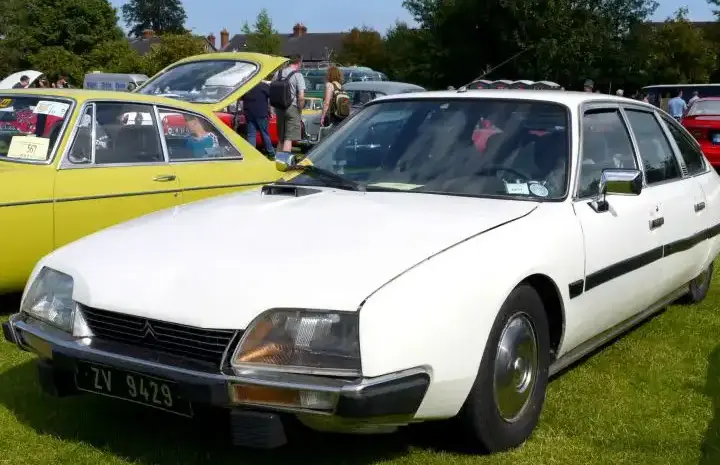
The Citroën CX I Prestige 25, produced between 1983 and 1985, represented a significant evolution in Citroën’s long history of innovative automotive engineering. Part of the first series (Phase I) of the CX model range, designated 1HX0, the Prestige 25 was positioned as a premium offering within the lineup, boasting a more powerful engine and enhanced features compared to the base models. It followed the groundbreaking Citroën DS and ID series, continuing the tradition of hydropneumatic suspension and advanced aerodynamics. The CX aimed to blend luxury, performance, and comfort, appealing to buyers seeking a sophisticated and technologically advanced vehicle.
Technical Specifications
| Brand | Citroën |
| Model | CX |
| Generation | CX I (Phase I, 1982) |
| Type (Engine) | Prestige 25 (138 Hp) |
| Start of production | 1983 |
| End of production | 1985 |
| Powertrain Architecture | Internal Combustion engine |
| Body type | Hatchback |
| Seats | 5 |
| Doors | 5 |
| Fuel Type | Petrol (Gasoline) |
| Acceleration 0 – 100 km/h | 10.6 sec |
| Acceleration 0 – 62 mph | 10.6 sec |
| Acceleration 0 – 60 mph | 10.1 sec |
| Maximum speed | 200 km/h (124.27 mph) |
| Weight-to-power ratio | 10.5 kg/Hp, 95.2 Hp/tonne |
| Weight-to-torque ratio | 6.9 kg/Nm, 145.5 Nm/tonne |
| Power | 138 Hp @ 5000 rpm |
| Power per litre | 55.2 Hp/l |
| Torque | 211 Nm @ 4000 rpm (155.63 lb.-ft. @ 4000 rpm) |
| Maximum engine speed | 6000 rpm |
| Engine layout | Front, Transverse |
| Engine Model/Code | M25.659 |
| Engine displacement | 2499 cm3 (152.5 cu. in.) |
| Number of cylinders | 4 |
| Engine configuration | Inline |
| Cylinder Bore | 93 mm (3.66 in.) |
| Piston Stroke | 92 mm (3.62 in.) |
| Compression ratio | 8.75:1 |
| Number of valves per cylinder | 2 |
| Fuel injection system | Multi-port manifold injection |
| Engine aspiration | Naturally aspirated engine |
| Engine oil capacity | 5 l (5.28 US qt | 4.4 UK qt) |
| Coolant | 12.3 l (13 US qt | 10.82 UK qt) |
| Kerb Weight | 1450 kg (3196.7 lbs) |
| Max. weight | 1910 kg (4210.83 lbs) |
| Max load | 460 kg (1014.13 lbs) |
| Trunk (boot) space – minimum | 325 l (11.48 cu. ft.) |
| Fuel tank capacity | 68 l (17.96 US gal | 14.96 UK gal) |
| Length | 4916 mm (193.54 in.) |
| Width | 1770 mm (69.69 in.) |
| Height | 1375 mm (54.13 in.) |
| Wheelbase | 3095 mm (121.85 in.) |
| Front track | 1522 mm (59.92 in.) |
| Rear (Back) track | 1368 mm (53.86 in.) |
| Front overhang | 1057 mm (41.61 in.) |
| Rear overhang | 764 mm (30.08 in.) |
| Drag coefficient (Cd) | 0.36 |
| Minimum turning circle | 13.4 m (43.96 ft.) |
| Drivetrain Architecture | The Internal combustion engine (ICE) drives the front wheels of the vehicle. |
| Drive wheel | Front wheel drive |
| Number of gears and type of gearbox | 5 gears, manual transmission |
| Front brakes | Ventilated discs |
| Rear brakes | Disc |
| Steering type | Steering rack and pinion |
Powertrain & Engine Architecture
The Prestige 25 was powered by the M25.659 engine, a 2.5-liter inline-four cylinder gasoline engine. This engine was a significant upgrade from the smaller displacement engines offered in other CX variants. It featured a cast iron block and an aluminum cylinder head, employing a multi-port fuel injection system for improved efficiency and power delivery. The engine produced 138 horsepower at 5000 rpm and 211 Nm (155.63 lb-ft) of torque at 4000 rpm. The engine’s 8.75:1 compression ratio was a compromise between performance and the fuel quality available at the time. The five-speed manual transmission was the standard offering, providing a relatively direct connection between the engine and the front wheels. The engine’s transverse mounting contributed to the CX’s compact engine bay and improved weight distribution.
Driving Characteristics
The CX Prestige 25 offered a unique driving experience largely defined by its hydropneumatic suspension. This system, a Citroën hallmark, provided an exceptionally smooth and comfortable ride, absorbing road imperfections with remarkable effectiveness. The 138 hp engine, while not overtly sporty, provided adequate power for comfortable cruising and overtaking. Acceleration to 60 mph took approximately 10.1 seconds, and the car could reach a top speed of 124.27 mph. Compared to the lower-powered 1.6-liter and 2.0-liter versions, the Prestige 25 felt noticeably more responsive, particularly at higher speeds. However, it lacked the outright performance of the later turbocharged versions. The five-speed manual transmission allowed for precise control, but the gear ratios were geared towards relaxed cruising rather than aggressive acceleration. The steering, while precise, was power-assisted and could feel somewhat detached from the road.
Equipment & Trim Levels
The Prestige 25 trim level represented a step up in luxury and features. Standard equipment included comfortable cloth upholstery, a comprehensive instrument panel, and power-assisted steering. Optional extras included leather upholstery, air conditioning, and a sunroof. The interior design was typically Citroën – functional, ergonomic, and with a focus on driver comfort. The dashboard featured a unique rotating drum speedometer and a series of toggle switches for controlling various vehicle functions. The Prestige 25 also benefited from improved sound insulation compared to the base models, contributing to a quieter and more refined cabin experience.
Chassis & Braking
The CX I utilized a monocoque chassis construction, providing a strong and rigid platform. The hydropneumatic suspension system, featuring self-leveling and height adjustment, was a key component of the chassis design. The front suspension employed independent double wishbones, while the rear suspension utilized a trailing arm design. Braking was provided by ventilated discs at the front and solid discs at the rear, offering adequate stopping power for the vehicle’s weight and performance. The steering system was a rack and pinion type with power assistance, providing precise and effortless steering control.
Market Reception & Comparison
The Citroën CX Prestige 25 was generally well-received by automotive critics, who praised its comfortable ride, innovative technology, and distinctive styling. However, some critics noted the car’s relatively high price and complex maintenance requirements. Compared to its rivals, such as the Peugeot 505 and the Rover SD1, the CX offered a unique blend of comfort and technology. The Prestige 25’s fuel economy was reasonable for its time, but not exceptional. Reliability was a mixed bag, with the hydropneumatic suspension system requiring regular maintenance and occasional repairs. The 2.5-liter engine proved to be relatively durable, but the electrical systems could be prone to issues.
Legacy
The Citroën CX, and particularly the Prestige 25 variant, remains a beloved classic among automotive enthusiasts. Its innovative technology, distinctive styling, and exceptional ride comfort have cemented its place in automotive history. While the hydropneumatic suspension system can be challenging to maintain, the CX offers a unique driving experience that is difficult to replicate. Today, well-maintained examples of the Prestige 25 are sought after by collectors and enthusiasts, representing a tangible link to Citroën’s golden age of automotive innovation. The engine, while not known for being a powerhouse, is generally considered reliable if properly maintained, and parts availability, while not abundant, is still reasonable through specialist suppliers.