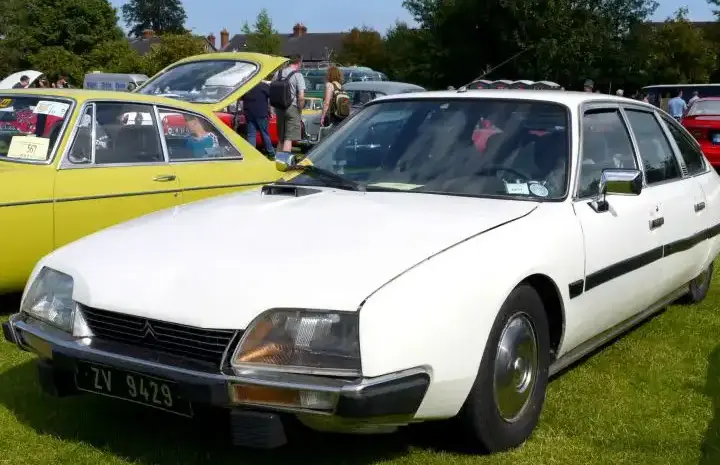
The Citroën CX II Break 25 TRD Turbo 2, produced between 1987 and 1991, represents a unique offering within the second generation (CX II) of Citroën’s innovative CX series. This variant, a diesel-powered station wagon (estate), aimed to provide a blend of practicality, comfort, and reasonable performance for European buyers. It occupied a mid-range position in the CX Break lineup, offering a step up in power and refinement compared to the naturally aspirated diesel models, while remaining more accessible than the flagship turbocharged petrol versions. The CX II Break, built on the extended CX platform, was known for its spacious interior and advanced hydropneumatic suspension system, a hallmark of Citroën engineering.
Technical Specifications
| Brand | Citroën |
| Model | CX |
| Generation | CX II Break |
| Type (Engine) | 25 TRD Turbo 2 (106 Hp) |
| Start of production | 1987 |
| End of production | 1991 |
| Powertrain Architecture | Internal Combustion engine |
| Body type | Station wagon (estate) |
| Seats | 5 |
| Doors | 5 |
| Fuel consumption (urban) | 8.6 l/100 km (27.4 US mpg, 32.8 UK mpg, 11.6 km/l) |
| Fuel consumption (extra urban) | 6.1 l/100 km (38.6 US mpg, 46.3 UK mpg, 16.4 km/l) |
| Fuel consumption (combined) | 7.5 l/100 km (31.4 US mpg, 37.7 UK mpg, 13.3 km/l) |
| Fuel Type | Diesel |
| Acceleration 0 – 100 km/h | 14.2 sec |
| Acceleration 0 – 62 mph | 14.2 sec |
| Acceleration 0 – 60 mph | 13.5 sec |
| Maximum speed | 178 km/h (110.6 mph) |
| Weight-to-power ratio | 14 kg/Hp, 71.6 Hp/tonne |
| Weight-to-torque ratio | 5.7 kg/Nm, 174.3 Nm/tonne |
| Power | 106 Hp @ 3900 rpm |
| Power per litre | 42.4 Hp/l |
| Torque | 258 Nm @ 2250 rpm (190.29 lb.-ft. @ 2250 rpm) |
| Engine layout | Front, Transverse |
| Engine displacement | 2500 cm3 (152.56 cu. in.) |
| Number of cylinders | 4 |
| Engine configuration | Inline |
| Cylinder Bore | 93 mm (3.66 in.) |
| Piston Stroke | 92 mm (3.62 in.) |
| Compression ratio | 21:1 |
| Number of valves per cylinder | 2 |
| Fuel injection system | Precombustion chamber injection |
| Engine aspiration | Turbocharger |
| Engine oil capacity | 5.3 l (5.6 US qt | 4.66 UK qt) |
| Coolant capacity | 13 l (13.74 US qt | 11.44 UK qt) |
| Kerb Weight | 1480 kg (3262.84 lbs.) |
| Max. weight | 2200 kg (4850.17 lbs.) |
| Max load | 720 kg (1587.33 lbs.) |
| Trunk (boot) space – minimum | 485 l (17.13 cu. ft.) |
| Trunk (boot) space – maximum | 1163 l (41.07 cu. ft.) |
| Fuel tank capacity | 68 l (17.96 US gal | 14.96 UK gal) |
| Max. roof load | 80 kg (176.37 lbs.) |
| Permitted towbar download | 100 kg (220.46 lbs.) |
| Length | 4929 mm (194.06 in.) |
| Width | 1770 mm (69.69 in.) |
| Height | 1475 mm (58.07 in.) |
| Wheelbase | 3095 mm (121.85 in.) |
| Front track | 1522 mm (59.92 in.) |
| Rear track | 1398 mm (55.04 in.) |
| Drag coefficient (Cd) | 0.37 |
| Minimum turning circle | 13.40 m (43.96 ft.) |
| Drivetrain Architecture | Front wheel drive |
| Number of gears | 5 |
| Gearbox type | Manual transmission |
| Front suspension | Hydro-pneumatic element |
| Rear suspension | Hydro-pneumatic element |
| Front brakes | Ventilated discs |
| Rear brakes | Disc |
| Steering type | Steering rack and pinion |
| Power steering | Hydraulic |
| Tires size | 195/70 R14 |
| Wheel rims size | 5.5J x 14 |
Powertrain & Engine Architecture
The heart of the CX II Break 25 TRD Turbo 2 is the 2.5-liter, inline-four cylinder diesel engine. Designated with engine codes like P85 or similar variations depending on specific market adjustments, this engine utilized precombustion chamber injection, a system common in European diesel engines of the era. This system involved a small precombustion chamber connected to the main cylinder, where fuel was initially ignited before being transferred to the main chamber for complete combustion. The turbocharger, a key component of the “TRD Turbo 2” designation, significantly boosted power output compared to naturally aspirated versions. The engine produced 106 horsepower at 3900 rpm and a respectable 258 Nm (190 lb-ft) of torque at 2250 rpm. This torque delivery was a hallmark of diesel engines, providing strong low-end pulling power. The engine was transversely mounted, driving the front wheels through a five-speed manual transmission. This transmission was chosen for its efficiency and suitability for the engine’s torque characteristics.
Driving Characteristics
The CX II Break 25 TRD Turbo 2 offered a unique driving experience. While not a sports car, the turbocharged diesel provided adequate performance for comfortable highway cruising and overtaking. Acceleration to 60 mph took around 13.5 seconds, and top speed was approximately 110 mph. The five-speed manual transmission allowed drivers to keep the engine in its optimal power band. Compared to the non-turbocharged diesel versions, the TRD Turbo 2 felt significantly more responsive. However, it didn’t match the outright performance of the petrol-powered CX models. The CX’s signature hydropneumatic suspension provided an exceptionally smooth and comfortable ride, absorbing bumps and imperfections in the road with ease. This, combined with the relatively quiet diesel engine, made for a refined driving experience.
Equipment & Trim Levels
The CX II Break 25 TRD Turbo 2 typically came equipped with a reasonable level of standard features. These included power steering, central locking, and a basic stereo system. Interior upholstery was typically cloth, with options for upgraded velour or leather available. The dashboard layout was characteristic of the CX, featuring a unique combination of analog gauges and switches. Optional extras included air conditioning, electric windows, and a sunroof. The “Break” designation indicated the station wagon body style, offering a large and practical cargo area. The interior was designed with practicality in mind, offering ample space for passengers and luggage.
Chassis & Braking
The CX II Break utilized Citroën’s renowned hydropneumatic suspension system, which provided self-leveling and adjustable ride height. This system used pressurized hydraulic fluid and nitrogen spheres to provide a remarkably smooth and controlled ride. The front suspension featured independent hydropneumatic elements, while the rear suspension also employed a hydropneumatic setup. Braking was handled by ventilated discs at the front and solid discs at the rear. Hydraulic assistance was standard, providing good stopping power. The steering system was a rack and pinion type with hydraulic power assistance, offering precise and responsive steering.
Market Reception & Comparison
The CX II Break 25 TRD Turbo 2 was generally well-received by automotive critics. It was praised for its comfortable ride, spacious interior, and fuel efficiency. However, some critics noted that the diesel engine was somewhat noisy and lacked the refinement of petrol engines. Compared to other CX Break variants, the 25 TRD Turbo 2 offered a good balance of performance and economy. It was more powerful than the naturally aspirated diesel models but less expensive and more fuel-efficient than the petrol-powered versions. Its main competitors included other European station wagons, such as the Volvo 240 and the Ford Sierra.
Legacy
The Citroën CX II Break 25 TRD Turbo 2, while not a high-volume seller, remains a fondly remembered vehicle among Citroën enthusiasts. The engine, while robust, can require specialized knowledge for maintenance and repair. The hydropneumatic suspension system, while providing an exceptional ride, can be prone to leaks and requires periodic servicing. Today, well-maintained examples are becoming increasingly collectible. The CX II Break 25 TRD Turbo 2 represents a unique chapter in Citroën’s history, showcasing the company’s commitment to innovation and engineering excellence. Its blend of practicality, comfort, and distinctive styling continues to appeal to those seeking a classic European station wagon.