
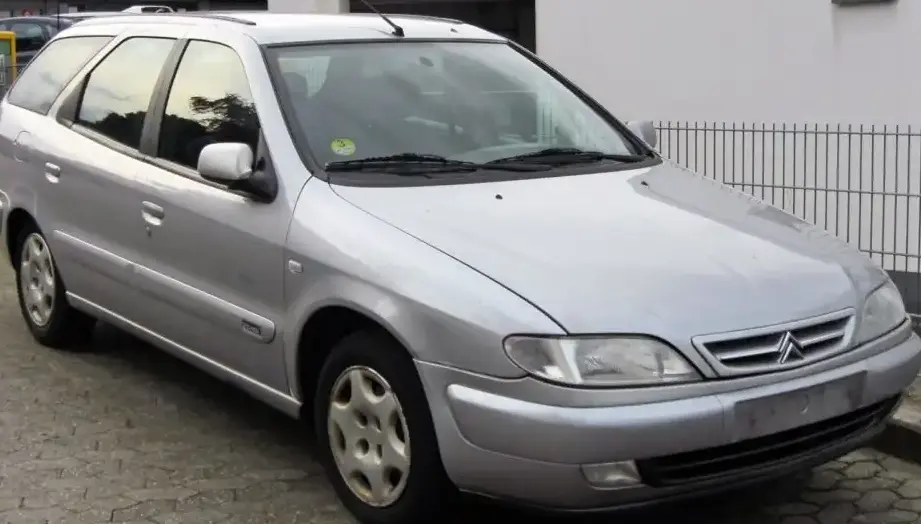
Technical Specifications
| Brand | Citroën |
| Model | Xsara |
| Generation | Xsara Break (N2, Phase I) |
| Type (Engine) | 1.8 i 16V (110 Hp) |
| Start of production | 1997 |
| End of production | 2000 |
| Powertrain Architecture | Internal Combustion engine |
| Body type | Station wagon (estate) |
| Seats | 5 |
| Doors | 5 |
| Fuel consumption (urban) | 12.1 l/100 km (19.4 US mpg, 23.3 UK mpg, 8.3 km/l) |
| Fuel consumption (extra urban) | 6.4 l/100 km (36.8 US mpg, 44.1 UK mpg, 15.6 km/l) |
| Fuel consumption (combined) | 8.4 l/100 km (28 US mpg, 33.6 UK mpg, 11.9 km/l) |
| CO2 emissions | 198 g/km |
| Fuel Type | Petrol (Gasoline) |
| Acceleration 0 – 100 km/h | 11.1 sec |
| Acceleration 0 – 62 mph | 11.1 sec |
| Acceleration 0 – 60 mph | 10.5 sec |
| Maximum speed | 196 km/h (121.79 mph) |
| Weight-to-power ratio | 10.5 kg/Hp, 95.7 Hp/tonne |
| Weight-to-torque ratio | 7.4 kg/Nm, 134.8 Nm/tonne |
| Power | 110 Hp @ 5500 rpm |
| Power per litre | 62.5 Hp/l |
| Torque | 155 Nm @ 4250 rpm (114.32 lb.-ft. @ 4250 rpm) |
| Engine layout | Front, Transverse |
| Engine Model/Code | LFY XU7JP4 |
| Engine displacement | 1761 cm3 (107.46 cu. in.) |
| Number of cylinders | 4 |
| Engine configuration | Inline |
| Cylinder Bore | 83 mm (3.27 in.) |
| Piston Stroke | 81.4 mm (3.2 in.) |
| Compression ratio | 10.4:1 |
| Number of valves per cylinder | 4 |
| Fuel injection system | Multi-port manifold injection |
| Engine aspiration | Naturally aspirated engine |
| Valvetrain | DOHC |
| Engine oil capacity | 4.75 l (5.02 US qt | 4.18 UK qt) |
| Coolant | 7 l (7.4 US qt | 6.16 UK qt) |
| Kerb Weight | 1150 kg (2535.32 lbs.) |
| Max. weight | 1670 kg (3681.72 lbs.) |
| Max load | 520 kg (1146.4 lbs.) |
| Trunk (boot) space – minimum | 517 l (18.26 cu. ft.) |
| Trunk (boot) space – maximum | 1512 l (53.4 cu. ft.) |
| Fuel tank capacity | 54 l (14.27 US gal | 11.88 UK gal) |
| Max. roof load | 100 kg (220.46 lbs.) |
| Permitted trailer load with brakes (12%) | 1100 kg (2425.08 lbs.) |
| Permitted trailer load without brakes | 610 kg (1344.82 lbs.) |
| Permitted towbar download | 70 kg (154.32 lbs.) |
| Length | 4354 mm (171.42 in.) |
| Width | 1698 mm (66.85 in.) |
| Width including mirrors | 1994 mm (78.5 in.) |
| Height | 1426 mm (56.14 in.) |
| Wheelbase | 2540 mm (100 in.) |
| Front track | 1423 mm (56.02 in.) |
| Rear (Back) track | 1430 mm (56.3 in.) |
| Front overhang | 868 mm (34.17 in.) |
| Rear overhang | 946 mm (37.24 in.) |
| Minimum turning circle | 11.5 m (37.73 ft.) |
| Drivetrain | Front wheel drive |
| Number of gears and type of gearbox | 5 gears, manual transmission |
| Front suspension | Independent, type McPherson with coil spring and anti-roll bar |
| Rear suspension | Torsion |
| Front brakes | Ventilated discs |
| Rear brakes | Disc |
| Assisting systems | ABS (Anti-lock braking system) |
| Steering type | Steering rack and pinion |
| Power steering | Hydraulic Steering |
| Tires size | 185/65 R14 |
The Citroën Xsara Break 1.8i 16V, produced between 1997 and 2000, was a key offering within the first generation (N2) of the Xsara estate car range. Positioned as a mid-range variant, it aimed to strike a balance between performance, practicality, and affordability for family buyers. The Xsara Break, built on the PSA Group’s 1HX0 platform – shared with the Peugeot 306 Break – competed in the growing compact estate segment, offering a spacious interior and generous cargo area. This particular 1.8L 16V engine and five-speed manual transmission combination proved popular, providing a noticeable power increase over base models while remaining more accessible than the higher-performance options.
Powertrain & Engine Architecture
The core of the Xsara Break 1.8i 16V is the LFY (or sometimes XU7JP4) 1.8-liter inline-four cylinder engine. This engine, a mainstay of PSA Group vehicles throughout the 1990s and early 2000s, is recognized for its relative reliability and respectable performance. It features a double overhead camshaft (DOHC) valvetrain operating four valves per cylinder, enhancing its breathing and power output compared to older designs. Fuel delivery is managed by a multi-port fuel injection system, ensuring precise fuel metering for optimal combustion. The engine generates 110 horsepower at 5500 rpm and 155 Nm (114 lb-ft) of torque at 4250 rpm. The engine is mounted transversely, powering the front wheels. The standard transmission for this variant was a five-speed manual gearbox, offering a good compromise between fuel efficiency and driver control. While an automatic transmission was available, it was less common and generally considered to diminish the engine’s performance.
Driving Characteristics
The 1.8i 16V Xsara Break delivered a noticeable performance improvement over the lower-powered 1.6-liter versions. While not a sports car, it provided sufficient acceleration for everyday driving and comfortable highway cruising. The five-speed manual transmission allowed drivers to maintain the engine within its optimal power band, resulting in a responsive driving experience. The gear ratios were well-suited for both urban and highway conditions. Compared to the more potent 2.0-liter 16V models, the 1.8L felt less stressed at higher speeds, but lacked the immediate punch for quick overtaking. The suspension provided a comfortable ride, effectively absorbing road imperfections, though it wasn’t particularly focused on sporty handling.
Equipment & Trim Levels
The 1.8i 16V trim typically included features such as power steering, central locking, electric front windows, and an adjustable steering column. Interior upholstery was generally cloth, with a relatively simple yet functional dashboard layout. Optional extras included air conditioning, alloy wheels, a sunroof, and upgraded audio systems. The specific equipment level varied depending on the market and any optional packages chosen by the original purchaser. The Xsara Break prioritized practicality, so even base models were reasonably well-equipped for a family vehicle.
Chassis & Braking
The Xsara Break utilized an independent McPherson strut suspension setup at the front, providing good handling and ride comfort. The rear suspension employed a torsion beam, a cost-effective and space-saving solution. Braking was handled by ventilated discs at the front and solid discs at the rear. Anti-lock Braking System (ABS) was standard, enhancing safety by preventing wheel lockup during hard braking. The chassis was engineered to deliver a stable and predictable driving experience, prioritizing comfort and practicality over outright sportiness.
Market Reception & Comparison
The Citroën Xsara Break 1.8i 16V was generally well-received by automotive critics as a practical and affordable estate car. It was praised for its spacious interior, large cargo capacity, and comfortable ride. Some critics noted that the engine could feel somewhat underpowered when fully loaded or tackling steep inclines. Compared to competitors like the Ford Focus Estate and Volkswagen Golf Estate, the Xsara Break offered a competitive level of equipment and practicality at a reasonable price. Fuel economy was considered average for its class, and reliability was generally good, although some owners reported minor electrical issues.
Legacy
The Citroën Xsara Break 1.8i 16V has proven to be a relatively durable and reliable vehicle. The XU7JP4 engine, while not without its quirks, is generally considered robust and capable of high mileage with proper maintenance. Today, these cars are increasingly sought after by enthusiasts and collectors, particularly those seeking a practical and affordable classic. Parts availability is generally good, although some specific trim pieces may be challenging to locate. The 1.8i 16V variant remains a popular choice in the used car market due to its balance of performance, economy, and dependability.
