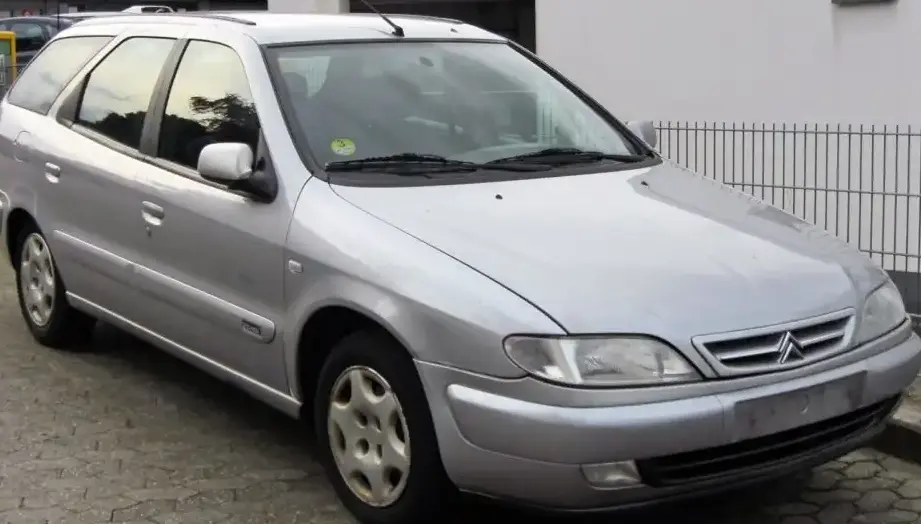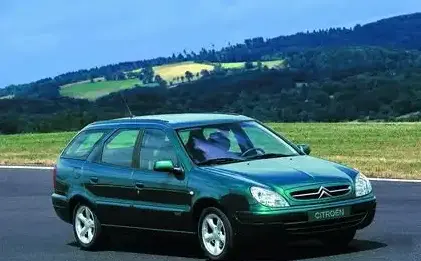
The Citroën Xsara Break 1.6i 16V Automatic, produced between 2000 and 2003, represents a practical and comfortable offering within the second generation (N2) of the Xsara Break estate car range. Positioned as a mid-range variant, it aimed to provide a balance between affordability, fuel efficiency, and convenience, appealing to families and drivers prioritizing ease of use over outright performance. This model falls within the broader context of the Xsara line, which was Citroën’s competitor in the compact family car segment, sharing its platform (PSA X4) with the Peugeot 307. The Phase II update brought minor cosmetic and equipment revisions compared to the earlier N2 models.
Technical Specifications
| Brand | Citroen |
| Model | Xsara |
| Generation | Xsara Break (N2, Phase II) |
| Type (Engine) | 1.6 i 16 V (109 Hp) Automatic |
| Start of production | 2000 year |
| End of production | 2003 year |
| Powertrain Architecture | Internal Combustion engine |
| Body type | Station wagon (estate) |
| Seats | 5 |
| Doors | 5 |
| Fuel consumption (urban) | 10.9 l/100 km (21.6 US mpg, 25.9 UK mpg, 9.2 km/l) |
| Fuel consumption (extra urban) | 5.6 l/100 km (42 US mpg, 50.4 UK mpg, 17.9 km/l) |
| Fuel consumption (combined) | 7.6 l/100 km (30.9 US mpg, 37.2 UK mpg, 13.2 km/l) |
| CO2 emissions | 180 g/km |
| Fuel Type | Petrol (Gasoline) |
| Acceleration 0 – 100 km/h | 14.4 sec |
| Acceleration 0 – 62 mph | 14.4 sec |
| Acceleration 0 – 60 mph | 13.7 sec |
| Maximum speed | 193 km/h (119.92 mph) |
| Emission standard | Euro 3 |
| Weight-to-power ratio | 11 kg/Hp, 91.1 Hp/tonne |
| Weight-to-torque ratio | 8.1 kg/Nm, 122.8 Nm/tonne |
| Power | 109 Hp @ 5800 rpm |
| Power per litre | 68.7 Hp/l |
| Torque | 147 Nm @ 4000 rpm (108.42 lb.-ft. @ 4000 rpm) |
| Engine layout | Front, Transverse |
| Engine Model/Code | TU5JP4 |
| Engine displacement | 1587 cm3 (96.84 cu. in.) |
| Number of cylinders | 4 |
| Engine configuration | Inline |
| Cylinder Bore | 78.5 mm (3.09 in.) |
| Piston Stroke | 82 mm (3.23 in.) |
| Number of valves per cylinder | 4 |
| Fuel injection system | Multi-port manifold injection |
| Engine aspiration | Naturally aspirated engine |
| Valvetrain | DOHC |
| Engine oil capacity | 3.25 l (3.43 US qt | 2.86 UK qt) |
| Coolant | 7 l (7.4 US qt | 6.16 UK qt) |
| Kerb Weight | 1197 kg (2638.93 lbs.) |
| Max. weight | 1728 kg (3809.59 lbs.) |
| Max load | 531 kg (1170.65 lbs.) |
| Trunk (boot) space – minimum | 517 l (18.26 cu. ft.) |
| Trunk (boot) space – maximum | 1512 l (53.4 cu. ft.) |
| Fuel tank capacity | 54 l (14.27 US gal | 11.88 UK gal) |
| Max. roof load | 100 kg (220.46 lbs.) |
| Permitted trailer load with brakes (12%) | 1100 kg (2425.08 lbs.) |
| Permitted trailer load without brakes | 610 kg (1344.82 lbs.) |
| Permitted towbar download | 70 kg (154.32 lbs.) |
| Length | 4369 mm (172.01 in.) |
| Width | 1705 mm (67.13 in.) |
| Width including mirrors | 1975 mm (77.76 in.) |
| Height | 1420 mm (55.91 in.) |
| Wheelbase | 2540 mm (100 in.) |
| Front track | 1433 mm (56.42 in.) |
| Rear (Back) track | 1442 mm (56.77 in.) |
| Front overhang | 880 mm (34.65 in.) |
| Rear overhang | 949 mm (37.36 in.) |
| Minimum turning circle | 11.5 m (37.73 ft.) |
| Drivetrain Architecture | Front wheel drive |
| Number of gears and type of gearbox | 4 gears, automatic transmission |
| Front suspension | Independent, type McPherson with coil spring and anti-roll bar |
| Rear suspension | Torsion |
| Front brakes | Ventilated discs |
| Rear brakes | Disc |
| Assisting systems | ABS (Anti-lock braking system) |
| Steering type | Steering rack and pinion |
| Power steering | Hydraulic Steering |
| Tires size | 195/55 R15 |
| Wheel rims size | 6J x 15 |
Powertrain & Engine Architecture
The heart of the Xsara Break 1.6i 16V Automatic is the TU5JP4 engine, a 1.6-liter inline-four cylinder petrol engine. This engine is a mainstay of the PSA Group, known for its relative simplicity and durability. The ‘16V’ designation indicates a four-valve-per-cylinder configuration, enhancing breathing and contributing to improved power output. Fuel delivery is managed by a multi-port fuel injection system, providing precise fuel metering for optimal combustion. The engine utilizes a double overhead camshaft (DOHC) valvetrain, further optimizing valve timing and engine efficiency. The automatic transmission is a four-speed unit, designed to provide smooth and convenient gear changes. While not offering the responsiveness of a manual transmission, it catered to drivers prioritizing comfort and ease of driving, particularly in urban environments.
Driving Characteristics
The 109 horsepower and 147 Nm (108 lb-ft) of torque produced by the TU5JP4 engine, coupled with the four-speed automatic transmission, resulted in a driving experience focused on practicality rather than performance. Acceleration from 0-60 mph took around 13.7 seconds, and top speed was approximately 119.92 mph. The automatic transmission’s gear ratios were tuned for fuel economy and smooth cruising, rather than aggressive acceleration. Compared to the manual version of the same engine, the automatic offered slightly reduced responsiveness. Higher-output variants, such as those equipped with the 2.0-liter 16V engine, provided significantly more spirited performance, while diesel models (like the 1.9 TDI) offered superior fuel economy and torque.
Equipment & Trim Levels
The 1.6i 16V Automatic trim typically included features such as power steering, central locking, electric front windows, and an RDS radio. Interior upholstery was generally cloth, with a functional and durable design. Optional extras could include air conditioning, alloy wheels, and a sunroof. The Phase II update often brought minor improvements to interior trim materials and the availability of additional safety features. The level of equipment placed this variant comfortably in the mid-range of the Xsara Break lineup, offering a good balance of features for the price.
Chassis & Braking
The Xsara Break featured an independent McPherson strut front suspension and a torsion beam rear suspension. This setup provided a reasonable compromise between ride comfort and handling. Front brakes were ventilated discs, offering good stopping power, while rear brakes were solid discs. ABS (Anti-lock Braking System) was standard, enhancing safety during emergency braking situations. The suspension was tuned to prioritize comfort, making it well-suited for long journeys and everyday driving. Stabilizer bars were fitted to both axles to reduce body roll during cornering.
Market Reception & Comparison
The Citroën Xsara Break 1.6i 16V Automatic was generally well-received as a practical and affordable family estate car. Critics praised its spacious interior, comfortable ride, and reasonable fuel economy. However, the automatic transmission was sometimes criticized for its lack of responsiveness compared to the manual gearbox. Compared to rivals like the Ford Focus Estate and Volkswagen Golf Estate, the Xsara Break offered a distinctive French design and a focus on comfort. The 1.6i engine provided adequate performance for most drivers, but those seeking more power often opted for the 2.0-liter or diesel variants.
Legacy
The TU5JP4 engine, in general, has proven to be a reliable and durable unit, with many examples still in service today. The four-speed automatic transmission, while not as sophisticated as modern transmissions, is also generally reliable if properly maintained. Xsara Breaks with this powertrain are now commonly found on the used car market, offering an affordable and practical option for those seeking a spacious estate car. Regular maintenance, including oil changes and timing belt replacements, is crucial for ensuring the long-term reliability of this powertrain. The 1.6i Automatic variant remains a popular choice for drivers who prioritize comfort and ease of use over outright performance.