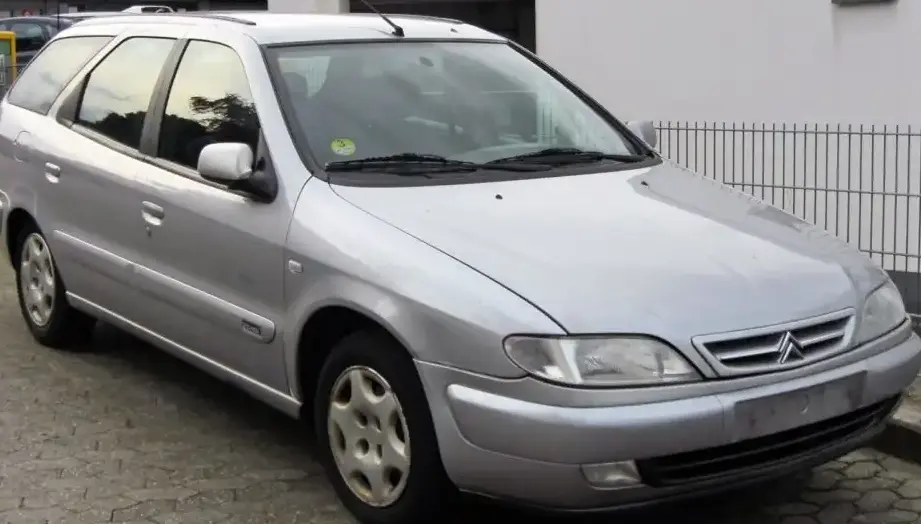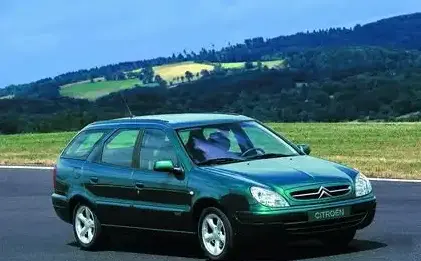
The Citroën Xsara Break 2.0 16V, produced between 2000 and 2003, represents a compelling blend of practicality and performance within the second-generation (N2) Xsara lineup. As a five-door station wagon (estate), it served as a versatile family vehicle, offering increased cargo capacity compared to the hatchback variant. This particular engine and trim level occupied a mid-range position in the Xsara Break portfolio, positioned above the base 1.6-liter models and below the more performance-oriented, though less common, V6 options. It was primarily marketed in Europe, where station wagons held a significant share of the family car market.
Technical Specifications
| Brand | Citroën |
| Model | Xsara |
| Generation | Xsara Break (N2, Phase II) |
| Type (Engine) | 2.0 16V (136 Hp) |
| Start of production | 2000 |
| End of production | 2003 |
| Powertrain Architecture | Internal Combustion engine |
| Body type | Station wagon (estate) |
| Seats | 5 |
| Doors | 5 |
| Fuel consumption (urban) | 11.4 l/100 km (20.6 US mpg, 24.8 UK mpg, 8.8 km/l) |
| Fuel consumption (extra urban) | 5.6 l/100 km (42 US mpg, 50.4 UK mpg, 17.9 km/l) |
| Fuel consumption (combined) | 7.7 l/100 km (30.5 US mpg, 36.7 UK mpg, 13 km/l) |
| CO2 emissions | 184 g/km |
| Fuel Type | Petrol (Gasoline) |
| Acceleration 0 – 100 km/h | 9.8 sec |
| Acceleration 0 – 62 mph | 9.8 sec |
| Acceleration 0 – 60 mph | 9.3 sec |
| Maximum speed | 210 km/h (130.49 mph) |
| Emission standard | Euro 3 |
| Weight-to-power ratio | 9 kg/Hp, 111.7 Hp/tonne |
| Weight-to-torque ratio | 6.4 kg/Nm, 156 Nm/tonne |
| Power | 136 Hp @ 6000 rpm |
| Power per litre | 68.1 Hp/l |
| Torque | 190 Nm @ 4100 rpm (140.14 lb.-ft. @ 4100 rpm) |
| Engine layout | Front, Transverse |
| Engine Model/Code | RFN EW10J4 |
| Engine displacement | 1997 cm3 (121.86 cu. in.) |
| Number of cylinders | 4 |
| Engine configuration | Inline |
| Cylinder Bore | 85 mm (3.35 in.) |
| Piston Stroke | 88 mm (3.46 in.) |
| Compression ratio | 10.8:1 |
| Number of valves per cylinder | 4 |
| Fuel injection system | Multi-port manifold injection |
| Engine aspiration | Naturally aspirated engine |
| Valvetrain | DOHC |
| Engine oil capacity | 4.25 l (4.49 US qt | 3.74 UK qt) |
| Coolant | 7 l (7.4 US qt | 6.16 UK qt) |
| Kerb Weight | 1218 kg (2685.23 lbs.) |
| Max. weight | 1728 kg (3809.59 lbs.) |
| Max load | 510 kg (1124.36 lbs.) |
| Trunk (boot) space – minimum | 517 l (18.26 cu. ft.) |
| Trunk (boot) space – maximum | 1512 l (53.4 cu. ft.) |
| Fuel tank capacity | 54 l (14.27 US gal | 11.88 UK gal) |
| Max. roof load | 100 kg (220.46 lbs.) |
| Permitted trailer load with brakes (12%) | 1100 kg (2425.08 lbs.) |
| Permitted trailer load without brakes | 630 kg (1388.91 lbs.) |
| Permitted towbar download | 70 kg (154.32 lbs.) |
| Length | 4369 mm (172.01 in.) |
| Width | 1705 mm (67.13 in.) |
| Width including mirrors | 1975 mm (77.76 in.) |
| Height | 1420 mm (55.91 in.) |
| Wheelbase | 2540 mm (100 in.) |
| Front track | 1433 mm (56.42 in.) |
| Rear (Back) track | 1442 mm (56.77 in.) |
| Front overhang | 880 mm (34.65 in.) |
| Rear overhang | 949 mm (37.36 in.) |
| Minimum turning circle | 11.5 m (37.73 ft.) |
| Drivetrain Architecture | The Internal combustion engine (ICE) drives the front wheels of the vehicle. |
| Drive wheel | Front wheel drive |
| Number of gears and type of gearbox | 5 gears, manual transmission |
| Front suspension | Independent, type McPherson with coil spring and anti-roll bar |
| Rear suspension | Torsion |
| Front brakes | Ventilated discs |
| Rear brakes | Disc |
| Assisting systems | ABS (Anti-lock braking system) |
| Steering type | Steering rack and pinion |
| Power steering | Hydraulic Steering |
| Tires size | 195/55 R15 |
| Wheel rims size | 6J x 15 |
Powertrain & Engine Architecture
The heart of the Xsara Break 2.0 16V is the RFN (EW10J4) engine, a 1.997-liter inline-four cylinder gasoline engine. This engine belongs to the EW series developed by PSA Peugeot Citroën. It features a double overhead camshaft (DOHC) valvetrain with four valves per cylinder, contributing to its relatively high power output for its displacement. Fuel delivery is managed by a multi-port fuel injection system. The engine’s 136 horsepower peak is achieved at 6,000 rpm, while its 190 Nm (140 lb-ft) of torque is available at 4,100 rpm. The engine is transversely mounted in the front of the vehicle. The transmission is a five-speed manual gearbox, providing a balance between fuel efficiency and performance.
Driving Characteristics
The 2.0 16V Xsara Break offered a noticeable step up in performance compared to the lower-displacement engines available in the range. While not a sports car, the 136 hp engine provided adequate power for comfortable cruising and overtaking maneuvers. The five-speed manual transmission allowed drivers to keep the engine in its optimal power band. Acceleration from 0 to 60 mph was achieved in approximately 9.3 seconds, and the top speed was around 130 mph. The suspension, tuned for comfort, provided a reasonably compliant ride, although it wasn’t as sporty as some competitors. The steering was light and precise, making it easy to maneuver in urban environments.
Equipment & Trim Levels
The 2.0 16V trim typically included features such as power windows, central locking, power steering, and an anti-lock braking system (ABS). Interior upholstery was generally cloth, with options for upgraded materials. Depending on the specific market and optional packages selected, features like air conditioning, a CD player, alloy wheels, and fog lights could be added. The dashboard layout was functional and straightforward, typical of Citroën designs of the era.
Chassis & Braking
The Xsara Break utilized an independent McPherson strut suspension setup at the front, providing good handling characteristics. The rear suspension employed a torsion beam, a cost-effective solution that offered a reasonable balance between comfort and stability. Braking duties were handled by ventilated discs at the front and solid discs at the rear. The ABS system enhanced braking performance and safety, particularly in adverse conditions.
Market Reception & Comparison
The Citroën Xsara Break 2.0 16V was generally well-received by automotive critics. It was praised for its spacious interior, comfortable ride, and decent performance. Compared to rivals like the Ford Focus Estate and Volkswagen Golf Estate, the Xsara Break offered a distinctive French design and a competitive price point. Fuel economy was respectable for its class, averaging around 30.5 US mpg in combined driving. However, some critics noted that the interior materials weren’t as premium as those found in some German competitors.
Legacy
The RFN engine, while generally reliable, is known to have some potential issues, including occasional problems with the throttle body and ignition coils. Regular maintenance, including oil changes and timing belt replacements, is crucial for ensuring long-term reliability. Today, the Xsara Break 2.0 16V can be found as an affordable used car, offering a practical and spacious option for those seeking a budget-friendly station wagon. Its relatively simple mechanical design makes it appealing to DIY mechanics, and parts availability remains reasonable. While not a collector’s item, it represents a solid and dependable family vehicle from the early 2000s.