Technical Specifications
| Brand | Citroen |
| Model | Xsara |
| Generation | Xsara Break (N2, Phase II) |
| Type (Engine) | 2.0 HDi (90 Hp) |
| Start of production | 2001 year |
| End of production | 2003 year |
| Powertrain Architecture | Internal Combustion engine |
| Body type | Station wagon (estate) |
| Seats | 5 |
| Doors | 5 |
| Fuel consumption (economy) – urban | 7.5 l/100 km (31.4 US mpg, 37.7 UK mpg, 13.3 km/l) |
| Fuel consumption (economy) – extra urban | 4.3 l/100 km (54.7 US mpg, 65.7 UK mpg, 23.3 km/l) |
| Fuel consumption (economy) – combined | 5.5 l/100 km (42.8 US mpg, 51.4 UK mpg, 18.2 km/l) |
| CO2 emissions | 144 g/km |
| Fuel Type | Diesel |
| Acceleration 0 – 100 km/h | 13.6 sec |
| Acceleration 0 – 62 mph | 13.6 sec |
| Acceleration 0 – 60 mph | 12.9 sec |
| Maximum speed | 181 km/h (112.47 mph) |
| Emission standard | Euro 3 |
| Weight-to-power ratio | 13.9 kg/Hp, 72 Hp/tonne |
| Weight-to-torque ratio | 6.1 kg/Nm, 164 Nm/tonne |
| Power | 90 Hp @ 4000 rpm |
| Power per litre | 45.1 Hp/l |
| Torque | 205 Nm @ 1900 rpm (151.2 lb.-ft. @ 1900 rpm) |
| Engine layout | Front, Transverse |
| Engine Model/Code | RHY DW10TD |
| Engine displacement | 1997 cm3 (121.86 cu. in.) |
| Number of cylinders | 4 |
| Engine configuration | Inline |
| Cylinder Bore | 85 mm (3.35 in.) |
| Piston Stroke | 88 mm (3.46 in.) |
| Compression ratio | 18:1 |
| Number of valves per cylinder | 2 |
| Fuel injection system | Diesel Commonrail |
| Engine aspiration | Turbocharger |
| Valvetrain | OHC |
| Engine oil capacity | 4.2 l (4.44 US qt | 3.7 UK qt) |
| Coolant | 5.8 l (6.13 US qt | 5.1 UK qt) |
| Kerb Weight | 1250 kg (2755.78 lbs.) |
| Max. weight | 1759 kg (3877.93 lbs.) |
| Max load | 509 kg (1122.15 lbs.) |
| Trunk (boot) space – minimum | 517 l (18.26 cu. ft.) |
| Trunk (boot) space – maximum | 1512 l (53.4 cu. ft.) |
| Fuel tank capacity | 54 l (14.27 US gal | 11.88 UK gal) |
| Max. roof load | 100 kg (220.46 lbs.) |
| Permitted trailer load with brakes (12%) | 1100 kg (2425.08 lbs.) |
| Permitted trailer load without brakes | 645 kg (1421.98 lbs.) |
| Permitted towbar download | 70 kg (154.32 lbs.) |
| Length | 4369 mm (172.01 in.) |
| Width | 1705 mm (67.13 in.) |
| Width including mirrors | 1975 mm (77.76 in.) |
| Height | 1420 mm (55.91 in.) |
| Wheelbase | 2540 mm (100 in.) |
| Front track | 1433 mm (56.42 in.) |
| Rear (Back) track | 1442 mm (56.77 in.) |
| Front overhang | 880 mm (34.65 in.) |
| Rear overhang | 949 mm (37.36 in.) |
| Minimum turning circle (turning diameter) | 11.5 m (37.73 ft.) |
| Drivetrain Architecture | The Internal combustion engine (ICE) drives the front wheels of the vehicle. |
| Drive wheel | Front wheel drive |
| Number of gears and type of gearbox | 5 gears, manual transmission |
| Front suspension | Independent, type McPherson with coil spring and anti-roll bar |
| Rear suspension | Torsion |
| Front brakes | Ventilated discs |
| Rear brakes | Disc |
| Assisting systems | ABS (Anti-lock braking system) |
| Steering type | Steering rack and pinion |
| Power steering | Hydraulic Steering |
| Tires size | 195/55 R15 |
| Wheel rims size | 6J x 15 |
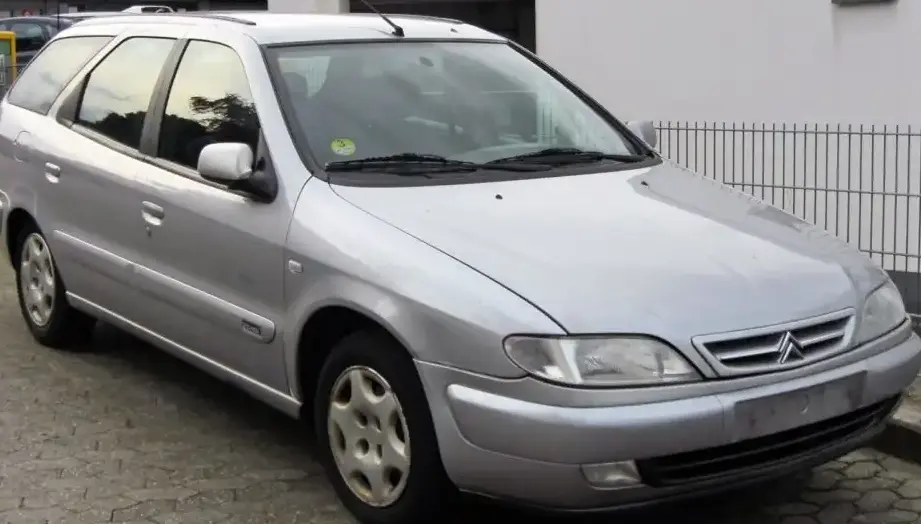
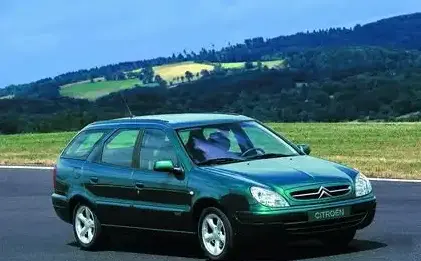
The Citroen Xsara Break 2.0 HDi 90 hp, produced from 2001 to 2003, is a station wagon variant of the N2 series Xsara. It falls within the Phase II refresh of the model, characterized by subtle styling updates and improvements to interior trim. Built on the PSA Group’s 1HX0/A3 platform (shared with the Peugeot 307), the Xsara Break aimed to provide a practical and affordable family vehicle. The 2.0 HDi engine was a key component of Citroen’s diesel strategy, offering a balance of fuel economy and reasonable performance. This particular variant was designed to appeal to buyers who prioritized efficiency and load-carrying capacity over outright speed.
Powertrain & Engine Architecture
At the heart of the Xsara Break 2.0 HDi 90 is the DW10TD engine, specifically coded RHY. This is a 1997cc, four-cylinder diesel engine utilizing a common rail direct injection system. The DW10 engine family is a long-running and widely used design within the PSA Group. The RHY version, producing 90 horsepower at 4000 rpm and 205 Nm (151.2 lb-ft) of torque at 1900 rpm, benefits from a turbocharger to enhance power output. The engine features an overhead camshaft (OHC) valvetrain with two valves per cylinder. The common rail system, a significant advancement over earlier diesel injection technologies, allows for precise fuel delivery, resulting in improved combustion efficiency, reduced noise, and lower emissions. The 5-speed manual transmission was standard, providing a relatively long-geared setup optimized for fuel economy.
Driving Characteristics
The 2.0 HDi 90 hp variant of the Xsara Break delivers a driving experience focused on practicality and economy rather than performance. Acceleration is modest, taking around 13.6 seconds to reach 62 mph (100 km/h). The engine’s torque, however, is readily available from low engine speeds, making it suitable for everyday driving and hauling loads. The long gearing of the five-speed manual transmission contributes to relaxed cruising at highway speeds, but requires downshifts for quicker overtaking maneuvers. Compared to the more powerful HDi 110 hp version, the 90 hp model feels noticeably slower, particularly when fully loaded. However, the difference in fuel economy is marginal, making the 90 hp version an attractive option for budget-conscious buyers.
Equipment & Trim Levels
The 2.0 HDi 90 version of the Xsara Break typically came equipped with a reasonable level of standard features. These included central locking, power steering, electric front windows, and an adjustable steering column. Interior upholstery was typically cloth, with a functional, if somewhat basic, dashboard layout. Optional extras included air conditioning, alloy wheels, a CD stereo, and rear electric windows. Higher trim levels, such as the Exclusive, added features like automatic headlights, rain-sensing wipers, and upgraded interior trim. The overall interior ambiance was geared towards practicality and durability rather than luxury.
Chassis & Braking
The Xsara Break’s chassis features an independent McPherson strut front suspension with a coil spring and anti-roll bar, providing a comfortable ride and decent handling. The rear suspension utilizes a torsion beam setup, which is a cost-effective and space-efficient solution. Braking is handled by ventilated discs at the front and solid discs at the rear. Anti-lock Braking System (ABS) was standard, enhancing safety during emergency braking situations. The suspension setup is tuned for comfort, prioritizing ride quality over sporty handling. The steering is hydraulic, providing a reasonably light and responsive feel.
Market Reception & Comparison
The Citroen Xsara Break 2.0 HDi 90 hp was generally well-received by automotive critics as a practical and economical family car. It was praised for its fuel efficiency, spacious interior, and comfortable ride. However, some reviewers noted its lack of outright performance compared to rivals. Compared to the HDi 110 version, the 90 hp model offered a lower purchase price and slightly better fuel economy, making it a more appealing option for buyers on a tighter budget. Against competitors like the Ford Focus Estate and Volkswagen Golf Estate, the Xsara Break offered a competitive package in terms of price, space, and fuel efficiency.
Legacy
The DW10TD engine, found in the Xsara Break 2.0 HDi 90, is known for its durability and reliability, provided it is properly maintained. Common issues include potential problems with the turbocharger and fuel injectors, but these are generally not widespread. Today, the Xsara Break 2.0 HDi 90 represents an affordable and practical used car option. Its fuel efficiency and spacious interior continue to make it a viable choice for those seeking a budget-friendly estate car. Parts availability is generally good, and the relatively simple mechanical design makes it relatively easy to maintain and repair. However, potential buyers should be aware of the age-related wear and tear common to vehicles of this era.