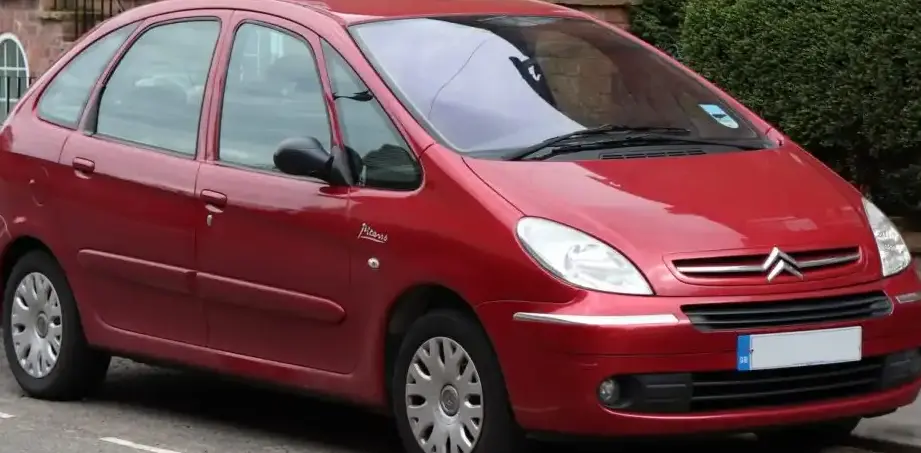
The Citroen Xsara Picasso (N68, Phase II) 1.6 16V, produced between 2005 and 2010, represented a key offering in Citroen’s compact minivan lineup. Positioned as a mid-range trim, it aimed to balance affordability with practicality and a reasonable level of equipment. This variant sat within the second phase of the N68 generation, benefiting from styling and mechanical updates introduced to enhance the original Picasso’s appeal. It was primarily marketed in Europe, where the compact MPV segment was particularly popular, offering a spacious and versatile alternative to traditional hatchbacks and sedans.
Technical Specifications
| Brand | Citroen |
| Model | Xsara |
| Generation | Xsara Picasso (N68, Phase II) |
| Type (Engine) | 1.6 16V (109 Hp) |
| Start of production | 2005 |
| End of production | 2010 |
| Powertrain Architecture | Internal Combustion engine |
| Body type | Minivan |
| Seats | 5 |
| Doors | 5 |
| Fuel consumption (urban) | 9.5 l/100 km (24.8 US mpg, 29.7 UK mpg, 10.5 km/l) |
| Fuel consumption (extra urban) | 6.0 l/100 km (39.2 US mpg, 47.1 UK mpg, 16.7 km/l) |
| Fuel consumption (combined) | 7.3 l/100 km (32.2 US mpg, 38.7 UK mpg, 13.7 km/l) |
| CO2 emissions | 172 g/km |
| Fuel Type | Petrol (Gasoline) |
| Acceleration 0 – 100 km/h | 12.6 sec |
| Acceleration 0 – 62 mph | 12.6 sec |
| Acceleration 0 – 60 mph | 12 sec |
| Maximum speed | 180 km/h (111.85 mph) |
| Emission standard | Euro 4 |
| Weight-to-power ratio | 11.6 kg/Hp, 86 Hp/tonne |
| Weight-to-torque ratio | 8.6 kg/Nm, 115.9 Nm/tonne |
| Power | 109 Hp @ 6000 rpm |
| Power per litre | 68.7 Hp/l |
| Torque | 147 Nm @ 4000 rpm (108.42 lb.-ft. @ 4000 rpm) |
| Engine layout | Front, Transverse |
| Engine Model/Code | NFU TU5JP4 |
| Engine displacement | 1587 cm3 (96.84 cu. in.) |
| Number of cylinders | 4 |
| Engine configuration | Inline |
| Cylinder Bore | 78.5 mm (3.09 in.) |
| Piston Stroke | 82 mm (3.23 in.) |
| Compression ratio | 9.6:1 |
| Number of valves per cylinder | 4 |
| Fuel injection system | Multi-port manifold injection |
| Engine aspiration | Naturally aspirated engine |
| Valvetrain | DOHC |
| Engine oil capacity | 3.5 l (3.7 US qt | 3.08 UK qt) |
| Coolant | 6.6 l (6.97 US qt | 5.81 UK qt) |
| Kerb Weight | 1268 kg (2795.46 lbs.) |
| Max. weight | 1800 kg (3968.32 lbs.) |
| Max load | 532 kg (1172.86 lbs.) |
| Trunk (boot) space – minimum | 550 l (19.42 cu. ft.) |
| Trunk (boot) space – maximum | 2128 l (75.15 cu. ft.) |
| Fuel tank capacity | 55 l (14.53 US gal | 12.1 UK gal) |
| Max. roof load | 80 kg (176.37 lbs.) |
| Permitted trailer load with brakes (8%) | 1300 kg (2866.01 lbs.) |
| Permitted trailer load with brakes (12%) | 1200 kg (2645.55 lbs.) |
| Permitted trailer load without brakes | 670 kg (1477.1 lbs.) |
| Permitted towbar download | 80 kg (176.37 lbs.) |
| Length | 4276 mm (168.35 in.) |
| Width | 1751 mm (68.94 in.) |
| Width including mirrors | 2000 mm (78.74 in.) |
| Height | 1637 mm (64.45 in.) |
| Wheelbase | 2760 mm (108.66 in.) |
| Front track | 1434 mm (56.46 in.) |
| Rear (Back) track | 1452 mm (57.17 in.) |
| Front overhang | 838 mm (32.99 in.) |
| Rear overhang | 678 mm (26.69 in.) |
| Minimum turning circle | 12 m (39.37 ft.) |
| Drivetrain Architecture | The Internal combustion engine (ICE) drives the front wheels of the vehicle. |
| Drive wheel | Front wheel drive |
| Number of gears and type of gearbox | 5 gears, manual transmission |
| Front suspension | Independent, type McPherson with coil spring and anti-roll bar |
| Rear suspension | Semi-independent suspension, longitudinal arms with transverse torsion shafts |
| Front brakes | Ventilated discs |
| Rear brakes | Disc |
| Assisting systems | ABS (Anti-lock braking system) |
| Steering type | Steering rack and pinion |
| Power steering | Hydraulic Steering |
| Tires size | 185/65 R15 |
| Wheel rims size | 6J x 15 |
Powertrain & Engine Architecture
The heart of this Xsara Picasso variant is the NFU (or sometimes TU5JP4) 1.6-liter inline-four cylinder gasoline engine. This engine is a member of Citroen/Peugeot’s well-established TU series, known for its relative simplicity and durability. The 16-valve cylinder head, controlled by a double overhead camshaft (DOHC) valvetrain, contributes to improved breathing and higher power output compared to earlier 8-valve versions. Fuel delivery is managed by a multi-port fuel injection system, providing precise fuel metering for optimal combustion. The engine produces 109 horsepower at 6000 rpm and 147 Nm (108 lb-ft) of torque at 4000 rpm. The engine is transversely mounted at the front of the vehicle, driving the front wheels. The transmission is a five-speed manual gearbox, chosen for its affordability and efficiency. While an automatic transmission was offered on other Picasso variants, it wasn’t typically paired with this specific 1.6L engine.
Driving Characteristics
The 1.6 16V engine, coupled with the five-speed manual transmission, provides adequate, though not exhilarating, performance. Acceleration from 0 to 100 km/h (0-62 mph) takes around 12.6 seconds, and the top speed is approximately 180 km/h (112 mph). The engine feels relatively responsive in the mid-range, making it suitable for everyday driving and highway cruising. However, it can feel strained when fully loaded or attempting brisk acceleration. The manual gearbox offers precise shifts, and the gear ratios are well-suited to maximizing fuel efficiency. Compared to the more powerful 2.0L 16V engine offered in other Picasso models, this variant prioritizes economy over outright performance. It also differs significantly from the diesel options (like the 1.6HDi or 2.0HDi) which offered superior torque and fuel economy but a different driving experience.
Equipment & Trim Levels
The 1.6 16V Picasso typically came equipped with a reasonable level of standard features. These included power steering, central locking, electric front windows, and an adjustable steering column. Interior upholstery was generally cloth, with a functional and durable design. Air conditioning was often included, but sometimes offered as an optional extra. Higher trim levels added features like alloy wheels, rear electric windows, a CD stereo, and upgraded interior trim. Safety features included ABS brakes and driver/passenger airbags. The Picasso was designed with practicality in mind, offering a flexible interior with sliding rear seats and a generous amount of storage space.
Chassis & Braking
The Xsara Picasso utilizes a McPherson strut front suspension and a semi-independent torsion beam rear suspension. This setup provides a comfortable ride quality, well-suited for absorbing bumps and imperfections in the road. The front brakes are ventilated discs, providing good stopping power, while the rear brakes are solid discs. The steering is rack and pinion, offering precise and responsive handling. The relatively lightweight nature of the 1.6L engine contributes to balanced handling characteristics. Stabilizer bars are fitted to both the front and rear axles to reduce body roll during cornering.
Market Reception & Comparison
The 1.6 16V Picasso was generally well-received by critics as a practical and affordable family vehicle. It was praised for its spacious interior, comfortable ride, and reasonable fuel economy. However, some reviewers noted that the engine lacked the power of its larger counterparts. Compared to the 2.0L 16V model, the 1.6L offered lower running costs but a less engaging driving experience. The diesel variants were favored by those prioritizing fuel efficiency and torque. The 1.6L Picasso represented a sweet spot for buyers seeking a balance between price, practicality, and economy.
Legacy
The Citroen Xsara Picasso 1.6 16V has proven to be a relatively reliable vehicle, with the TU series engine being known for its durability. Common issues are generally minor and relate to age-related wear and tear, such as suspension components and electrical sensors. On the used car market, these models are often available at affordable prices, making them an attractive option for budget-conscious buyers. While not a performance icon, the 1.6L Picasso remains a popular choice for those seeking a practical and spacious family vehicle with reasonable running costs. Its blend of affordability, practicality, and relative reliability has ensured its continued presence on roads throughout Europe and beyond.