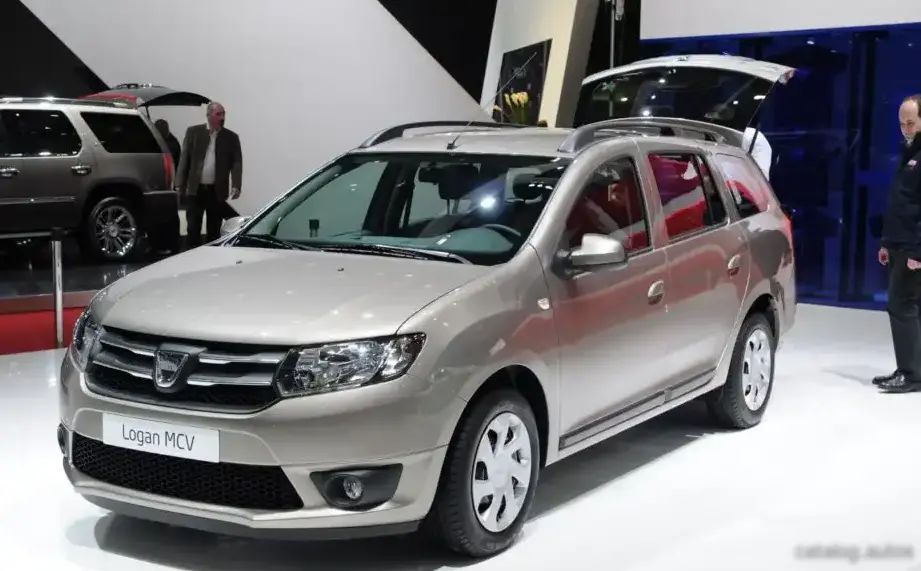
The Dacia Logan II MCV 1.5 dCi (75 hp) FAP is a station wagon produced by the Romanian automaker Dacia between 2013 and 2015. It represents an entry-level offering within the second generation Logan MCV (Multi-Capacity Vehicle) lineup, positioned as a budget-friendly and practical family vehicle. The MCV, essentially a wagon version of the Logan sedan, aimed to provide maximum interior space for minimal cost. This particular variant, equipped with the 1.5-liter diesel engine and a five-speed manual transmission, was primarily targeted at buyers in European markets where diesel fuel was prevalent and fuel economy was a high priority. The “FAP” designation indicates the presence of a Diesel Particulate Filter, a component designed to reduce harmful emissions.
Technical Specifications
| Brand | Dacia |
| Model | Logan |
| Generation | Logan II MCV |
| Type (Engine) | 1.5 dCi (75 Hp) FAP |
| Start of production | 2013 |
| End of production | 2015 |
| Powertrain Architecture | Internal Combustion engine |
| Body type | Station wagon (estate) |
| Seats | 5 |
| Doors | 5 |
| Fuel consumption (urban) | 4.4 l/100 km (53.5 US mpg, 64.2 UK mpg, 22.7 km/l) |
| Fuel consumption (extra urban) | 3.7 l/100 km (63.6 US mpg, 76.3 UK mpg, 27 km/l) |
| Fuel consumption (combined) | 3.9 l/100 km (60.3 US mpg, 72.4 UK mpg, 25.6 km/l) |
| Fuel Type | Diesel |
| Acceleration 0 – 100 km/h | 14.8 sec |
| Acceleration 0 – 62 mph | 14.8 sec |
| Acceleration 0 – 60 mph | 14.1 sec |
| Maximum speed | 164 km/h (101.9 mph) |
| Weight-to-power ratio | 14.5 kg/Hp, 68.8 Hp/tonne |
| Weight-to-torque ratio | 5.5 kg/Nm, 183.5 Nm/tonne |
| Power | 75 Hp @ 4000 rpm |
| Power per litre | 51.3 Hp/l |
| Torque | 200 Nm @ 1750 rpm (147.51 lb.-ft. @ 1750 rpm) |
| Engine layout | Front, Transverse |
| Engine Model/Code | K9K 612 |
| Engine displacement | 1461 cm3 (89.16 cu. in.) |
| Number of cylinders | 4 |
| Engine configuration | Inline |
| Number of valves per cylinder | 2 |
| Fuel injection system | Diesel Commonrail |
| Engine aspiration | Turbocharger, Intercooler |
| Engine oil capacity | 4.5 l (4.76 US qt | 3.96 UK qt) |
| Coolant capacity | 4.5 l (4.76 US qt | 3.96 UK qt) |
| Kerb Weight | 1090 kg (2403.04 lbs.) |
| Max. weight | 1670 kg (3681.72 lbs.) |
| Max load | 580 kg (1278.68 lbs.) |
| Trunk (boot) space – minimum | 573 l (20.24 cu. ft.) |
| Trunk (boot) space – maximum | 1518 l (53.61 cu. ft.) |
| Fuel tank capacity | 50 l (13.21 US gal | 11 UK gal) |
| Length | 4492 mm (176.85 in.) |
| Width | 1733 mm (68.23 in.) |
| Height | 1539 mm (60.59 in.) |
| Wheelbase | 2634 mm (103.7 in.) |
| Drivetrain Architecture | The Internal combustion engine (ICE) drives the front wheels of the vehicle. |
| Drive wheel | Front wheel drive |
| Number of gears and type of gearbox | 5 gears, manual transmission |
| Steering type | Steering rack and pinion |
| Tires size | 185/65 R15 |
| Wheel rims size | 15 |
INTRODUCTION
The Dacia Logan II MCV 1.5 dCi (75 hp) FAP, launched in 2013, was a key component of Dacia’s strategy to offer affordable and practical vehicles to a broad customer base. Built on the 1HX0/A3 platform shared with Renault models, the Logan MCV aimed to maximize cargo capacity and passenger space. This 75 horsepower diesel variant was positioned as the entry point to the MCV range, appealing to buyers prioritizing fuel efficiency and low running costs over outright performance. It was particularly popular in European countries with high diesel penetration and favorable tax incentives for lower-emission vehicles.
Powertrain & Engine Architecture
At the heart of this Logan MCV variant lies the K9K 612 engine, a 1.5-liter inline-four cylinder diesel engine. This engine is a common design within the Renault-Nissan-Dacia alliance, known for its robustness and relatively simple construction. The K9K 612 utilizes a diesel common rail fuel injection system, delivering fuel at high pressure for improved combustion efficiency and reduced emissions. A turbocharger with an intercooler is employed to boost power output, providing 75 horsepower at 4000 rpm and 200 Nm (147.51 lb-ft) of torque at 1750 rpm. The engine features two valves per cylinder and is known for its durability, though it can be susceptible to issues with the fuel injectors and turbocharger over time. The engine is transversely mounted in the front of the vehicle. The five-speed manual transmission is a standard unit, chosen for its simplicity and cost-effectiveness. Gear ratios are geared towards maximizing fuel economy rather than providing sporty acceleration.
Driving Characteristics
The 1.5 dCi (75 hp) engine, coupled with the five-speed manual transmission, delivers modest performance. Acceleration from 0 to 100 km/h (0-62 mph) takes approximately 14.8 seconds, and top speed is around 164 km/h (101.9 mph). The engine feels somewhat underpowered when fully loaded or tackling steep inclines. However, in typical urban and highway driving conditions, it provides adequate performance for everyday use. The turbocharger provides a noticeable boost in torque at lower engine speeds, making it relatively easy to keep up with traffic. The manual transmission is light and easy to operate, but the long gear ratios emphasize fuel economy over spirited driving. Compared to higher-output versions of the Logan MCV, such as those with more powerful diesel engines or gasoline options, this variant feels significantly slower and less refined.
Equipment & Trim Levels
The 1.5 dCi (75 hp) FAP variant typically represented the base trim level for the Logan MCV. Standard equipment generally included power steering, central locking, electric front windows, and a basic audio system. Safety features were also relatively basic, often limited to ABS brakes and driver/passenger airbags. Interior upholstery was typically cloth, and the dashboard featured a functional but utilitarian design. Optional extras included air conditioning, alloy wheels, and a more advanced audio system. The focus was on providing essential features at the lowest possible price point.
Chassis & Braking
The Logan MCV’s chassis is a relatively simple design, prioritizing cost-effectiveness and durability. The front suspension utilizes MacPherson struts, while the rear suspension employs a torsion beam axle. This setup provides a comfortable ride quality, but handling is not particularly sharp. Brakes are disc brakes on the front wheels and drum brakes on the rear wheels, adequate for the vehicle’s weight and performance. Stabilizer bars were often omitted on the base trim level to further reduce costs. The steering is a rack and pinion system, providing reasonable precision but lacking in feedback.
Market Reception & Comparison
The Dacia Logan II MCV 1.5 dCi (75 hp) FAP was generally well-received by critics for its exceptional value for money. It was praised for its spacious interior, large cargo capacity, and excellent fuel economy. However, it was also criticized for its lack of refinement, basic interior, and modest performance. Compared to other trims in the Logan MCV lineup, this variant offered the lowest price but also the least amount of power and equipment. Against competitors like the Skoda Fabia Estate or Renault Clio Sport Tourer, the Logan MCV offered significantly more space for a similar price, but lacked the build quality and driving dynamics of those rivals.
Legacy
The 1.5 dCi engine, in various iterations, proved to be a reliable and durable powertrain. However, the K9K engine is known for potential issues with the fuel injectors and turbocharger, requiring periodic maintenance. In the used car market, the Logan II MCV 1.5 dCi (75 hp) FAP remains an affordable and practical option for buyers seeking a spacious and fuel-efficient station wagon. Its simplicity and robust construction make it relatively easy and inexpensive to maintain, contributing to its continued popularity as a budget-friendly family vehicle. While not a performance car, it continues to serve as a dependable workhorse for those prioritizing practicality and value.