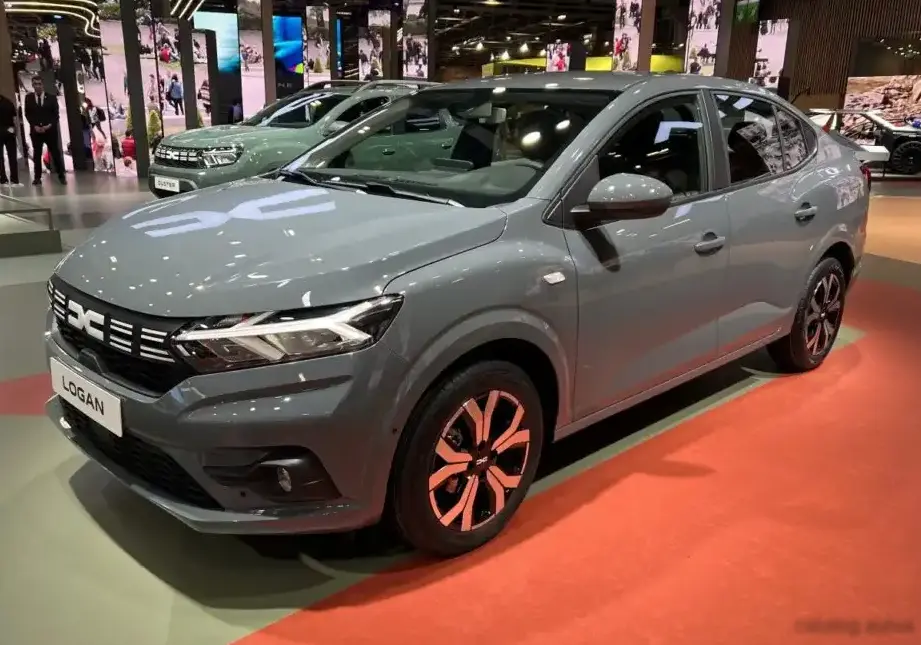
The Dacia Logan III (facelift 2022) 1.0 ECO-G 100, a 90/100 horsepower LPG-capable variant, represents a significant offering in the budget-conscious sedan market. Introduced in September 2022, this model builds upon the established foundation of the Logan III, which itself is based on the 1HX0/A3 platform shared with Renault. The ECO-G 100 distinguishes itself through its bi-fuel capability, offering drivers the flexibility of gasoline or Liquefied Petroleum Gas (LPG) operation, and positions itself as an economical choice for both personal and commercial use, particularly in European markets where LPG infrastructure is well-developed. This variant is typically considered an entry-level to mid-range option within the Logan III lineup, prioritizing fuel efficiency and affordability over outright performance.
Technical Specifications
| Brand | Dacia |
| Model | Logan |
| Generation | Logan III (facelift 2022) |
| Type (Engine) | 1.0 ECO-G 100 (90/100 Hp) LPG Manual 5-speed |
| Start of production | September, 2022 |
| Powertrain Architecture | Internal Combustion engine |
| Body type | Sedan |
| Seats | 5 |
| Doors | 4 |
| Combined fuel consumption (WLTP) | 5.3-5.6 l/100 km (44.4 – 42 US mpg, 53.3 – 50.4 UK mpg, 18.9 – 17.9 km/l) |
| Combined fuel consumption (WLTP) (LPG) | 6.9-7.3 l/100 km |
| CO2 emissions (WLTP) | 119-127 g/km |
| CO2 emissions (LPG) (WLTP) | 106-112 g/km |
| Fuel Type | Petrol / LPG |
| Acceleration 0 – 100 km/h | 11.6 sec |
| Acceleration 0 – 62 mph | 11.6 sec |
| Acceleration 0 – 60 mph | 11 sec |
| Maximum speed | 181 km/h (112.47 mph) |
| Maximum speed (LPG) | 186 km/h |
| Emission standard | Euro 6 |
| Weight-to-power ratio | 12.7 kg/Hp, 78.5 Hp/tonne |
| Weight-to-torque ratio | 7.2 kg/Nm, 139.5 Nm/tonne |
| Power | 90 Hp @ 4800-5000 rpm |
| Power per litre | 90.1 Hp/l |
| Power (LPG) | 100 Hp @ 4600-5000 rpm |
| Power per litre (LPG) | 100.1 Hp/l |
| Torque | 160 Nm @ 2100-3750 rpm (118.01 lb.-ft. @ 2100-3750 rpm) |
| Torque (LPG) | 170 Nm @ 2000-3500 rpm |
| Engine layout | Front, Transverse |
| Engine Model/Code | H4D 480 |
| Engine displacement | 999 cm3 (60.96 cu. in.) |
| Number of cylinders | 3 |
| Engine configuration | Inline |
| Number of valves per cylinder | 4 |
| Fuel injection system | Multi-port manifold injection |
| Engine aspiration | Turbocharger |
| Engine oil capacity | 4.1 l (4.33 US qt | 3.61 UK qt) |
| Kerb Weight | 1147 kg (2528.7 lbs.) |
| Max. weight | 1589 kg (3503.15 lbs.) |
| Max load | 442 kg (974.44 lbs.) |
| Trunk (boot) space – minimum | 528 l (18.65 cu. ft.) |
| Trunk (boot) space – maximum | 1361 l (48.06 cu. ft.) |
| Fuel tank capacity | 50 l (13.21 US gal | 11 UK gal) |
| Fuel tank capacity (LPG) | 40 l |
| Permitted trailer load with brakes (12%) | 1100 kg (2425.08 lbs.) |
| Permitted trailer load without brakes | 595 kg (1311.75 lbs.) |
| Length | 4396 mm (173.07 in.) |
| Width | 1848 mm (72.76 in.) |
| Width including mirrors | 2007 mm (79.02 in.) |
| Height | 1501 mm (59.09 in.) |
| Wheelbase | 2649 mm (104.29 in.) |
| Front track | 1533 mm (60.35 in.) |
| Rear (Back) track | 1519 mm (59.8 in.) |
| Front overhang | 819 mm (32.24 in.) |
| Rear overhang | 928 mm (36.54 in.) |
| Ride height (ground clearance) | 161 mm (6.34 in.) |
| Drivetrain Architecture | The Internal combustion engine (ICE) drives the front wheels of the vehicle. |
| Drive wheel | Front wheel drive |
| Number of gears and type of gearbox | 5 gears, manual transmission |
| Front brakes | Disc |
| Rear brakes | Drum |
| Assisting systems | ABS (Anti-lock braking system) |
| Steering type | Steering rack and pinion |
| Tires size | 185/65 R15 |
Powertrain & Engine Architecture
The heart of the Logan III ECO-G 100 is the H4D 480, a 999cc, three-cylinder turbocharged gasoline engine. This engine is part of Renault’s ‘TCe’ family and utilizes multi-point fuel injection. The engine’s turbocharger provides a boost in power and torque, compensating for its small displacement. The LPG conversion is factory-installed, featuring dedicated injectors and a separate fuel tank, allowing seamless switching between gasoline and LPG. The 5-speed manual transmission is a standard unit, chosen for its simplicity and cost-effectiveness. The engine produces 90 horsepower on gasoline and 100 horsepower when running on LPG, with a torque output of 160 Nm (118 lb-ft) on gasoline and 170 Nm (125 lb-ft) on LPG. The slight power increase on LPG is due to the fuel’s higher octane rating.
Driving Characteristics
The 1.0 ECO-G 100 offers adequate, though not exhilarating, performance. Acceleration from 0-100 km/h (0-62 mph) takes approximately 11.6 seconds. The engine feels responsive enough for everyday driving, particularly in urban environments. The 5-speed manual transmission is well-matched to the engine’s characteristics, providing reasonable gear spacing. Compared to higher-output Logan variants, such as those with larger gasoline engines, the ECO-G 100 prioritizes fuel economy over outright speed. The LPG system operates smoothly, with minimal noticeable difference in performance when switched from gasoline. The gear ratios are tuned for efficiency, meaning highway cruising requires slightly higher engine speeds compared to more powerful versions.
Equipment & Trim Levels
The ECO-G 100 trim typically includes standard features such as air conditioning, power steering, electric front windows, and a basic audio system. Safety equipment includes ABS, ESP (Electronic Stability Program), and driver/passenger airbags. Higher trim levels may add features like alloy wheels, a touchscreen infotainment system, rear parking sensors, and cruise control. Interior upholstery is generally cloth, with a functional and durable design. The dashboard layout is straightforward and user-friendly, focusing on practicality rather than luxury.
Chassis & Braking
The Logan III utilizes a MacPherson strut front suspension and a torsion beam rear suspension. This setup provides a comfortable ride quality, suitable for a variety of road conditions. The front brakes are disc brakes, while the rear brakes are drum brakes – a cost-saving measure common in this segment. The steering is a rack and pinion system, offering reasonable precision. The suspension is tuned for comfort, prioritizing ride quality over sporty handling. Stabilizer bars are included to reduce body roll during cornering.
Market Reception & Comparison
The Dacia Logan III ECO-G 100 has been well-received in markets where LPG is a popular fuel source. Critics have praised its fuel efficiency and affordability. Compared to gasoline-only Logan variants, the ECO-G 100 offers lower running costs, particularly for drivers who frequently travel long distances. The LPG system does add some weight, but the performance impact is minimal. Reliability is generally good, although the LPG system requires periodic maintenance. Compared to competitors in the budget sedan segment, the Logan ECO-G 100 stands out due to its bi-fuel capability and spacious interior.
Legacy
The H4D 480 engine, in both gasoline and LPG forms, has proven to be a relatively reliable unit. The Logan III, as a whole, has established a reputation for being a practical and affordable vehicle. On the used car market, the ECO-G 100 variant is often sought after by drivers looking for a cost-effective and environmentally friendly transportation option. The longevity of the LPG system depends on proper maintenance, but well-maintained examples can provide many years of reliable service. The ECO-G 100 represents Dacia’s commitment to offering accessible and efficient vehicles to a broad range of customers.