Technical Specifications
| Brand | Dacia |
| Model | Sandero |
| Generation | Sandero I |
| Type (Engine) | 1.5 dCi (75 Hp) FAP |
| Start of production | 2010 |
| End of production | 2012 |
| Powertrain Architecture | Internal Combustion engine |
| Body type | Hatchback |
| Seats | 5 |
| Doors | 5 |
| Fuel consumption (urban) | 4.9 l/100 km (48 US mpg, 57.6 UK mpg, 20.4 km/l) |
| Fuel consumption (extra urban) | 3.6 l/100 km (65.3 US mpg, 78.5 UK mpg, 27.8 km/l) |
| Fuel consumption (combined) | 4 l/100 km (58.8 US mpg, 70.6 UK mpg, 25 km/l) |
| CO2 emissions | 104 g/km |
| Fuel Type | Diesel |
| Acceleration 0 – 100 km/h | 14.2 sec |
| Acceleration 0 – 62 mph | 14.2 sec |
| Acceleration 0 – 60 mph | 13.5 sec |
| Maximum speed | 162 km/h (100.66 mph) |
| Emission standard | Euro 5 |
| Weight-to-power ratio | 14.5 kg/Hp, 68.8 Hp/tonne |
| Weight-to-torque ratio | 6.1 kg/Nm, 165.1 Nm/tonne |
| Power | 75 Hp @ 4000 rpm |
| Power per litre | 51.3 Hp/l |
| Torque | 180 Nm @ 1750 rpm (132.76 lb.-ft. @ 1750 rpm) |
| Engine layout | Front, Transverse |
| Engine Model/Code | K9K 892 |
| Engine displacement | 1461 cm3 (89.16 cu. in.) |
| Number of cylinders | 4 |
| Engine configuration | Inline |
| Cylinder Bore | 76 mm (2.99 in.) |
| Piston Stroke | 80.5 mm (3.17 in.) |
| Compression ratio | 17.6:1 |
| Number of valves per cylinder | 2 |
| Fuel injection system | Diesel Commonrail |
| Engine aspiration | Turbocharger, Intercooler |
| Valvetrain | SOHC |
| Engine oil capacity | 4.5 l (4.76 US qt | 3.96 UK qt) |
| Coolant capacity | 5.7 l (6.02 US qt | 5.02 UK qt) |
| Kerb Weight | 1090 kg (2403.04 lbs.) |
| Max. weight | 1575 kg (3472.28 lbs.) |
| Max load | 485 kg (1069.24 lbs.) |
| Trunk (boot) space – minimum | 320 l (11.3 cu. ft.) |
| Trunk (boot) space – maximum | 1200 l (42.38 cu. ft.) |
| Fuel tank capacity | 50 l (13.21 US gal | 11 UK gal) |
| Max. roof load | 80 kg (176.37 lbs.) |
| Permitted trailer load with brakes (12%) | 1100 kg (2425.08 lbs.) |
| Permitted trailer load without brakes | 580 kg (1278.68 lbs.) |
| Permitted towbar download | 75 kg (165.35 lbs.) |
| Length | 4020 mm (158.27 in.) |
| Width | 1746 mm (68.74 in.) |
| Width including mirrors | 1997 mm (78.62 in.) |
| Height | 1534 mm (60.39 in.) |
| Wheelbase | 2588 mm (101.89 in.) |
| Front track | 1480 mm (58.27 in.) |
| Rear track | 1470 mm (57.87 in.) |
| Front overhang | 781 mm (30.75 in.) |
| Rear overhang | 651 mm (25.63 in.) |
| Ride height (ground clearance) | 155 mm (6.1 in.) |
| Drag coefficient (Cd) | 0.35 |
| Minimum turning circle | 10.5 m (34.45 ft.) |
| Drivetrain Architecture | Front wheel drive |
| Number of gears and type of gearbox | 5 gears, manual transmission |
| Front suspension | Independent type McPherson, Transverse stabilizer |
| Rear suspension | Coil spring, Torsion |
| Front brakes | Ventilated discs, 259 mm |
| Rear brakes | Drum, 203 mm |
| Assisting systems | ABS (Anti-lock braking system) |
| Steering type | Steering rack and pinion |
| Power steering | Hydraulic Steering |
| Tires size | 185/65 R15 |
| Wheel rims size | 6J x 15 |
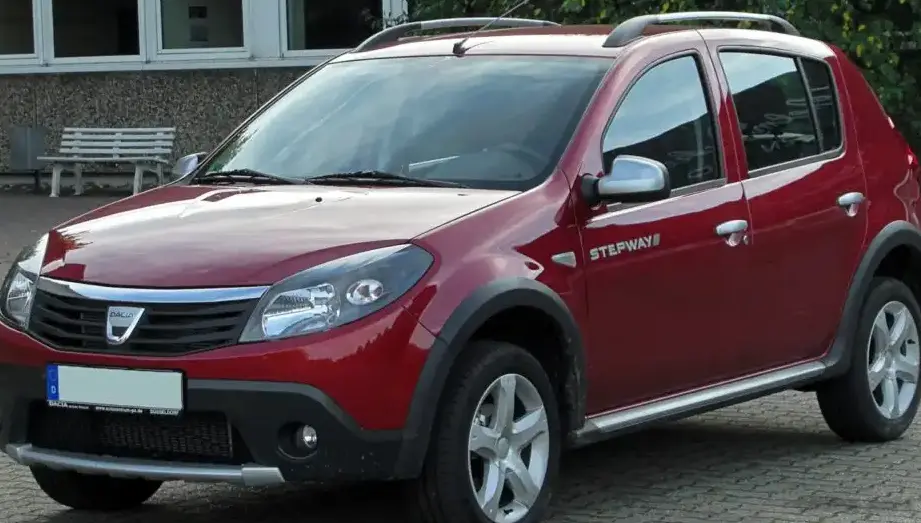
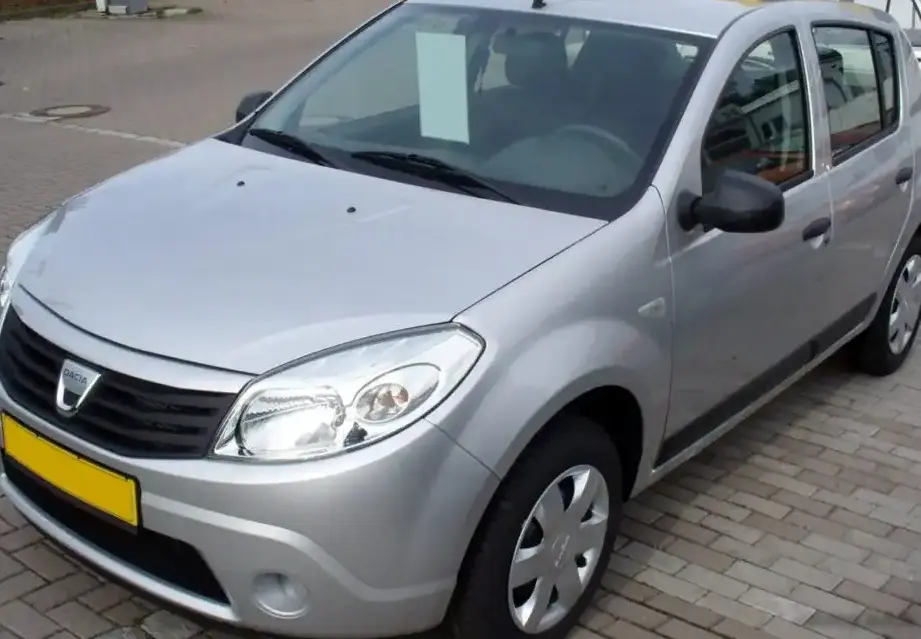
The Dacia Sandero I 1.5 dCi (75 hp) FAP was a diesel-powered variant of the first-generation Dacia Sandero, produced between 2010 and 2012. It occupied the entry-level position within the Sandero range, specifically aimed at providing affordable and fuel-efficient transportation, primarily in European markets. This model was instrumental in establishing the Sandero as a popular choice for budget-conscious buyers, capitalizing on the growing demand for economical diesel hatchbacks. The inclusion of a Diesel Particulate Filter (DPF), denoted by the “FAP” designation, was a key feature, designed to reduce harmful emissions and comply with increasingly stringent European emission regulations.
Powertrain & Engine Architecture
The engine powering the Sandero I 1.5 dCi (75 hp) FAP is the Renault-developed K9K 892, a 1.5-liter inline-four cylinder diesel. This engine is part of the well-regarded K9K family, known for its inherent reliability and fuel economy. The engine employs a common rail direct injection system, injecting fuel directly into the combustion chamber at high pressure for optimized combustion efficiency. A turbocharger, coupled with an intercooler, is utilized to boost power output and enhance torque delivery across the engine’s operating range. The engine features a single overhead camshaft (SOHC) valvetrain with two valves per cylinder. Crucially, the inclusion of a Diesel Particulate Filter (DPF) was essential for meeting Euro 5 emission standards, effectively trapping soot particles produced during the combustion process. The engine is mounted transversely at the front of the vehicle, driving the front wheels.
Driving Characteristics
With an output of 75 horsepower and 180 Nm (132.76 lb.-ft.) of torque, the 1.5 dCi wasn’t designed for blistering performance. Acceleration from 0 to 60 mph took approximately 13.5 seconds, and 0-100 km/h (0-62 mph) in 14.2 seconds, making it a relatively slow performer by contemporary standards. However, the engine’s torque peak at 1750 rpm provided adequate pulling power at lower engine speeds, making it suitable for both urban commuting and highway cruising. The Sandero I 1.5 dCi (75 hp) FAP was exclusively offered with a five-speed manual transmission. Compared to Sandero variants equipped with the 1.6-liter petrol engine, the diesel offered significantly superior fuel economy, but at the cost of outright acceleration and responsiveness. The gear ratios were carefully selected to prioritize fuel efficiency over sporty driving dynamics.
Equipment & Trim Levels
The 1.5 dCi (75 hp) FAP generally represented the base trim level for the Sandero I. Standard equipment typically included power steering, central locking, electric front windows, and an ABS anti-lock braking system. The interior featured cloth upholstery and a relatively simple dashboard design with limited features. Optional extras, available at an additional cost, included air conditioning, a radio/CD player, and alloy wheels. The overall focus was on providing a functional and affordable vehicle, so luxury features were deliberately minimized to keep the purchase price low.
Chassis & Braking
The Sandero I utilized a McPherson strut independent suspension system at the front, providing a reasonable level of ride comfort and handling. The rear suspension employed a torsion beam setup, a cost-effective solution common in vehicles of this class. The front brakes were ventilated discs, offering better stopping power than the drum brakes used on the rear wheels. This braking configuration was typical for vehicles in the Sandero’s price segment. The steering system was a hydraulic rack and pinion, providing adequate precision and feedback for everyday driving. The relatively lightweight construction of the Sandero helped to mitigate the limitations of the modest braking performance.
Market Reception & Comparison
The Dacia Sandero I 1.5 dCi (75 hp) FAP was well-received in markets where fuel economy and affordability were paramount. Automotive critics consistently praised its low running costs and practicality. However, the engine’s limited power output and the relatively basic interior were frequently cited as drawbacks. When compared to other diesel hatchbacks of the era, such as the Peugeot 207 or Renault Clio, the Sandero offered a more competitive price point but lacked some of the refinement and features found in those models. Its fuel economy was competitive within its class, and its overall reliability was generally considered to be good.
Legacy
The K9K engine family, including the K9K 892 variant used in the Sandero I 1.5 dCi, has proven to be exceptionally durable. Numerous examples of this engine remain in operation today, having accumulated significant mileage. While DPF-related issues can occasionally arise with age and infrequent long-distance journeys, the engine itself is generally regarded as a reliable and robust unit. In the used car market, the Sandero I 1.5 dCi (75 hp) FAP continues to be a popular choice for buyers seeking an affordable and economical vehicle. Its simplicity, low maintenance costs, and fuel efficiency continue to appeal to budget-conscious drivers.