Technical Specifications
| Brand | Dacia |
| Model | Sandero |
| Generation | Sandero I Stepway |
| Type (Engine) | 1.5 dCi (68 Hp) |
| Start of production | 2009 |
| End of production | 2010 |
| Powertrain Architecture | Internal Combustion engine |
| Body type | Crossover |
| Seats | 5 |
| Doors | 5 |
| Fuel consumption (urban) | 6.2 l/100 km (37.9 US mpg, 45.6 UK mpg, 16.1 km/l) |
| Fuel consumption (extra urban) | 4.8 l/100 km (49 US mpg, 58.9 UK mpg, 20.8 km/l) |
| Fuel consumption (combined) | 5.3 l/100 km (44.4 US mpg, 53.3 UK mpg, 18.9 km/l) |
| CO2 emissions | 140 g/km |
| Fuel Type | Diesel |
| Acceleration 0 – 100 km/h | 16.7 sec |
| Acceleration 0 – 62 mph | 16.7 sec |
| Acceleration 0 – 60 mph | 15.9 sec |
| Maximum speed | 150 km/h (93.21 mph) |
| Emission standard | Euro 4 |
| Weight-to-power ratio | 16.8 kg/Hp |
| Weight-to-torque ratio | 7.1 kg/Nm |
| Power | 68 Hp @ 4000 rpm |
| Torque | 160 Nm @ 1700 rpm (118.01 lb.-ft. @ 1700 rpm) |
| Engine layout | Front, Transverse |
| Engine Model/Code | K9K 792 |
| Engine displacement | 1461 cm3 (89.16 cu. in.) |
| Number of cylinders | 4 |
| Engine configuration | Inline |
| Cylinder Bore | 76 mm (2.99 in.) |
| Piston Stroke | 80.5 mm (3.17 in.) |
| Compression ratio | 17.6:1 |
| Number of valves per cylinder | 2 |
| Fuel injection system | Diesel Commonrail |
| Engine aspiration | Turbocharger, Intercooler |
| Valvetrain | SOHC |
| Engine oil capacity | 4.5 l (4.76 US qt | 3.96 UK qt) |
| Coolant capacity | 5.7 l (6.02 US qt | 5.02 UK qt) |
| Kerb Weight | 1141 kg (2515.47 lbs.) |
| Max. weight | 1615 kg (3560.47 lbs.) |
| Max load | 474 kg (1044.99 lbs.) |
| Trunk (boot) space – minimum | 320 l (11.3 cu. ft.) |
| Trunk (boot) space – maximum | 1200 l (42.38 cu. ft.) |
| Fuel tank capacity | 50 l (13.21 US gal | 11 UK gal) |
| Max. roof load | 80 kg (176.37 lbs.) |
| Permitted trailer load with brakes (12%) | 1100 kg (2425.08 lbs.) |
| Permitted trailer load without brakes | 605 kg (1333.8 lbs.) |
| Permitted towbar download | 60 kg (132.28 lbs.) |
| Length | 4024 mm (158.43 in.) |
| Width | 1753 mm (69.02 in.) |
| Width including mirrors | 1997 mm (78.62 in.) |
| Height | 1590 mm (62.6 in.) |
| Wheelbase | 2588 mm (101.89 in.) |
| Front track | 1494 mm (58.82 in.) |
| Rear track | 1483 mm (58.39 in.) |
| Front overhang | 785 mm (30.91 in.) |
| Rear overhang | 651 mm (25.63 in.) |
| Ride height (ground clearance) | 175 mm (6.89 in.) |
| Drag coefficient (Cd) | 0.39 |
| Minimum turning circle | 10.5 m (34.45 ft.) |
| Drivetrain Architecture | Front wheel drive |
| Number of gears and type of gearbox | 5 gears, manual transmission |
| Front suspension | Independent type McPherson, Transverse stabilizer |
| Rear suspension | Coil spring, Torsion |
| Front brakes | Ventilated discs, 259×20.6 mm |
| Rear brakes | Drum, 203 mm |
| Assisting systems | ABS (Anti-lock braking system) |
| Steering type | Steering rack and pinion |
| Power steering | Hydraulic Steering |
| Tires size | 195/55 R16 |
| Wheel rims size | 6.5J x 16 |
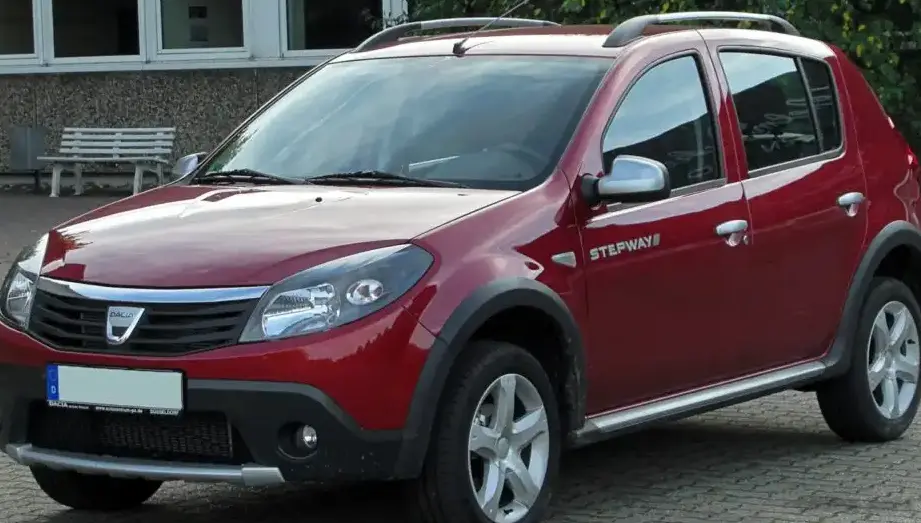
The Dacia Sandero I Stepway 1.5 dCi (68 Hp) was a key model in Dacia’s early expansion across Europe. Introduced in 2009 as part of the first-generation Sandero (based on the 1HX0/A3 platform shared with Renault), the Stepway variant offered increased ground clearance and a more robust appearance compared to the standard hatchback. This particular engine and trim level was designed to appeal to buyers seeking a practical, economical, and slightly more adventurous vehicle. It represented a significant portion of the Stepway sales, particularly in markets where diesel engines were favored for their fuel efficiency.
Powertrain & Engine Architecture
The heart of this Stepway variant is the Renault-sourced 1.5 dCi engine, specifically the K9K 792 code. This is a four-cylinder, inline diesel engine featuring a turbocharger with intercooler and a diesel common rail fuel injection system. The engine utilizes a single overhead camshaft (SOHC) valvetrain with two valves per cylinder. The 1.5 dCi engine was known for its relatively simple design and robust construction. The common rail system allowed for precise fuel delivery, contributing to improved fuel economy and reduced emissions. The five-speed manual transmission was the only gearbox option available with this engine, prioritizing efficiency over outright performance. The engine’s transverse mounting and front-wheel-drive configuration were standard for this class of vehicle.
Driving Characteristics
The 68 horsepower output and 160 Nm (118 lb-ft) of torque resulted in modest, but adequate, performance. Acceleration from 0-100 km/h (0-62 mph) took approximately 16.7 seconds, and top speed was limited to 150 km/h (93 mph). The engine felt somewhat strained when accelerating hard or climbing hills, requiring frequent gear changes to maintain momentum. However, in typical urban and highway driving conditions, the 1.5 dCi provided sufficient power for everyday use. The manual transmission offered a reasonable level of control, but the gear ratios were geared towards fuel economy rather than sporty driving. Compared to higher-output versions of the Sandero Stepway, such as those with the 1.6 petrol engine, this variant felt significantly slower, but offered substantially better fuel economy.
Equipment & Trim Levels
The 1.5 dCi Stepway typically came with a basic, but functional, level of equipment. Standard features generally included power steering, central locking, electric front windows, and an ABS anti-lock braking system. Interior upholstery was typically cloth, and the dashboard featured a simple, utilitarian design. Optional extras could include air conditioning, a radio/CD player, and alloy wheels. The Stepway trim level itself added plastic cladding around the wheel arches and along the sills, giving it a more rugged appearance. The focus was on providing a practical and affordable vehicle, so luxury features were kept to a minimum.
Chassis & Braking
The Sandero Stepway featured an independent McPherson strut suspension at the front and a coil spring torsion beam suspension at the rear. The Stepway variant benefited from increased ride height compared to the standard Sandero, improving its ability to cope with rough roads and uneven surfaces. The front brakes were ventilated discs, providing adequate stopping power, while the rear brakes were drum brakes, a cost-saving measure. The hydraulic power steering offered a reasonable level of assistance, making it easy to maneuver in tight spaces. Stabilizer bars were fitted to both the front and rear axles to reduce body roll during cornering.
Market Reception & Comparison
The Dacia Sandero I Stepway 1.5 dCi was generally well-received by critics for its affordability and fuel efficiency. It was praised as a practical and economical choice for budget-conscious buyers. However, its performance was often criticized as being underwhelming, particularly when compared to more powerful rivals. Compared to other trims in the Sandero lineup, the 1.5 dCi Stepway offered the best fuel economy, but at the expense of performance. The petrol-powered versions provided more spirited driving, but were less economical. The Stepway variant, in general, was seen as a more appealing option than the standard Sandero due to its increased ground clearance and more rugged appearance.
Legacy
The 1.5 dCi engine proved to be a reliable and durable unit, and many examples are still on the road today. While not known for its refinement or performance, it offered excellent fuel economy and relatively low maintenance costs. The Sandero Stepway, and this 1.5 dCi variant in particular, played a significant role in establishing Dacia as a major player in the European automotive market. On the used car market, these models remain popular due to their affordability and practicality. However, potential buyers should be aware of the age-related issues common to older diesel engines, such as potential problems with the turbocharger and fuel injection system. Overall, the Dacia Sandero I Stepway 1.5 dCi represents a sensible and economical choice for those seeking a basic, but reliable, crossover vehicle.