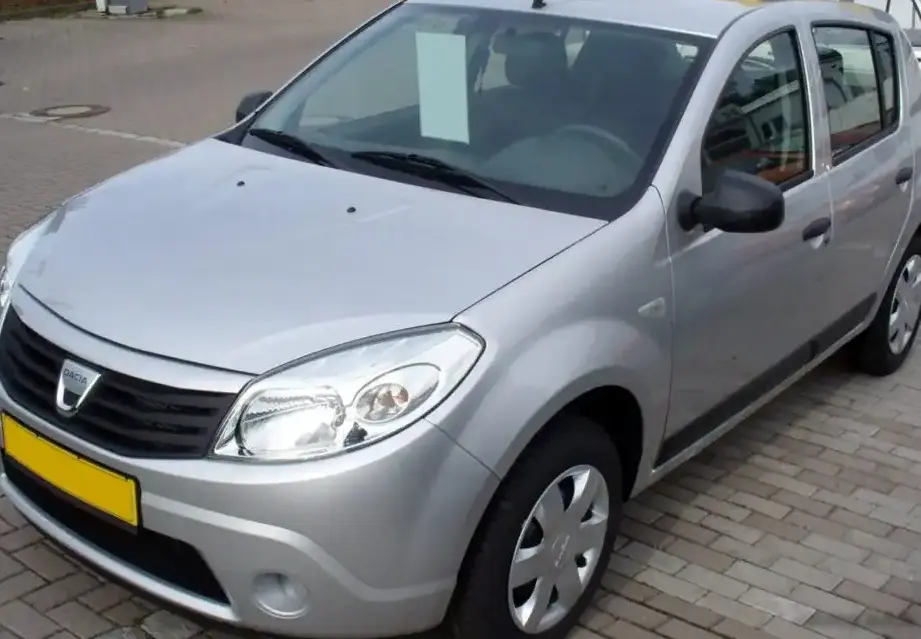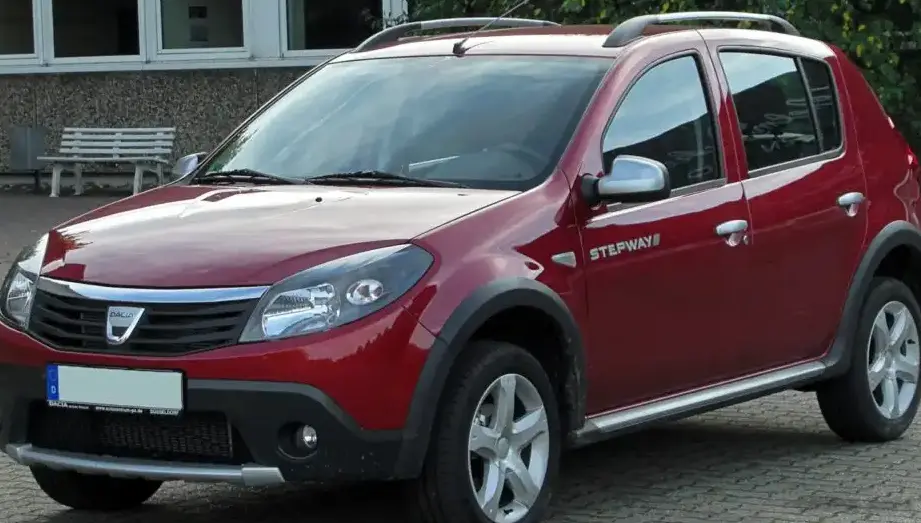
The Dacia Sandero I Stepway 1.5 dCi (88 hp) with a Diesel Particulate Filter (FAP) was a popular variant of the first-generation Sandero Stepway, produced between 2010 and 2012. Positioned as an entry-level option within the Stepway range, it offered a blend of affordability, fuel efficiency, and a slightly raised ride height compared to the standard Sandero. This model played a significant role in Dacia’s expansion across Europe, appealing to buyers seeking a practical and economical crossover-style vehicle. It was built on the Dacia/Renault X90 platform, also known as the 1HX0/A3 platform.
Technical Specifications
| Brand | Dacia |
| Model | Sandero |
| Generation | Sandero I Stepway |
| Type (Engine) | 1.5 dCi (88 Hp) FAP |
| Start of production | 2010 |
| End of production | 2012 |
| Powertrain Architecture | Internal Combustion engine |
| Body type | Crossover |
| Seats | 5 |
| Doors | 5 |
| Fuel consumption (urban) | 5.4 l/100 km (43.6 US mpg, 52.3 UK mpg, 18.5 km/l) |
| Fuel consumption (extra urban) | 4.2 l/100 km (56 US mpg, 67.3 UK mpg, 23.8 km/l) |
| Fuel consumption (combined) | 4.6 l/100 km (51.1 US mpg, 61.4 UK mpg, 21.7 km/l) |
| CO2 emissions | 121 g/km |
| Fuel Type | Diesel |
| Acceleration 0 – 100 km/h | 13.3 sec |
| Acceleration 0 – 62 mph | 13.3 sec |
| Acceleration 0 – 60 mph | 12.6 sec |
| Maximum speed | 162 km/h (100.66 mph) |
| Emission standard | Euro 5 |
| Weight-to-power ratio | 12.7 kg/Hp |
| Weight-to-torque ratio | 5.6 kg/Nm |
| Power | 88 Hp @ 3750 rpm |
| Torque | 200 Nm @ 1750 rpm (147.51 lb.-ft. @ 1750 rpm) |
| Engine layout | Front, Transverse |
| Engine Model/Code | K9K 892 |
| Engine displacement | 1461 cm3 (89.16 cu. in.) |
| Number of cylinders | 4 |
| Engine configuration | Inline |
| Cylinder Bore | 76 mm (2.99 in.) |
| Piston Stroke | 80.5 mm (3.17 in.) |
| Compression ratio | 17.6:1 |
| Number of valves per cylinder | 2 |
| Fuel injection system | Diesel Commonrail |
| Engine aspiration | Turbocharger, Intercooler |
| Valvetrain | SOHC |
| Engine oil capacity | 4.5 l (4.76 US qt | 3.96 UK qt) |
| Coolant capacity | 5.7 l (6.02 US qt | 5.02 UK qt) |
| Kerb Weight | 1114 kg (2455.95 lbs.) |
| Max. weight | 1615 kg (3560.47 lbs.) |
| Max load | 501 kg (1104.52 lbs.) |
| Trunk (boot) space – minimum | 320 l (11.3 cu. ft.) |
| Trunk (boot) space – maximum | 1200 l (42.38 cu. ft.) |
| Fuel tank capacity | 50 l (13.21 US gal | 11 UK gal) |
| Max. roof load | 80 kg (176.37 lbs.) |
| Permitted trailer load with brakes (12%) | 1100 kg (2425.08 lbs.) |
| Permitted trailer load without brakes | 590 kg (1300.73 lbs.) |
| Permitted towbar download | 60 kg (132.28 lbs.) |
| Length | 4024 mm (158.43 in.) |
| Width | 1753 mm (69.02 in.) |
| Width including mirrors | 1997 mm (78.62 in.) |
| Height | 1584 mm (62.36 in.) |
| Wheelbase | 2588 mm (101.89 in.) |
| Front track | 1494 mm (58.82 in.) |
| Rear track | 1483 mm (58.39 in.) |
| Front overhang | 785 mm (30.91 in.) |
| Rear overhang | 651 mm (25.63 in.) |
| Ride height (ground clearance) | 175 mm (6.89 in.) |
| Drag coefficient (Cd) | 0.36 |
| Minimum turning circle | 10.5 m (34.45 ft.) |
| Drivetrain | Front wheel drive |
| Number of gears | 5 |
| Gearbox type | Manual transmission |
| Front suspension | Independent type McPherson, Transverse stabilizer |
| Rear suspension | Coil spring, Torsion |
| Front brakes | Ventilated discs, 259×20.6 mm |
| Rear brakes | Drum, 203 mm |
| Assisting systems | ABS (Anti-lock braking system) |
| Steering type | Steering rack and pinion |
| Power steering | Hydraulic Steering |
| Tires size | 195/55 R16 |
| Wheel rims size | 6.5J x 16 |
INTRODUCTION
The Dacia Sandero I Stepway 1.5 dCi (88 hp) FAP, launched in 2010, represented a key expansion of the Sandero range. The Stepway variant, characterized by its increased ground clearance and rugged styling cues, aimed to bridge the gap between a traditional hatchback and a small SUV. The 1.5 dCi engine, a Renault-sourced unit, was a mainstay of Dacia’s lineup, known for its fuel efficiency and relatively low running costs. The inclusion of a Diesel Particulate Filter (FAP) was crucial for meeting increasingly stringent European emission standards. This particular configuration was aimed at buyers prioritizing economy and practicality over outright performance.
Powertrain & Engine Architecture
The heart of the Sandero I Stepway 1.5 dCi (88 hp) is the K9K 892 engine, a 1.5-liter inline-four cylinder diesel. This engine is part of the K9K family, widely used by Renault and its subsidiaries. It features a single overhead camshaft (SOHC) and utilizes a common rail direct fuel injection system, delivering fuel at high pressure for improved combustion efficiency. A turbocharger with an intercooler is employed to boost power output. The 88 hp version of the K9K 892 was specifically tuned for fuel economy, with a focus on maximizing torque at lower engine speeds. The engine’s 200 Nm (147.51 lb.-ft.) of torque is available from 1750 rpm, providing adequate pulling power for everyday driving. The engine is transversely mounted at the front of the vehicle. The transmission is a five-speed manual gearbox, chosen for its simplicity and efficiency.
Driving Characteristics
The 1.5 dCi 88 hp Stepway offered a comfortable, if not particularly exciting, driving experience. Acceleration from 0-100 km/h (0-62 mph) took around 13.3 seconds, and top speed was limited to 162 km/h (100.66 mph). The engine’s torque delivery made it reasonably responsive in urban environments, but overtaking on highways required careful planning. Compared to higher-powered versions of the Sandero, or those equipped with a petrol engine, the 1.5 dCi felt noticeably slower. However, the manual gearbox allowed drivers to make the most of the available power, and the relatively light weight of the Stepway helped to mitigate the engine’s limitations. The gear ratios were optimized for fuel efficiency, with taller gearing in higher gears.
Equipment & Trim Levels
The Stepway trim level, even in its base 1.5 dCi configuration, offered a more generous level of equipment than the standard Sandero. Standard features typically included air conditioning, power steering, electric front windows, and a basic audio system. The Stepway also featured distinctive styling elements, such as roof rails, plastic body cladding, and raised suspension. Interior upholstery was typically cloth, with a functional and durable design. Optional extras included alloy wheels, rear electric windows, and an upgraded audio system with Bluetooth connectivity. Safety features included ABS brakes and driver/passenger airbags.
Chassis & Braking
The Sandero I Stepway utilized a McPherson strut front suspension and a torsion beam rear suspension. The Stepway’s suspension was slightly raised compared to the standard Sandero, providing increased ground clearance for navigating rougher terrain. The front brakes were ventilated discs, while the rear brakes were drums. This configuration was typical for vehicles in this price segment. The hydraulic power steering provided light and easy steering, making it well-suited for urban driving. The tires were typically 195/55 R16, offering a good balance of comfort and grip.
Market Reception & Comparison
The Dacia Sandero I Stepway 1.5 dCi (88 hp) FAP was well-received by critics and consumers alike, particularly for its affordability and fuel efficiency. It offered a compelling alternative to more expensive small SUVs and crossovers. Compared to the petrol-powered Sandero variants, the 1.5 dCi offered significantly better fuel economy, making it an attractive option for high-mileage drivers. However, the diesel engine came with a higher purchase price and potentially higher maintenance costs. Compared to higher-powered diesel versions of the Sandero, the 88 hp variant offered a more economical entry point, albeit with reduced performance.
Legacy
The K9K 892 engine, in its various iterations, proved to be a reliable and durable powerplant. While diesel engines, in general, can be more susceptible to maintenance issues related to the fuel injection system and turbocharger, the K9K engine has a generally good reputation for longevity. Today, used examples of the Sandero I Stepway 1.5 dCi (88 hp) FAP are still relatively common on the used car market. They continue to appeal to buyers seeking an affordable and economical vehicle, but potential buyers should be aware of the potential maintenance costs associated with a diesel engine and the importance of ensuring the FAP is functioning correctly.