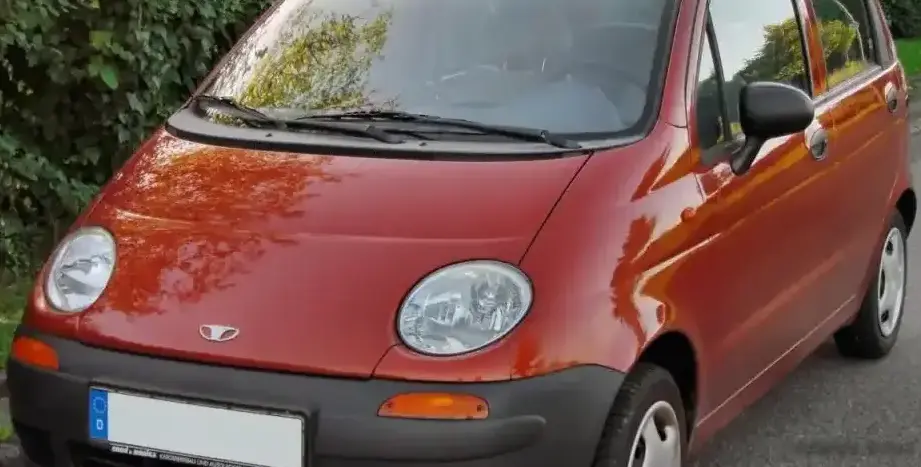
Technical Specifications
| Brand | Daewoo |
| Model | Matiz |
| Generation | Matiz I (facelift 2000) |
| Type (Engine) | 0.8 i (52 Hp) Automatic |
| Start of production | 2000 year |
| End of production | 2005 year |
| Powertrain Architecture | Internal Combustion engine |
| Body type | Hatchback |
| Seats | 4 |
| Doors | 5 |
| Fuel consumption (urban) | 7.3 l/100 km (32.2 US mpg, 38.7 UK mpg, 13.7 km/l) |
| Fuel consumption (extra urban) | 6.3 l/100 km (37.3 US mpg, 44.8 UK mpg, 15.9 km/l) |
| Fuel consumption (combined) | 6.8 l/100 km (34.6 US mpg, 41.5 UK mpg, 14.7 km/l) |
| Fuel Type | Petrol (Gasoline) |
| Acceleration 0 – 100 km/h | 18 sec |
| Acceleration 0 – 62 mph | 18 sec |
| Acceleration 0 – 60 mph | 17.1 sec |
| Maximum speed | 135 km/h (83.89 mph) |
| Weight-to-power ratio | 15.5 kg/Hp, 64.5 Hp/tonne |
| Weight-to-torque ratio | 11.7 kg/Nm, 85.6 Nm/tonne |
| Power | 52 Hp @ 5900 rpm |
| Power per litre | 65.3 Hp/l |
| Torque | 69 Nm @ 4600 rpm (50.89 lb.-ft. @ 4600 rpm) |
| Engine layout | Front, Transverse |
| Engine Model/Code | F8CV |
| Engine displacement | 796 cm3 (48.57 cu. in.) |
| Number of cylinders | 3 |
| Engine configuration | Inline |
| Cylinder Bore | 68.5 mm (2.7 in.) |
| Piston Stroke | 72 mm (2.83 in.) |
| Compression ratio | 9.3:1 |
| Number of valves per cylinder | 2 |
| Fuel injection system | Multi-port manifold injection |
| Engine aspiration | Naturally aspirated engine |
| Valvetrain | OHC |
| Engine oil capacity | 2.7 l (2.85 US qt | 2.38 UK qt) |
| Coolant | 4 l (4.23 US qt | 3.52 UK qt) |
| Kerb Weight | 806 kg (1776.93 lbs.) |
| Max. weight | 1210 kg (2667.59 lbs.) |
| Max load | 404 kg (890.67 lbs.) |
| Trunk (boot) space – minimum | 145 l (5.12 cu. ft.) |
| Trunk (boot) space – maximum | 830 l (29.31 cu. ft.) |
| Fuel tank capacity | 38 l (10.04 US gal | 8.36 UK gal) |
| Length | 3495 mm (137.6 in.) |
| Width | 1495 mm (58.86 in.) |
| Height | 1485 mm (58.46 in.) |
| Wheelbase | 2340 mm (92.13 in.) |
| Front track | 1315 mm (51.77 in.) |
| Rear (Back) track | 1280 mm (50.39 in.) |
| Minimum turning circle | 9.1 m (29.86 ft.) |
| Drivetrain Architecture | The Internal combustion engine (ICE) drives the front wheels of the vehicle. |
| Drive wheel | Front wheel drive |
| Number of gears and type of gearbox | 4 gears, automatic transmission |
| Front suspension | Spring Strut |
| Rear suspension | Coil spring |
| Front brakes | Disc |
| Rear brakes | Drum |
| Assisting systems | ABS (Anti-lock braking system) |
| Steering type | Steering rack and pinion |
| Tires size | 145/70 R13 |
| Wheel rims size | 4.5Jx13 |
The Daewoo Matiz, particularly the facelifted first generation produced from 2000 to 2005, represented a significant step for the South Korean automaker into the European city car market. This diminutive hatchback, known for its affordability and practicality, was offered with a range of engine and transmission options. The 0.8-liter, 52 horsepower variant paired with a four-speed automatic transmission was a key offering, aimed at buyers prioritizing ease of use over outright performance. It occupied the entry-level position within the Matiz lineup, providing basic transportation with the convenience of an automatic gearbox. This model was primarily sold in Europe, where demand for small, economical cars was high.
Powertrain & Engine Architecture
The heart of this Matiz variant is the F8CV engine, a 796cc inline three-cylinder petrol engine. This engine, a staple of Daewoo’s small car offerings, utilizes a multi-port fuel injection system to deliver fuel to the cylinders. The engine features an overhead camshaft (OHC) valvetrain with two valves per cylinder. The F8CV is known for its simplicity and relatively low maintenance requirements. Paired with this engine is a four-speed automatic transmission. This transmission, while providing convenience, was not known for its sophistication or particularly quick shifts. It was designed primarily for smooth operation and fuel efficiency rather than sporty performance. The automatic transmission was a significant selling point for buyers who preferred the ease of use over the more common manual gearbox.
Driving Characteristics
The 0.8-liter, 52 horsepower Matiz Automatic was never intended to be a performance car. Acceleration was leisurely, taking approximately 18 seconds to reach 62 mph. In real-world driving, the automatic transmission contributed to a somewhat sluggish feel, particularly when attempting to overtake or merge onto highways. The gear ratios were optimized for fuel economy rather than rapid acceleration. Compared to the five-speed manual version, the automatic suffered a noticeable performance deficit. However, within the confines of urban environments, the Matiz Automatic proved to be perfectly adequate, offering sufficient power for navigating city streets and parking. The light steering and compact dimensions made it easy to maneuver in tight spaces.
Equipment & Trim Levels
The 0.8-liter Automatic Matiz typically came with a basic level of equipment. Standard features generally included power steering, central locking, and front disc brakes. Interior upholstery was typically cloth, and the dashboard featured a simple, functional design. Optional extras, depending on the market, could include air conditioning, power windows, and a radio/cassette player. The trim level was generally considered the base model, focusing on affordability and essential features. Higher trim levels, available with larger engines, offered more luxurious appointments and additional features.
Chassis & Braking
The Matiz utilized a simple chassis design with a spring strut front suspension and a coil spring rear suspension. This setup prioritized ride comfort over handling precision. The front brakes were discs, providing adequate stopping power, while the rear brakes were drums, a cost-saving measure common in this class of vehicle. ABS (Anti-lock Braking System) was often included as standard equipment, enhancing safety. The relatively lightweight construction of the Matiz helped to offset the limitations of the suspension and braking systems.
Market Reception & Comparison
The Daewoo Matiz Automatic was generally well-received as an affordable and practical city car. Critics praised its low price, fuel efficiency, and ease of driving. However, the performance of the automatic transmission was often criticized as being sluggish. Compared to other city cars of the time, such as the Fiat Panda or the Renault Twingo, the Matiz offered a competitive price point but lacked the refinement and driving dynamics of some of its rivals. Fuel economy was a strong point, making it an attractive option for budget-conscious buyers. Reliability was generally considered good, although the automatic transmission could be prone to issues if not properly maintained.
Legacy
The Daewoo Matiz, and specifically the 0.8-liter Automatic variant, remains a common sight on European roads today, a testament to its durability and affordability. While not a performance icon, it served as a reliable and economical mode of transportation for many drivers. In the used car market, these models are typically very affordable, making them attractive to first-time car buyers or those seeking a cheap and cheerful runabout. The F8CV engine, while simple, has proven to be relatively robust, and parts availability remains reasonable. However, potential buyers should be aware of the potential for issues with the automatic transmission, particularly if it has not been regularly serviced.