Technical Specifications
| Brand | Daewoo |
| Model | Matiz |
| Generation | Matiz I (facelift 2000) |
| Type (Engine) | 1.0 i (64 Hp) |
| Start of production | 2003 year |
| End of production | 2005 year |
| Powertrain Architecture | Internal Combustion engine |
| Body type | Hatchback |
| Seats | 4 |
| Doors | 5 |
| Fuel consumption (urban) | 8.2 l/100 km (28.7 US mpg, 34.4 UK mpg, 12.2 km/l) |
| Fuel consumption (extra urban) | 5.3 l/100 km (44.4 US mpg, 53.3 UK mpg, 18.9 km/l) |
| Fuel consumption (combined) | 6.4 l/100 km (36.8 US mpg, 44.1 UK mpg, 15.6 km/l) |
| Fuel Type | Petrol (Gasoline) |
| Acceleration 0 – 100 km/h | 15.3 sec |
| Acceleration 0 – 62 mph | 15.3 sec |
| Acceleration 0 – 60 mph | 14.5 sec |
| Maximum speed | 152 km/h (94.45 mph) |
| Weight-to-power ratio | 12.9 kg/Hp, 77.5 Hp/tonne |
| Weight-to-torque ratio | 9.5 kg/Nm, 105.3 Nm/tonne |
| Power | 64 Hp @ 5400 rpm |
| Power per litre | 64.3 Hp/l |
| Torque | 87 Nm @ 4200 rpm (64.17 lb.-ft. @ 4200 rpm) |
| Engine layout | Front, Transverse |
| Engine Model/Code | B10S |
| Engine displacement | 995 cm3 (60.72 cu. in.) |
| Number of cylinders | 4 |
| Engine configuration | Inline |
| Cylinder Bore | 68.5 mm (2.7 in.) |
| Piston Stroke | 67.5 mm (2.66 in.) |
| Compression ratio | 9.3:1 |
| Number of valves per cylinder | 2 |
| Fuel injection system | Multi-port manifold injection |
| Engine aspiration | Naturally aspirated engine |
| Engine oil capacity | 3.2 l (3.38 US qt | 2.82 UK qt) |
| Coolant capacity | 4.2 l (4.44 US qt | 3.7 UK qt) |
| Kerb Weight | 826 kg (1821.02 lbs.) |
| Max. weight | 1230 kg (2711.69 lbs.) |
| Max load | 404 kg (890.67 lbs.) |
| Trunk (boot) space – minimum | 145 l (5.12 cu. ft.) |
| Trunk (boot) space – maximum | 830 l (29.31 cu. ft.) |
| Fuel tank capacity | 38 l (10.04 US gal | 8.36 UK gal) |
| Length | 3495 mm (137.6 in.) |
| Width | 1495 mm (58.86 in.) |
| Height | 1485 mm (58.46 in.) |
| Wheelbase | 2340 mm (92.13 in.) |
| Front track | 1315 mm (51.77 in.) |
| Rear (Back) track | 1280 mm (50.39 in.) |
| Minimum turning circle | 9 m (29.53 ft.) |
| Drivetrain Architecture | Front wheel drive |
| Number of gears and type of gearbox | 5 gears, manual transmission |
| Front suspension | Spring Strut |
| Rear suspension | Coil spring |
| Front brakes | Disc |
| Rear brakes | Drum |
| Assisting systems | ABS (Anti-lock braking system) |
| Steering type | Steering rack and pinion |
| Tires size | 155/65 R13 |
| Wheel rims size | 13 |
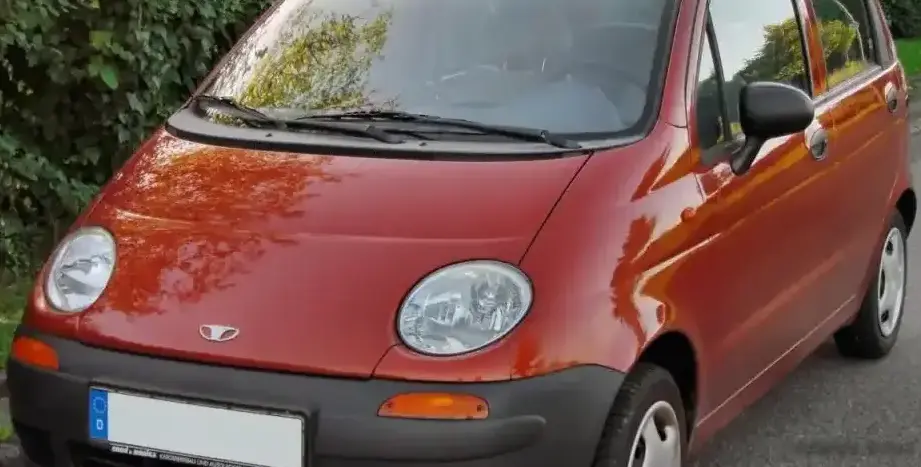
The Daewoo Matiz, rebranded as the Chevrolet Matiz following General Motors’ acquisition of Daewoo, was a city car manufactured from 1998 to 2015. The first generation, internally known as the M100, received a substantial facelift in 2000 and continued production until 2005. The 1.0 i variant, producing 64 horsepower, represented the entry-level offering in the Matiz range, particularly during the post-facelift years (2003-2005). This model was designed to provide affordable and economical transportation, primarily targeting urban commuters and first-time car buyers. It was a crucial model for Daewoo, and later Chevrolet, in European markets and other regions where small, fuel-efficient vehicles were in high demand.
Powertrain & Engine Architecture
The 1.0-liter, inline-four cylinder engine, designated B10S, powered this Matiz variant. It featured a single overhead camshaft (SOHC) valvetrain with two valves per cylinder. The engine utilized a multi-point fuel injection system, a relatively simple system that provided adequate fuel delivery for its intended purpose. The B10S engine was known for its simplicity and durability, though it wasn’t designed for high performance. The engine’s 995cc displacement and 9.3:1 compression ratio contributed to its fuel efficiency, but limited its overall power output. A five-speed manual transmission was standard, offering a reasonable spread of gears for city driving and occasional highway use. The transmission was geared towards economy rather than sporty performance, with relatively long gear ratios.
Driving Characteristics
The 1.0 i Matiz with the five-speed manual transmission offered modest performance. Acceleration was slow, taking over 15 seconds to reach 60 mph, and its top speed hovered around 94 mph. However, the car was perfectly suited for urban environments, where its small size and light steering made it easy to maneuver and park. The engine felt strained at higher speeds, and overtaking required careful planning. The long gear ratios prioritized fuel economy over rapid acceleration. The suspension was tuned for comfort, providing a relatively smooth ride on city streets, but it could feel somewhat unsettled on uneven surfaces. The brakes, consisting of front discs and rear drums, were adequate for normal driving conditions, but lacked the stopping power of more powerful vehicles.
Equipment & Trim Levels
The 1.0 i Matiz was typically offered as a base model, emphasizing affordability. Standard equipment generally included power steering, central locking, and basic instrumentation. Interior upholstery was typically cloth, and the dashboard featured a simple, functional design. Optional extras, depending on the market, could include air conditioning, power windows, and a radio/cassette player. The trim level was designed to appeal to budget-conscious buyers who prioritized practicality and economy over luxury features.
Chassis & Braking
The Matiz utilized a front-wheel-drive layout with a simple MacPherson strut suspension at the front and a twist-beam suspension at the rear. The front brakes were disc brakes, while the rear brakes were drum brakes, a common cost-saving measure for vehicles in this segment. The steering was a rack-and-pinion system, providing light and easy steering feel. The relatively lightweight construction of the Matiz contributed to its nimble handling, but the suspension setup wasn’t designed for aggressive driving.
Market Reception & Comparison
The 1.0 i Matiz was generally well-received as an affordable and economical city car. Critics praised its fuel efficiency, compact size, and ease of driving. However, it was often criticized for its lack of power and basic interior. Compared to other small cars of the time, such as the Fiat Panda or the Renault Twingo, the Matiz offered a competitive price point but lacked the refinement and performance of some of its rivals. The 1.0 i variant was positioned below the slightly more powerful (and often more expensive) 1.0 SE trim, which offered a few additional features like upgraded interior trim and sometimes, power windows.
Legacy
The Daewoo/Chevrolet Matiz, particularly the 1.0 i variant, established a reputation for reliability and low running costs. The B10S engine, while not particularly powerful, proved to be durable and relatively easy to maintain. In the used car market, these Matizes remain popular as inexpensive and practical transportation options. However, potential buyers should be aware of the car’s age and the possibility of wear and tear on components such as the suspension and brakes. Rust can also be a concern, particularly in regions with harsh winters. Despite its age, the Matiz continues to be a common sight on city streets in many parts of the world, a testament to its affordability and practicality. It served as a vital entry point into car ownership for many, and its simple design continues to make it a relatively straightforward vehicle for amateur mechanics to work on.