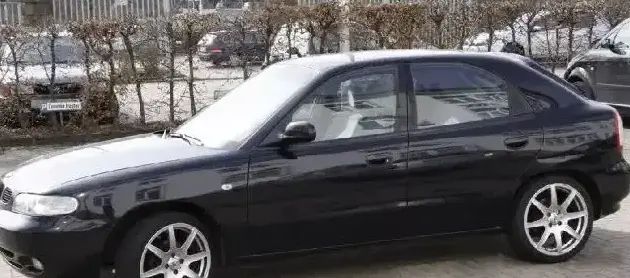
The Daewoo Nubira III 1.6 i 16V Automatic, produced between 2004 and 2005, represented a mid-cycle offering within the third generation (Nubira III) of Daewoo’s compact sedan. Positioned as a mainstream, family-oriented vehicle, the Nubira aimed to provide affordable transportation with a reasonable level of comfort and features. This particular variant, equipped with the 1.6-liter engine and a four-speed automatic transmission, served as a key volume seller, appealing to buyers prioritizing ease of use over outright performance. It was part of the J-platform family of vehicles, shared with other GM subsidiaries after Daewoo’s acquisition by General Motors in 2002.
Technical Specifications
| Brand | Daewoo |
| Model | Nubira |
| Generation | Nubira III |
| Type (Engine) | 1.6 i 16V (110 Hp) Automatic |
| Start of production | 2004 |
| End of production | 2005 |
| Powertrain Architecture | Internal Combustion engine |
| Body type | Sedan |
| Seats | 5 |
| Doors | 4 |
| Fuel consumption (urban) | 9.1 l/100 km (25.8 US mpg) |
| Fuel consumption (extra urban) | 6 l/100 km (39.2 US mpg) |
| Fuel consumption (combined) | 8.1 l/100 km (29 US mpg) |
| Fuel Type | Petrol (Gasoline) |
| Acceleration 0 – 100 km/h | 14.3 sec |
| Acceleration 0 – 62 mph | 14.3 sec |
| Acceleration 0 – 60 mph | 13.6 sec |
| Maximum speed | 176 km/h (109.36 mph) |
| Weight-to-power ratio | 10.7 kg/Hp |
| Weight-to-torque ratio | 7.9 kg/Nm |
| Power | 110 Hp @ 5800 rpm |
| Torque | 150 Nm @ 4000 rpm (110.63 lb.-ft. @ 4000 rpm) |
| Engine layout | Front, Transverse |
| Engine Model/Code | F16D3 |
| Engine displacement | 1598 cm3 (97.52 cu. in.) |
| Number of cylinders | 4 |
| Engine configuration | Inline |
| Cylinder Bore | 79 mm (3.11 in.) |
| Piston Stroke | 81.5 mm (3.21 in.) |
| Compression ratio | 9.5:1 |
| Number of valves per cylinder | 4 |
| Fuel injection system | Multi-port manifold injection |
| Engine aspiration | Naturally aspirated engine |
| Valvetrain | DOHC |
| Engine oil capacity | 3.75 l (3.96 US qt | 3.3 UK qt) |
| Coolant capacity | 7.2 l (7.61 US qt | 6.34 UK qt) |
| Kerb Weight | 1180 kg (2601.45 lbs.) |
| Max. weight | 1660 kg (3659.67 lbs.) |
| Max load | 480 kg (1058.22 lbs.) |
| Trunk (boot) space – minimum | 404 l (14.27 cu. ft.) |
| Fuel tank capacity | 60 l (15.85 US gal | 13.2 UK gal) |
| Length | 4500 mm (177.17 in.) |
| Width | 1725 mm (67.91 in.) |
| Height | 1445 mm (56.89 in.) |
| Wheelbase | 2600 mm (102.36 in.) |
| Front track | 1480 mm (58.27 in.) |
| Rear (Back) track | 1480 mm (58.27 in.) |
| Drivetrain Architecture | Front wheel drive |
| Number of gears and type of gearbox | 4 gears, automatic transmission |
| Front suspension | Spring Strut |
| Rear suspension | Double wishbone |
| Front brakes | Ventilated discs |
| Rear brakes | Disc |
| Assisting systems | ABS (Anti-lock braking system) |
| Steering type | Steering rack and pinion |
| Tires size | 195/55 R14 |
| Wheel rims size | 6Jx14 |
Powertrain & Engine Architecture
The Nubira III 1.6 i Automatic utilized the Daewoo-developed (later GM) F16D3 engine. This 1.6-liter inline-four cylinder engine featured a double overhead camshaft (DOHC) valvetrain with four valves per cylinder, contributing to improved breathing and efficiency. The engine employed multi-point fuel injection, delivering fuel directly to each intake port. The F16D3 produced 110 horsepower at 5800 rpm and 150 Nm (110.63 lb-ft) of torque at 4000 rpm. Paired with this engine was a four-speed automatic transmission, a common choice for buyers seeking convenience. This transmission, while providing smooth shifts, wasn’t known for its sportiness or fuel efficiency compared to more modern automatic gearboxes. The engine’s design prioritized reliability and affordability over cutting-edge performance.
Driving Characteristics
The 1.6-liter engine and four-speed automatic combination in the Nubira III delivered adequate, but not exhilarating, performance. Acceleration from 0-60 mph took approximately 13.6 seconds, and top speed was around 109 mph. The automatic transmission’s gear ratios were geared towards fuel economy and smooth cruising rather than quick acceleration. Compared to the manual transmission versions of the Nubira, the automatic felt noticeably slower. The power delivery was linear, but the engine lacked the low-end torque found in larger displacement engines. In typical driving situations, the Nubira 1.6 Automatic provided sufficient power for everyday commuting and highway driving, but overtaking maneuvers required careful planning. The steering was light and easy, making it suitable for urban environments.
Equipment & Trim Levels
The Nubira III 1.6 i Automatic typically came with a standard equipment list that included air conditioning, power windows, power door locks, and a basic audio system. Interior upholstery was usually cloth, with a relatively simple dashboard layout. Optional extras included alloy wheels, a sunroof, and an upgraded audio system. The trim level for this variant generally fell into the mid-range of the Nubira lineup, offering a balance between affordability and features. It was positioned above the base models, which often lacked air conditioning and power accessories, but below the higher-spec trims that offered leather upholstery and more advanced features.
Chassis & Braking
The Nubira III utilized a front-wheel-drive layout with a MacPherson strut suspension in the front and a double wishbone suspension in the rear. The front brakes were ventilated discs, providing adequate stopping power, while the rear brakes were solid discs. ABS (Anti-lock Braking System) was standard, enhancing safety. The suspension tuning was geared towards comfort, providing a relatively smooth ride over uneven surfaces. The chassis was designed to provide a stable and predictable handling experience, although it wasn’t particularly sporty. Stabilizer bars were included, but were relatively thin compared to those found on performance-oriented vehicles.
Market Reception & Comparison
The Daewoo Nubira III 1.6 i Automatic was generally well-received as an affordable and practical family sedan. Critics noted its spacious interior, comfortable ride, and reasonable fuel economy. However, the engine’s lack of power and the automatic transmission’s sluggishness were common criticisms. Compared to other compact sedans available at the time, such as the Honda Civic and Toyota Corolla, the Nubira offered a lower price point but lacked the same level of refinement and performance. Fuel economy was competitive, averaging around 29 US mpg in combined driving. Reliability was generally considered average, with some reports of minor electrical issues.
Legacy
The Daewoo Nubira III 1.6 i Automatic, while not a standout performer, remains a relatively affordable and accessible used car option. The F16D3 engine is known for its durability, and with proper maintenance, can provide many years of reliable service. However, finding replacement parts can sometimes be challenging due to Daewoo’s limited presence in the US market after the GM acquisition. Today, these vehicles are often sought after by budget-conscious buyers looking for a simple and dependable mode of transportation. The Nubira III represents a transitional period for the brand, bridging the gap between Daewoo’s independent operation and its integration into the General Motors portfolio.