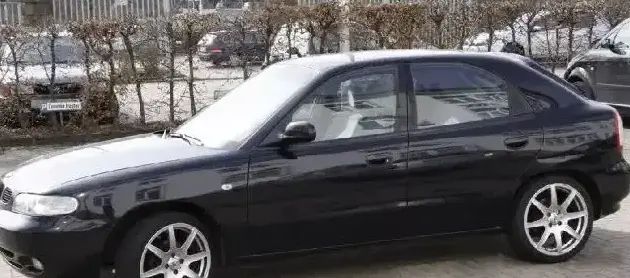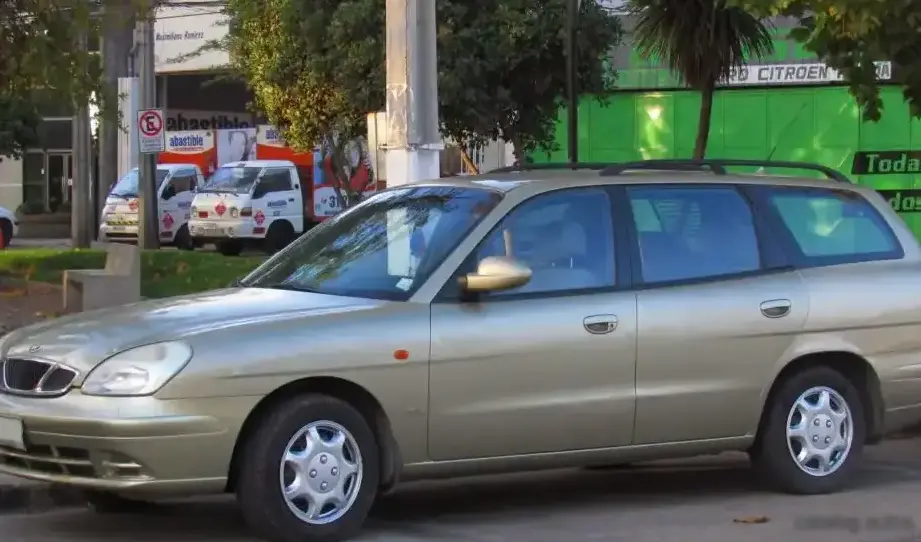
The Daewoo Nubira Wagon II 1.6 i Automatic, produced between 2001 and 2004, represented a practical and affordable option within the compact station wagon segment. Part of the second generation Nubira (J100 series), this variant aimed to provide family-oriented transportation with a focus on comfort and ease of use. It was primarily marketed in Europe and select international markets, offering a budget-friendly alternative to more established European brands. The Nubira Wagon II, in general, was Daewoo’s attempt to gain a foothold in the competitive European estate car market, offering a spacious interior and a large cargo area at a competitive price point.
Technical Specifications
| Brand | Daewoo |
| Model | Nubira |
| Generation | Nubira Wagon II |
| Type (Engine) | 1.6 i (106 Hp) Automatic |
| Start of production | 2001 |
| End of production | 2004 |
| Powertrain Architecture | Internal Combustion engine |
| Body type | Station wagon (estate) |
| Seats | 5 |
| Doors | 5 |
| Fuel consumption (urban) | 10.5 l/100 km (22.4 US mpg) |
| Fuel consumption (extra urban) | 6.2 l/100 km (37.9 US mpg) |
| Fuel consumption (combined) | 7.8 l/100 km (30.2 US mpg) |
| Fuel Type | Petrol (Gasoline) |
| Acceleration 0 – 100 km/h | 11 sec |
| Acceleration 0 – 62 mph | 11 sec |
| Acceleration 0 – 60 mph | 10.5 sec |
| Maximum speed | 175 km/h (108.74 mph) |
| Weight-to-power ratio | 12.4 kg/Hp |
| Weight-to-torque ratio | 9.1 kg/Nm |
| Power | 106 Hp @ 6000 rpm |
| Torque | 145 Nm @ 3400 rpm (106.95 lb.-ft. @ 3400 rpm) |
| Engine layout | Front, Transverse |
| Engine displacement | 1598 cm3 (97.52 cu. in.) |
| Number of cylinders | 4 |
| Engine configuration | Inline |
| Cylinder Bore | 79 mm (3.11 in.) |
| Piston Stroke | 81.5 mm (3.21 in.) |
| Compression ratio | 9.5:1 |
| Number of valves per cylinder | 4 |
| Fuel injection system | Multi-port manifold injection |
| Engine aspiration | Naturally aspirated engine |
| Valvetrain | OHC |
| Engine oil capacity | 3.75 l (3.96 US qt | 3.3 UK qt) |
| Kerb Weight | 1313 kg (2894.67 lbs.) |
| Max. weight | 1860 kg (4100.6 lbs.) |
| Max load | 547 kg (1205.93 lbs.) |
| Trunk (boot) space – minimum | 412 l (14.55 cu. ft.) |
| Trunk (boot) space – maximum | 1448 l (51.14 cu. ft.) |
| Fuel tank capacity | 62 l (16.38 US gal | 13.64 UK gal) |
| Length | 4550 mm (179.13 in.) |
| Width | 1720 mm (67.72 in.) |
| Height | 1430 mm (56.3 in.) |
| Wheelbase | 2570 mm (101.18 in.) |
| Front track | 1464 mm (57.64 in.) |
| Rear (Back) track | 1464 mm (57.64 in.) |
| Drivetrain Architecture | The Internal combustion engine (ICE) drives the front wheels of the vehicle. |
| Drive wheel | Front wheel drive |
| Number of gears and type of gearbox | 4 gears, automatic transmission |
| Front suspension | Wishbone |
| Rear suspension | Wishbone |
| Front brakes | Disc |
| Rear brakes | Drum |
| Assisting systems | ABS (Anti-lock braking system) |
| Steering type | Steering rack and pinion |
| Power steering | Hydraulic Steering |
| Tires size | 185/65 R14 |
| Wheel rims size | 5.5J x 14 |
Powertrain & Engine Architecture
The Nubira Wagon II 1.6 i Automatic was powered by Daewoo’s 1.6-liter inline-four cylinder engine. This engine, often identified by its internal code, was a relatively simple design featuring a single overhead camshaft (SOHC) valvetrain with four valves per cylinder. The engine utilized a multi-point fuel injection system, providing adequate fuel delivery for its modest power output. The 1598cc engine produced 106 horsepower at 6000 rpm and 145 Nm (107 lb-ft) of torque at 3400 rpm. The engine’s design prioritized fuel efficiency and reliability over outright performance. The four-speed automatic transmission was a conventional hydraulic unit, chosen for its smoothness and ease of use, catering to the target audience who prioritized comfort over sporty driving dynamics.
Driving Characteristics
The 1.6-liter engine paired with the four-speed automatic transmission delivered adequate, but not exhilarating, performance. Acceleration from 0 to 60 mph took approximately 10.5 seconds, and the top speed was around 108 mph. The automatic transmission’s gear ratios were tuned for fuel economy and smooth cruising, rather than aggressive acceleration. Compared to the manual transmission versions of the Nubira, the automatic suffered a slight performance penalty. Higher-output engine options, such as the 1.8-liter, offered significantly more responsive acceleration. The car felt best suited for relaxed highway driving and city commuting, where its comfortable ride and easy-to-use transmission were most appreciated.
Equipment & Trim Levels
The 1.6 i Automatic trim level typically represented the entry-level or mid-range offering in the Nubira Wagon II lineup. Standard equipment generally included power steering, central locking, electric front windows, and an AM/FM radio. Air conditioning was often an optional extra. Interior upholstery was typically cloth, with a relatively basic dashboard layout. Higher trim levels offered features like alloy wheels, upgraded audio systems, and additional safety equipment. The focus of this trim was providing essential features at an affordable price point.
Chassis & Braking
The Nubira Wagon II utilized a front-wheel-drive layout with independent wishbone suspension at the front and a semi-independent wishbone suspension at the rear. The front brakes were disc brakes, providing adequate stopping power, while the rear brakes were drum brakes, a cost-saving measure common in this class of vehicle. ABS (Anti-lock Braking System) was often included as standard equipment, enhancing safety. The suspension was tuned for comfort, providing a relatively soft ride quality. Stabilizer bars were present, but were relatively thin compared to sportier models, further emphasizing the car’s comfort-oriented nature.
Market Reception & Comparison
The Daewoo Nubira Wagon II 1.6 i Automatic was generally well-received as a practical and affordable family car. Critics praised its spacious interior, large cargo area, and competitive price. However, the 1.6-liter engine was often criticized for being underpowered, particularly when paired with the automatic transmission. Compared to other trims in the Nubira lineup, the 1.6 i Automatic offered the best fuel economy but the lowest performance. It competed with other compact station wagons like the Ford Focus Estate, Opel/Vauxhall Astra Estate, and Renault Megane Estate, often undercutting them on price.
Legacy
The Daewoo Nubira Wagon II, while not a groundbreaking vehicle, provided reliable and affordable transportation for many owners. The 1.6-liter engine and four-speed automatic transmission proved to be relatively durable, with many examples still on the road today. However, parts availability can be a challenge due to Daewoo’s eventual acquisition by General Motors and the subsequent discontinuation of the brand in many markets. In the used car market, these Nubiras are typically valued for their practicality and low purchase price, making them a budget-friendly option for those seeking a spacious and reliable station wagon. The car represents a snapshot of a time when Daewoo was attempting to establish itself as a major player in the European automotive market.