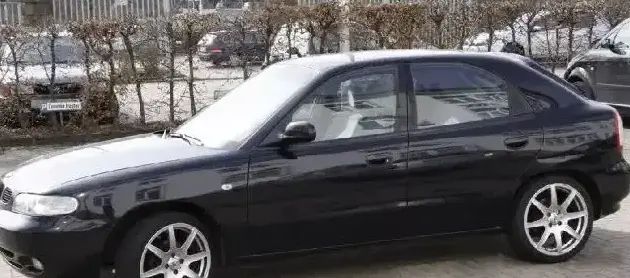
The Daewoo Nubira Wagon II 2.0, produced between 2001 and 2004, represented a practical and affordable option in the compact station wagon segment. Positioned as a mid-range offering within the Nubira Wagon II lineup, it aimed to provide family-oriented buyers with a spacious and versatile vehicle. The Nubira Wagon II, built upon the J100 platform, was Daewoo’s attempt to establish a stronger foothold in the European and global markets, offering a blend of practicality, value, and a relatively modern feature set for its price point. This particular 2.0-liter automatic variant was designed to appeal to drivers prioritizing ease of use and comfort over outright performance.
Technical Specifications
| Brand | Daewoo |
| Model | Nubira |
| Generation | Nubira Wagon II |
| Type (Engine) | 2.0 (133 Hp) Automatic |
| Start of production | 2001 |
| End of production | 2004 |
| Powertrain Architecture | Internal Combustion engine |
| Body type | Station wagon (estate) |
| Seats | 5 |
| Doors | 5 |
| Fuel consumption (urban) | 13.7 l/100 km (17.2 US mpg, 20.6 UK mpg, 7.3 km/l) |
| Fuel consumption (extra urban) | 6.9 l/100 km (34.1 US mpg, 40.9 UK mpg, 14.5 km/l) |
| Fuel consumption (combined) | 8.8 l/100 km (26.7 US mpg, 32.1 UK mpg, 11.4 km/l) |
| Fuel Type | Petrol (Gasoline) |
| Acceleration 0 – 100 km/h | 11.5 sec |
| Acceleration 0 – 62 mph | 11.5 sec |
| Acceleration 0 – 60 mph | 10.9 sec |
| Maximum speed | 183 km/h (113.71 mph) |
| Weight-to-power ratio | 9.9 kg/Hp, 100.6 Hp/tonne |
| Weight-to-torque ratio | 7.2 kg/Nm, 139.2 Nm/tonne |
| Power | 133 Hp @ 5400 rpm |
| Power per litre | 66.6 Hp/l |
| Torque | 184 Nm @ 4400 rpm (135.71 lb.-ft. @ 4400 rpm) |
| Engine layout | Front, Transverse |
| Engine displacement | 1998 cm3 (121.93 cu. in.) |
| Number of cylinders | 4 |
| Engine configuration | Inline |
| Cylinder Bore | 86 mm (3.39 in.) |
| Piston Stroke | 86 mm (3.39 in.) |
| Compression ratio | 9.6:1 |
| Number of valves per cylinder | 4 |
| Fuel injection system | Multi-port manifold injection |
| Engine aspiration | Naturally aspirated engine |
| Valvetrain | DOHC |
| Kerb Weight | 1322 kg (2914.51 lbs.) |
| Max. weight | 1860 kg (4100.6 lbs.) |
| Max load | 538 kg (1186.09 lbs.) |
| Trunk (boot) space – minimum | 412 l (14.55 cu. ft.) |
| Trunk (boot) space – maximum | 1448 l (51.14 cu. ft.) |
| Fuel tank capacity | 62 l (16.38 US gal | 13.64 UK gal) |
| Length | 4550 mm (179.13 in.) |
| Width | 1720 mm (67.72 in.) |
| Height | 1430 mm (56.3 in.) |
| Wheelbase | 2570 mm (101.18 in.) |
| Front track | 1464 mm (57.64 in.) |
| Rear (Back) track | 1464 mm (57.64 in.) |
| Drivetrain Architecture | The Internal combustion engine (ICE) drives the front wheels of the vehicle. |
| Drive wheel | Front wheel drive |
| Number of gears and type of gearbox | 4 gears, automatic transmission |
| Front suspension | Wishbone |
| Rear suspension | Wishbone |
| Front brakes | Disc |
| Rear brakes | Drum |
| Assisting systems | ABS (Anti-lock braking system) |
| Steering type | Steering rack and pinion |
| Power steering | Hydraulic Steering |
| Tires size | 185/65 R14 |
| Wheel rims size | 5.5J x 14 |
Powertrain & Engine Architecture
The Nubira Wagon II 2.0 Automatic was powered by Daewoo’s 1998cc inline-four cylinder engine. This engine, often identified by its internal codes, utilized a multi-port fuel injection system to deliver fuel to the cylinders. The engine featured a double overhead camshaft (DOHC) valvetrain, contributing to improved breathing and efficiency compared to older single overhead cam designs. The 9.6:1 compression ratio was a typical value for naturally aspirated engines of this era, balancing performance and fuel economy. Paired with this engine was a four-speed automatic transmission, designed for smooth and convenient operation. While not offering the responsiveness of a manual gearbox, the automatic transmission catered to drivers seeking a more relaxed driving experience. The transmission’s gear ratios were tuned for everyday drivability, prioritizing fuel efficiency and comfortable cruising over rapid acceleration.
Driving Characteristics
The 133 horsepower and 184 Nm (136 lb-ft) of torque produced by the 2.0-liter engine provided adequate, though not exhilarating, performance. Acceleration from 0 to 60 mph took approximately 10.9 seconds, and the car had a top speed of around 114 mph. Compared to the manual transmission version of the same engine, the automatic suffered a slight performance penalty due to the inherent losses within the torque converter. However, the automatic offered a smoother and more forgiving driving experience, particularly in urban traffic. The four-speed automatic transmission, while adequate, lacked the closer gear ratios of more modern transmissions, which could result in the engine feeling strained during aggressive acceleration or when climbing hills. The suspension, tuned for comfort, provided a reasonably compliant ride, but handling was not particularly sporty.
Equipment & Trim Levels
The 2.0 Automatic trim level of the Nubira Wagon II typically included features such as air conditioning, power windows, power door locks, and a basic audio system. Interior upholstery was generally cloth, with options for upgraded materials available. Dashboard design was functional and straightforward, prioritizing usability over aesthetic flair. Optional extras could include alloy wheels, a sunroof, and an upgraded audio system with a CD player. Safety features were relatively basic for the time, typically including ABS brakes and driver and passenger airbags. The Nubira Wagon II aimed to provide a good level of standard equipment for its price point, making it an attractive option for budget-conscious buyers.
Chassis & Braking
The Nubira Wagon II utilized a front-wheel-drive layout with independent wishbone suspension at all four corners. This suspension setup provided a reasonable balance between ride comfort and handling. The front brakes were disc brakes, offering better stopping power than the drum brakes used on the rear wheels. ABS (Anti-lock Braking System) was standard, enhancing safety by preventing wheel lockup during hard braking. Steering was rack and pinion, providing reasonably precise control. The chassis was designed to maximize interior space and practicality, resulting in a relatively large footprint for a compact station wagon.
Market Reception & Comparison
The Daewoo Nubira Wagon II 2.0 Automatic received mixed reviews from automotive critics. While praised for its spacious interior, practicality, and affordability, it was often criticized for its unremarkable performance and somewhat bland styling. Compared to other station wagons in its class, such as the Ford Focus Wagon or the Opel/Vauxhall Astra Estate, the Nubira Wagon II offered a more affordable price point but lacked the refinement and driving dynamics of its European competitors. Fuel economy was average for the class, and reliability was generally considered to be acceptable, though parts availability could be an issue in some markets following General Motors’ acquisition of Daewoo.
Legacy
The Daewoo Nubira Wagon II, while not a groundbreaking vehicle, served as a reasonably reliable and practical family car for many owners. The 2.0-liter engine, when properly maintained, proved to be durable and long-lasting. Today, the Nubira Wagon II is a relatively rare sight on the roads, but it retains a following among enthusiasts who appreciate its affordability and practicality. Used examples are typically inexpensive to purchase, but finding parts can be challenging. The Nubira Wagon II represents a transitional period for Daewoo/Chevrolet, as the brand sought to establish itself as a global player in the automotive market.