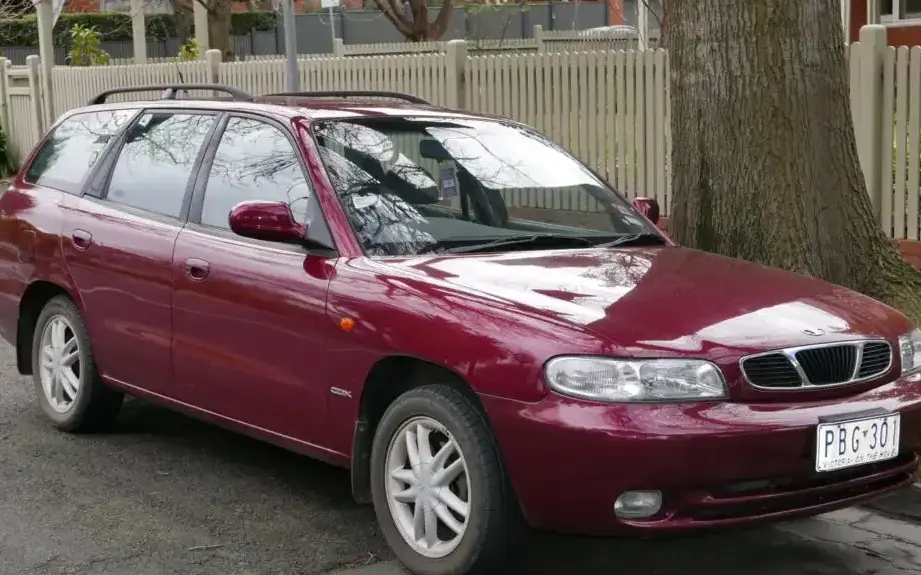
Technical Specifications
| Brand | Daewoo |
| Model | Nubira |
| Generation | Nubira Wagon (KLAJ) |
| Type (Engine) | 1.6 i 16V (106 Hp) |
| Start of production | 1997 |
| End of production | 2001 |
| Powertrain Architecture | Internal Combustion engine |
| Body type | Station wagon (estate) |
| Seats | 5 |
| Doors | 5 |
| Fuel consumption (urban) | 12.1 l/100 km (19.4 US mpg) |
| Fuel consumption (extra urban) | 7 l/100 km (33.6 US mpg) |
| Fuel Type | Petrol (Gasoline) |
| Acceleration 0 – 100 km/h | 11 sec |
| Acceleration 0 – 62 mph | 11 sec |
| Acceleration 0 – 60 mph | 10.5 sec |
| Maximum speed | 175 km/h (108.74 mph) |
| Weight-to-power ratio | 10.8 kg/Hp |
| Weight-to-torque ratio | 7.9 kg/Nm |
| Power | 106 Hp @ 6000 rpm |
| Torque | 145 Nm @ 3400 rpm (106.95 lb.-ft. @ 3400 rpm) |
| Engine layout | Front, Transverse |
| Engine Model/Code | A16DMS |
| Engine displacement | 1598 cm3 (97.52 cu. in.) |
| Number of cylinders | 4 |
| Engine configuration | Inline |
| Cylinder Bore | 79 mm (3.11 in.) |
| Piston Stroke | 81.5 mm (3.21 in.) |
| Compression ratio | 9:1 |
| Number of valves per cylinder | 4 |
| Fuel injection system | Multi-port manifold injection |
| Engine aspiration | Naturally aspirated engine |
| Valvetrain | DOHC |
| Engine oil capacity | 3.75 l (3.96 US qt | 3.3 UK qt) |
| Kerb Weight | 1140 kg (2513.27 lbs.) |
| Max. weight | 1860 kg (4100.6 lbs.) |
| Max load | 720 kg (1587.33 lbs.) |
| Trunk (boot) space – minimum | 412 l (14.55 cu. ft.) |
| Trunk (boot) space – maximum | 840 l (29.66 cu. ft.) |
| Fuel tank capacity | 62 l (16.38 US gal | 13.64 UK gal) |
| Length | 4550 mm (179.13 in.) |
| Width | 1720 mm (67.72 in.) |
| Height | 1470 mm (57.87 in.) |
| Wheelbase | 2570 mm (101.18 in.) |
| Front track | 1464 mm (57.64 in.) |
| Rear (Back) track | 1454 mm (57.24 in.) |
| Drivetrain Architecture | The Internal combustion engine (ICE) drives the front wheels of the vehicle. |
| Drive wheel | Front wheel drive |
| Number of gears and type of gearbox | 5 gears, manual transmission |
| Front suspension | Coil spring |
| Rear suspension | Coil spring |
| Front brakes | Ventilated discs |
| Rear brakes | Drum |
| Steering type | Steering rack and pinion |
| Power steering | Hydraulic Steering |
| Tires size | 185/65 R14 |
| Wheel rims size | 5.5J x 14 |
The Daewoo Nubira Wagon, specifically the KLAJ series produced between 1997 and 2001, represented Daewoo’s attempt to gain traction in the competitive compact station wagon segment. Positioned as a practical and affordable family vehicle, the 1.6 i 16V variant with 106 horsepower aimed to provide a balance between fuel efficiency and usability. This model was primarily marketed in Europe and other international markets, offering a spacious interior and a large cargo area within a relatively compact footprint. The Nubira Wagon was built on the J-platform, shared with other GM vehicles of the era, and served as a key model in Daewoo’s attempt to establish a stronger foothold in the global automotive market.
Powertrain & Engine Architecture
The heart of the Nubira Wagon 1.6 i 16V was the A16DMS engine, a 1.6-liter inline-four cylinder gasoline engine. This engine featured a double overhead camshaft (DOHC) valvetrain operating four valves per cylinder, contributing to improved breathing and higher-end power delivery. The A16DMS utilized a multi-port fuel injection system, delivering fuel directly to each intake port for precise fuel metering and efficient combustion. With a compression ratio of 9:1, the engine was designed to run on regular unleaded gasoline. The engine produced 106 horsepower at 6000 rpm and 145 Nm (106.95 lb-ft) of torque at 3400 rpm. The engine was transversely mounted in the front of the vehicle, driving the front wheels. A five-speed manual transmission was standard, although a four-speed automatic transmission was also available, impacting performance and fuel economy.
Driving Characteristics
The 1.6-liter engine, paired with the five-speed manual transmission, provided adequate, though not exhilarating, performance. Acceleration from 0 to 60 mph took approximately 10.5 seconds, and the top speed was around 108.74 mph. The engine felt relatively responsive in the mid-range, making it suitable for everyday driving and highway cruising. The automatic transmission option, while offering convenience, noticeably reduced acceleration and increased fuel consumption. Gear ratios were tuned for fuel efficiency rather than outright performance. Compared to the higher-output engines available in the Nubira range, such as the 2.0-liter variants, the 1.6L felt less powerful, particularly when fully loaded with passengers and cargo. However, the lighter engine weight contributed to slightly better handling and fuel economy.
Equipment & Trim Levels
The 1.6 i 16V Nubira Wagon typically came with a modest level of standard equipment. Base models generally included power steering, central locking, and an AM/FM radio. Interior upholstery was typically cloth, with a relatively simple dashboard layout. Optional extras included air conditioning, power windows, and an upgraded audio system. Higher trim levels, often denoted by specific package names, added features like alloy wheels, a sunroof, and more luxurious interior appointments. The Nubira Wagon aimed to provide a good value proposition, offering essential features at a competitive price point.
Chassis & Braking
The Nubira Wagon utilized a conventional chassis design with coil spring suspension at all four wheels. The front suspension featured MacPherson struts, while the rear employed a multi-link setup. This suspension configuration aimed to provide a comfortable ride and reasonable handling characteristics. Braking duties were handled by ventilated discs at the front and drum brakes at the rear. The braking system was adequate for everyday use, but lacked the stopping power of more advanced systems found in higher-performance vehicles. Stabilizer bars were included to reduce body roll during cornering, improving handling stability.
Market Reception & Comparison
The Daewoo Nubira Wagon 1.6 i 16V was generally well-received as a practical and affordable family vehicle. Critics praised its spacious interior, large cargo area, and competitive price. However, the engine was often criticized for being underpowered, particularly when compared to rivals in the segment. Fuel economy was considered average for its class. Compared to other trims in the Nubira lineup, the 1.6L offered the most affordable entry point, appealing to budget-conscious buyers. The higher-output engines provided more performance but came at a higher cost. Reliability was generally considered acceptable, although some owners reported minor issues with the engine and electrical systems.
Legacy
The Daewoo Nubira Wagon, including the 1.6 i 16V variant, has become a relatively affordable and readily available used car. The A16DMS engine is known for its relative simplicity and ease of maintenance, making it a popular choice for DIY mechanics. While not known for exceptional performance or luxury, the Nubira Wagon remains a practical and reliable option for those seeking an affordable station wagon. Parts availability can be a challenge in some regions, as Daewoo ceased to exist as an independent brand. However, many parts are interchangeable with other GM vehicles, simplifying maintenance and repair. The Nubira Wagon represents a significant chapter in Daewoo’s history, showcasing the brand’s attempt to compete in the global automotive market.