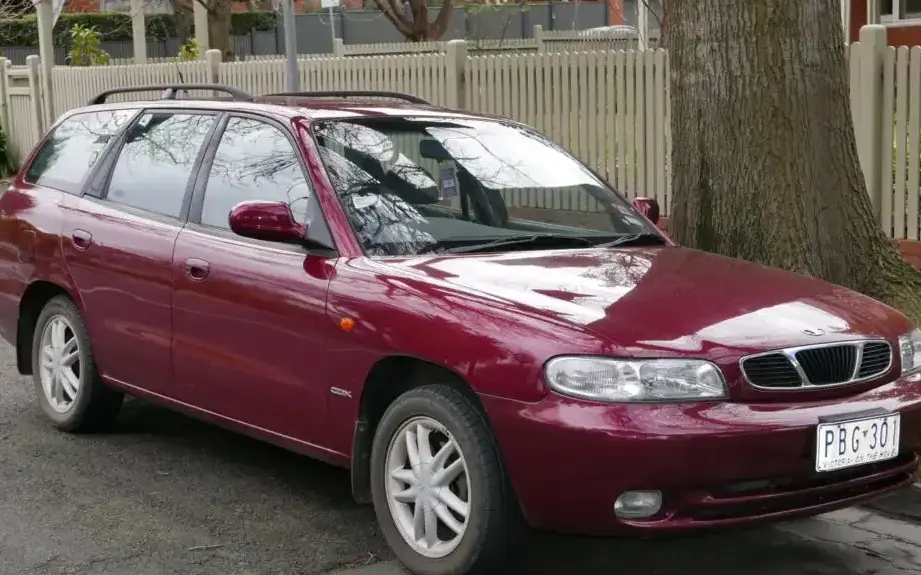
The Daewoo Nubira Wagon, specifically the KLAJ generation produced between 1997 and 2001, represented Daewoo’s entry into the competitive compact station wagon segment. Positioned as a practical and affordable family vehicle, the Nubira Wagon aimed to offer a spacious interior and generous cargo capacity. The 2.0-liter 16-valve engine, producing 133 horsepower, was a mid-range offering within the Nubira lineup, slotting above the base 1.6-liter engine and below any potential higher-performance variants. This model was primarily marketed in Europe and select international markets, as Daewoo’s presence in the North American market was limited during this period. The KLAJ Nubira Wagon was built upon the J-platform, shared with other GM vehicles of the era.
Technical Specifications
| Brand | Daewoo |
| Model | Nubira |
| Generation | Nubira Wagon (KLAJ) |
| Type (Engine) | 2.0 16V (133 Hp) |
| Start of production | 1997 |
| End of production | 2001 |
| Powertrain Architecture | Internal Combustion engine |
| Body type | Station wagon (estate) |
| Seats | 5 |
| Doors | 5 |
| Fuel consumption (urban) | 15.1 l/100 km (15.6 US mpg, 18.7 UK mpg, 6.6 km/l) |
| Fuel consumption (extra urban) | 7.4 l/100 km (31.8 US mpg, 38.2 UK mpg, 13.5 km/l) |
| Fuel Type | Petrol (Gasoline) |
| Acceleration 0 – 100 km/h | 9 sec |
| Acceleration 0 – 62 mph | 9 sec |
| Acceleration 0 – 60 mph | 8.6 sec |
| Maximum speed | 185 km/h (114.95 mph) |
| Weight-to-power ratio | 8.9 kg/Hp, 112.7 Hp/tonne |
| Weight-to-torque ratio | 6.4 kg/Nm, 155.9 Nm/tonne |
| Power | 133 Hp @ 5400 rpm |
| Power per litre | 66.6 Hp/l |
| Torque | 184 Nm @ 4400 rpm (135.71 lb.-ft. @ 4400 rpm) |
| Engine layout | Front, Transverse |
| Engine Model/Code | X20SED |
| Engine displacement | 1998 cm3 (121.93 cu. in.) |
| Number of cylinders | 4 |
| Engine configuration | Inline |
| Cylinder Bore | 86 mm (3.39 in.) |
| Piston Stroke | 86 mm (3.39 in.) |
| Compression ratio | 9.6:1 |
| Number of valves per cylinder | 4 |
| Fuel injection system | Multi-port manifold injection |
| Engine aspiration | Naturally aspirated engine |
| Valvetrain | DOHC |
| Engine oil capacity | 4 l (4.23 US qt | 3.52 UK qt) |
| Coolant capacity | 7 l (7.4 US qt | 6.16 UK qt) |
| Kerb Weight | 1180 kg (2601.45 lbs.) |
| Max. weight | 1860 kg (4100.6 lbs.) |
| Max load | 680 kg (1499.14 lbs.) |
| Trunk (boot) space – minimum | 412 l (14.55 cu. ft.) |
| Trunk (boot) space – maximum | 1448 l (51.14 cu. ft.) |
| Fuel tank capacity | 62 l (16.38 US gal | 13.64 UK gal) |
| Length | 4550 mm (179.13 in.) |
| Width | 1720 mm (67.72 in.) |
| Height | 1470 mm (57.87 in.) |
| Wheelbase | 2570 mm (101.18 in.) |
| Front track | 1464 mm (57.64 in.) |
| Rear (Back) track | 1454 mm (57.24 in.) |
| Drivetrain Architecture | The Internal combustion engine (ICE) drives the front wheels of the vehicle. |
| Drive wheel | Front wheel drive |
| Number of gears and type of gearbox | 5 gears, manual transmission |
| Front suspension | Coil spring |
| Rear suspension | Coil spring |
| Front brakes | Ventilated discs |
| Rear brakes | Disc |
| Assisting systems | ABS (Anti-lock braking system) |
| Steering type | Steering rack and pinion |
| Power steering | Hydraulic Steering |
| Wheel rims size | 5.5J |
Powertrain & Engine Architecture
The heart of the Nubira Wagon 2.0 was the X20SED engine, a 1.998-liter inline-four cylinder gasoline engine. This engine featured a dual overhead camshaft (DOHC) valvetrain with four valves per cylinder, contributing to its relatively good breathing characteristics for its time. Fuel delivery was handled by a multi-port fuel injection system, providing precise fuel metering for improved efficiency and reduced emissions. The engine’s 9.6:1 compression ratio was a typical value for naturally aspirated engines of this era. The engine was transversely mounted in the front of the vehicle, driving the front wheels. The five-speed manual transmission was the standard offering, providing a direct connection between the engine and the wheels. The transmission’s gear ratios were tuned for a balance of acceleration and fuel economy, though it wasn’t particularly sporty in its gearing.
Driving Characteristics
The 133 horsepower and 184 Nm (136 lb-ft) of torque offered by the 2.0-liter engine provided adequate, but not exhilarating, performance. Acceleration from 0 to 60 mph took around 8.6 seconds, making it competitive with other compact wagons of the late 1990s. The five-speed manual transmission allowed drivers to keep the engine in its optimal power band, but the engine lacked the low-end grunt of larger displacement engines. Compared to a hypothetical higher-output version, the 2.0-liter Nubira Wagon prioritized fuel economy and smooth operation over outright speed. The suspension was tuned for comfort, resulting in a relatively soft ride quality, but this also meant that handling was not particularly sharp. The steering, while hydraulically assisted, lacked feedback.
Equipment & Trim Levels
The Nubira Wagon 2.0 typically came equipped with features considered standard for a family vehicle of its time. These included power steering, central locking, electric front windows, and an AM/FM radio. Higher trim levels offered options such as air conditioning, alloy wheels, a sunroof, and upgraded interior upholstery. Interior materials were generally durable but not luxurious. The dashboard layout was functional and straightforward, prioritizing ease of use over aesthetic appeal. Safety features included a driver’s airbag and ABS anti-lock brakes.
Chassis & Braking
The Nubira Wagon utilized a relatively simple chassis design, featuring coil spring suspension at all four corners. The front suspension employed MacPherson struts, while the rear suspension used a twist beam setup. This configuration provided a comfortable ride but limited handling precision. Braking duties were handled by ventilated discs at the front and solid discs at the rear. The ABS system helped to maintain steering control during hard braking. The steering system was a rack-and-pinion setup, providing reasonable steering response.
Market Reception & Comparison
The Daewoo Nubira Wagon was generally well-received as a practical and affordable family vehicle. Critics praised its spacious interior and generous cargo capacity, but noted that its driving dynamics were not as refined as some of its competitors, such as the Ford Focus or Volkswagen Golf. Fuel economy was considered average for its class. Compared to the base 1.6-liter Nubira Wagon, the 2.0-liter version offered noticeably improved performance, making it a more suitable choice for drivers who frequently carried passengers or cargo. However, the 2.0-liter model was also more expensive to purchase and operate.
Legacy
The Daewoo Nubira Wagon, while not a groundbreaking vehicle, provided a solid and reliable transportation option for many families in the late 1990s and early 2000s. The X20SED engine proved to be reasonably durable, although regular maintenance was essential to prevent issues such as oil leaks and timing belt failures. Today, the Nubira Wagon is a relatively rare sight on the roads, but well-maintained examples are sought after by enthusiasts and collectors. Its affordability and practicality continue to make it an appealing option for those seeking a classic compact station wagon.