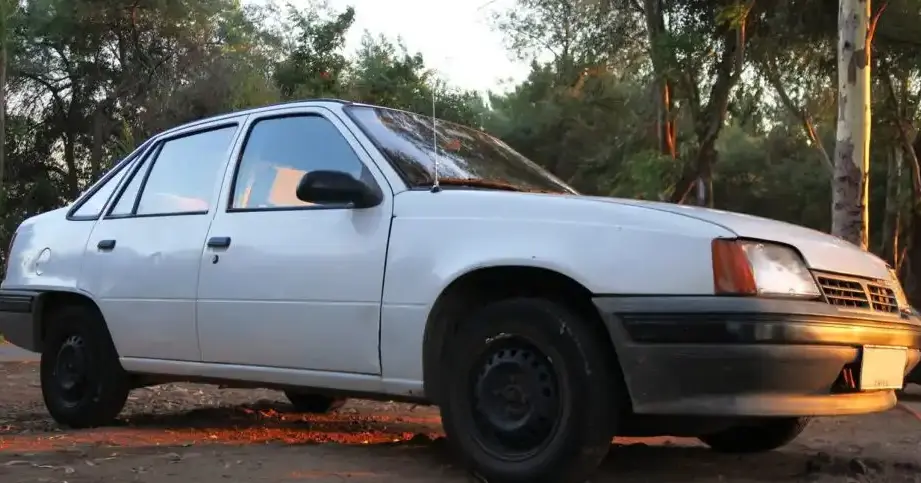
The Daewoo Racer, specifically the 2.0i hatchback variant producing 97 horsepower, represents a significant entry in the compact car market of the late 1980s and early 1990s. Produced from 1986 to 1995, the Racer was Daewoo’s initial foray into independent vehicle design and manufacturing, moving away from primarily assembling licensed models. This 2.0i version, positioned as a mid-range offering within the Racer lineup, aimed to provide a balance of performance and affordability, particularly appealing to buyers seeking a larger engine option in the subcompact class. The Racer was primarily marketed in South Korea, and also saw exports to select European and South American markets.
Technical Specifications
| Brand | Daewoo |
| Model | Racer |
| Generation | Racer Hatchback |
| Type (Engine) | 2.0i (97 Hp) |
| Start of production | 1986 |
| End of production | 1995 |
| Powertrain Architecture | Internal Combustion engine |
| Body type | Hatchback |
| Seats | 5 |
| Doors | 3 |
| Fuel Type | Petrol (Gasoline) |
| Weight-to-power ratio | 10.8 kg/Hp, 92.8 Hp/tonne |
| Weight-to-torque ratio | 6.5 kg/Nm, 153.1 Nm/tonne |
| Power | 97 Hp @ 4800 rpm |
| Power per litre | 48.5 Hp/l |
| Torque | 160 Nm @ 3600 rpm (118.01 lb.-ft. @ 3600 rpm) |
| Engine layout | Front, Transverse |
| Engine displacement | 1998 cm3 (121.93 cu. in.) |
| Number of cylinders | 4 |
| Engine configuration | Inline |
| Cylinder Bore | 86 mm (3.39 in.) |
| Piston Stroke | 86 mm (3.39 in.) |
| Compression ratio | 8.8:1 |
| Number of valves per cylinder | 2 |
| Fuel injection system | Single-point injection |
| Engine aspiration | Naturally aspirated engine |
| Valvetrain | OHC |
| Kerb Weight | 1045 kg (2303.83 lbs.) |
| Fuel tank capacity | 50 l (13.21 US gal | 11 UK gal) |
| Length | 4158 mm (163.7 in.) |
| Width | 1663 mm (65.47 in.) |
| Height | 1360 mm (53.54 in.) |
| Wheelbase | 2520 mm (99.21 in.) |
| Front track | 1400 mm (55.12 in.) |
| Rear track | 1406 mm (55.35 in.) |
| Drivetrain Architecture | The Internal combustion engine (ICE) drives the front wheels of the vehicle. |
| Drive wheel | Front wheel drive |
| Number of gears and type of gearbox | 5 gears, manual transmission |
| Front suspension | Wishbone |
| Rear suspension | Coil spring |
| Front brakes | Ventilated discs |
| Rear brakes | Drum |
| Assisting systems | ABS (Anti-lock braking system) |
| Steering type | Steering rack and pinion |
| Tires size | 175/70 R13 |
| Wheel rims size | 13 |
Powertrain & Engine Architecture
The heart of the Racer 2.0i is its 1998cc inline-four cylinder engine. This engine, often referred to by its internal code, utilized a single-point fuel injection system – a relatively common technology for the time, but less sophisticated than multi-point injection. The single injector delivered fuel into the intake manifold, rather than directly into each cylinder. The engine featured an overhead camshaft (OHC) valvetrain with two valves per cylinder. This configuration contributed to a reasonable balance of power and fuel efficiency. The 8.8:1 compression ratio was typical for engines of this era, designed to accommodate the quality of fuel available in various markets. The engine’s 97 horsepower output at 4800 rpm and 160 Nm (118 lb-ft) of torque at 3600 rpm provided adequate performance for everyday driving.
Driving Characteristics
The Racer 2.0i, with its 97 hp, offered a noticeable step up in performance compared to the smaller-engined variants. While not a sports car, the 2.0-liter engine provided sufficient power for confident overtaking and highway cruising. The five-speed manual transmission allowed drivers to effectively utilize the engine’s torque band. The gear ratios were fairly standard for the period, prioritizing fuel economy over outright acceleration. Compared to a potential future turbocharged or more modern engine, the Racer’s power delivery was linear but lacked the immediate response of more advanced systems. The front-wheel-drive configuration provided predictable handling, although it wasn’t particularly engaging for enthusiastic drivers.
Equipment & Trim Levels
The 2.0i trim level of the Racer typically included features such as a basic audio system, cloth upholstery, and manual windows and door locks. Air conditioning was often an optional extra. Interior plastics were durable but utilitarian, reflecting the car’s affordable positioning. The dashboard layout was functional, with clearly marked gauges for speed, fuel level, and engine temperature. Higher trim levels, if available in certain markets, might have added features like power windows, upgraded audio systems, and alloy wheels. However, the 2.0i was generally positioned as a well-equipped but not luxurious offering.
Chassis & Braking
The Racer’s chassis employed a front wishbone suspension and a rear coil spring setup. This configuration provided a comfortable ride quality, suitable for everyday commuting. The front brakes were ventilated discs, offering adequate stopping power, while the rear brakes were drums – a cost-saving measure common in vehicles of this class. An anti-lock braking system (ABS) was often included as standard equipment, enhancing safety. The steering utilized a rack and pinion system, providing reasonably precise control. The 175/70 R13 tires, mounted on 13-inch steel wheels, offered a good balance of grip and ride comfort.
Market Reception & Comparison
The Daewoo Racer 2.0i was generally well-received as a practical and affordable compact car. Critics praised its spacious interior and relatively comfortable ride. However, the single-point fuel injection system and somewhat dated engine technology were points of criticism compared to competitors offering multi-point injection or more modern engine designs. In terms of fuel economy, the 2.0i offered respectable figures for its class, but it wasn’t as efficient as the smaller-engined variants. Compared to other cars in its segment, such as the Ford Escort or Volkswagen Golf, the Racer offered a competitive price point but lacked the brand recognition and refinement of its European rivals.
Legacy
The Daewoo Racer, and particularly the 2.0i variant, holds a place in automotive history as a key model in Daewoo’s early efforts to establish itself as a global automaker. While Daewoo eventually faced financial difficulties and was acquired by General Motors, the Racer laid the foundation for the company’s future models. Today, the Racer 2.0i is a relatively rare sight on the roads, but it has gained a following among enthusiasts who appreciate its simplicity, affordability, and retro charm. The engine, while not particularly high-tech, proved to be reasonably durable and reliable, and parts availability remains adequate for those willing to maintain these classic vehicles. The Racer 2.0i represents a snapshot of automotive engineering from the late 1980s and early 1990s, offering a glimpse into a time when affordability and practicality were paramount.