
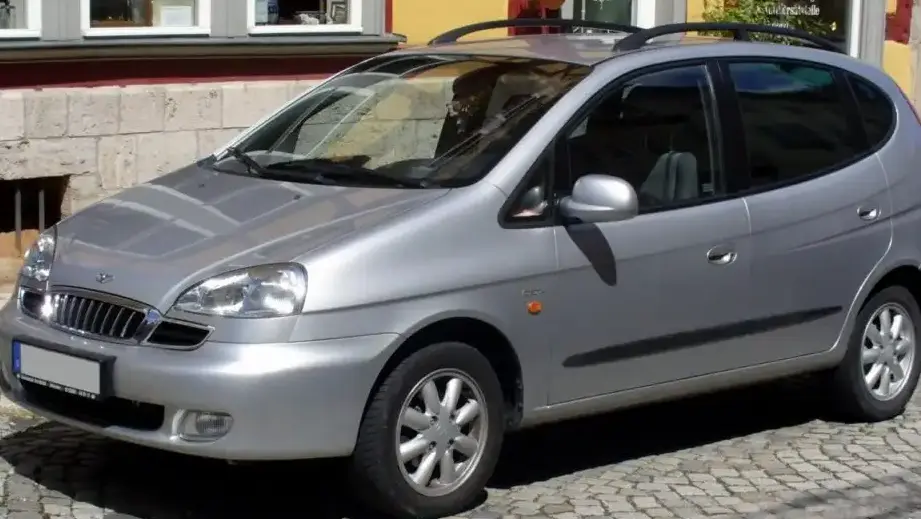
The Daewoo Rezzo, known as the Daewoo Tacuma in some European markets, was a compact minivan produced by the South Korean automaker Daewoo from 2001 to 2008. The Rezzo (KLAU) 1.6 i 16V, powered by the A16DMS engine producing 106 horsepower, represented a key offering in the Rezzo lineup, aiming for affordability and practicality within the burgeoning compact MPV segment. It was positioned as a family-oriented vehicle, offering seating for up to seven passengers in a relatively small footprint. The Rezzo was a product of Daewoo’s attempt to modernize its image and compete with established European and Japanese manufacturers in the multi-purpose vehicle (MPV) class.
Technical Specifications
| Brand | Daewoo |
| Model | Rezzo |
| Generation | Rezzo (KLAU) |
| Type (Engine) | 1.6 i 16V (106 Hp) |
| Start of production | 2001 |
| End of production | 2008 |
| Powertrain Architecture | Internal Combustion engine |
| Body type | Minivan |
| Seats | 7 |
| Doors | 5 |
| Fuel consumption (urban) | 11 l/100 km (21.4 US mpg) |
| Fuel consumption (extra urban) | 6.7 l/100 km (35.1 US mpg) |
| Fuel consumption (combined) | 8.3 l/100 km (28.3 US mpg) |
| Fuel Type | Petrol (Gasoline) |
| Acceleration 0 – 100 km/h | 11.8 sec |
| Acceleration 0 – 62 mph | 11.8 sec |
| Acceleration 0 – 60 mph | 11.2 sec |
| Maximum speed | 167 km/h (103.77 mph) |
| Weight-to-power ratio | 11.7 kg/Hp |
| Weight-to-torque ratio | 8.6 kg/Nm |
| Power | 106 Hp @ 6000 rpm |
| Torque | 145 Nm @ 3400 rpm (106.95 lb.-ft. @ 3400 rpm) |
| Engine layout | Front, Transverse |
| Engine Model/Code | A16DMS |
| Engine displacement | 1598 cm3 (97.52 cu. in.) |
| Number of cylinders | 4 |
| Engine configuration | Inline |
| Cylinder Bore | 79 mm (3.11 in.) |
| Piston Stroke | 81.5 mm (3.21 in.) |
| Compression ratio | 9:1 |
| Number of valves per cylinder | 4 |
| Fuel injection system | Multi-port manifold injection |
| Engine aspiration | Naturally aspirated engine |
| Valvetrain | DOHC |
| Engine oil capacity | 3.75 l (3.96 US qt | 3.3 UK qt) |
| Coolant capacity | 7.5 l (7.93 US qt | 6.6 UK qt) |
| Kerb Weight | 1245 kg (2744.76 lbs.) |
| Max. weight | 1825 kg (4023.44 lbs.) |
| Max load | 580 kg (1278.68 lbs.) |
| Trunk (boot) space – minimum | 347 l (12.25 cu. ft.) |
| Trunk (boot) space – maximum | 1425 l (50.32 cu. ft.) |
| Fuel tank capacity | 60 l (15.85 US gal | 13.2 UK gal) |
| Length | 4350 mm (171.26 in.) |
| Width | 1755 mm (69.09 in.) |
| Height | 1580 mm (62.2 in.) |
| Wheelbase | 2600 mm (102.36 in.) |
| Front track | 1476 mm (58.11 in.) |
| Rear track | 1480 mm (58.27 in.) |
| Drivetrain Architecture | Front wheel drive |
| Number of gears | 5 |
| Gearbox type | Manual transmission |
| Front suspension | Spring Strut |
| Rear suspension | Coil spring |
| Front brakes | Ventilated discs |
| Rear brakes | Disc |
| Assisting systems | ABS (Anti-lock braking system) |
| Steering type | Steering rack and pinion |
| Tires size | 185/70 R14 |
Powertrain & Engine Architecture
The heart of the Rezzo 1.6 i 16V was the A16DMS engine, a 1.6-liter inline-four cylinder gasoline engine. This engine featured a double overhead camshaft (DOHC) valvetrain with four valves per cylinder, contributing to its relatively efficient breathing. Fuel delivery was handled by a multi-point fuel injection system, a common setup for engines of this era. The A16DMS engine was known for its simplicity and relative reliability, though it wasn’t a powerhouse. The engine produced 106 horsepower at 6000 rpm and 145 Nm (106.95 lb-ft) of torque at 3400 rpm. This power was transmitted to the front wheels through a five-speed manual transmission. While an automatic transmission was offered in some markets, the 1.6L engine was often paired with the manual to maximize fuel economy and provide a more engaging driving experience.
Driving Characteristics
The Rezzo 1.6 i 16V with the manual transmission offered adequate, but not exhilarating, performance. Acceleration from 0 to 60 mph took around 11.2 seconds, and top speed was approximately 103.77 mph. The engine felt somewhat strained when fully loaded with passengers and luggage, particularly on inclines. The five-speed manual transmission was well-matched to the engine’s characteristics, providing reasonable gear spacing. Compared to higher-trim Rezzo models equipped with larger engines, the 1.6L felt noticeably less powerful. However, it offered a more economical driving experience, making it suitable for urban commuting and shorter trips. The suspension was tuned for comfort, providing a relatively smooth ride, but handling was not particularly sporty.
Equipment & Trim Levels
The Rezzo 1.6 i 16V typically came with a modest level of standard equipment. Base models generally included power steering, central locking, and basic audio system. Air conditioning was often an optional extra. Interior upholstery was typically cloth, and the dashboard featured a functional, if somewhat basic, design. Higher trim levels offered features such as alloy wheels, upgraded audio systems, and additional safety equipment. The Rezzo’s interior was designed with practicality in mind, offering flexible seating configurations to accommodate varying passenger and cargo needs. The third-row seats, while present, were best suited for children or short journeys.
Chassis & Braking
The Rezzo utilized a front-wheel-drive layout with a relatively simple suspension setup. The front suspension consisted of MacPherson struts, while the rear employed a coil spring arrangement. Braking duties were handled by ventilated discs at the front and solid discs at the rear. Anti-lock Braking System (ABS) was standard equipment, enhancing safety. The chassis was designed to prioritize ride comfort and interior space over sporty handling. The relatively lightweight construction of the Rezzo helped to offset the modest power output of the 1.6L engine.
Market Reception & Comparison
The Daewoo Rezzo 1.6 i 16V was generally well-received as an affordable and practical family vehicle. Critics praised its spacious interior and flexible seating arrangements. However, the engine’s performance was often cited as a weakness, particularly when compared to competitors from established European and Japanese brands. Fuel economy was considered reasonable for its class. Compared to other Rezzo trims, the 1.6L offered the most accessible price point, making it attractive to budget-conscious buyers. The 1.8L versions offered a noticeable performance improvement, but at a higher cost. The Rezzo competed with vehicles like the Renault Scenic, Citroën Xsara Picasso, and Opel/Vauxhall Zafira.
Legacy
The Daewoo Rezzo, while not a groundbreaking vehicle, played a role in establishing Daewoo (later Chevrolet) as a competitor in the European MPV market. The A16DMS engine proved to be reasonably reliable, and many examples of the Rezzo 1.6 i 16V remain on the road today. On the used car market, these models are typically valued for their affordability and practicality. Maintenance costs are generally low, thanks to the engine’s simplicity and the availability of spare parts. While not a collector’s item, the Rezzo 1.6 i 16V represents a practical and economical choice for those seeking a spacious and affordable family vehicle.
