
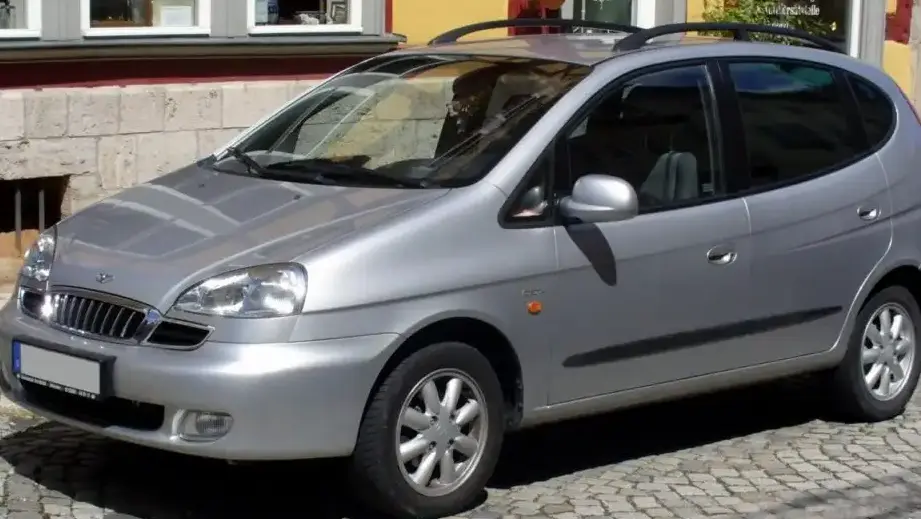
The Daewoo Rezzo 1.8 i, designated internally as the KLAU, was a five-door minivan produced by Daewoo Motors (later General Motors Daewoo) from 2000 to 2008. Positioned as a practical and affordable family vehicle, the Rezzo aimed to provide spaciousness and versatility in a compact package. This particular 1.8-liter, 101 horsepower variant with an automatic transmission represented a mid-range offering within the Rezzo lineup, balancing cost with convenience. It was primarily marketed towards families seeking a comfortable and economical people carrier, particularly in markets where Daewoo had a strong presence, such as South Korea and parts of Europe.
Technical Specifications
| Brand | Daewoo |
| Model | Rezzo |
| Generation | Rezzo (KLAU) |
| Type (Engine) | 1.8 i (101 Hp) |
| Start of production | 2000 |
| End of production | 2008 |
| Powertrain Architecture | Internal Combustion engine |
| Body type | Minivan |
| Seats | 5 |
| Doors | 5 |
| Fuel consumption (urban) | 12.5 l/100 km (18.8 US mpg, 22.6 UK mpg, 8 km/l) |
| Fuel consumption (extra urban) | 7.2 l/100 km (32.7 US mpg, 39.2 UK mpg, 13.9 km/l) |
| Fuel consumption (combined) | 9.3 l/100 km (25.3 US mpg, 30.4 UK mpg, 10.8 km/l) |
| Fuel Type | Petrol (Gasoline) |
| Acceleration 0 – 100 km/h | 12 sec |
| Acceleration 0 – 62 mph | 12 sec |
| Acceleration 0 – 60 mph | 11.4 sec |
| Maximum speed | 170 km/h (105.63 mph) |
| Weight-to-power ratio | 12.2 kg/Hp, 82.1 Hp/tonne |
| Weight-to-torque ratio | 8.4 kg/Nm, 118.7 Nm/tonne |
| Power | 101 Hp @ 5600 rpm |
| Power per litre | 56.2 Hp/l |
| Torque | 146 Nm @ 3300 rpm (107.68 lb.-ft. @ 3300 rpm) |
| Engine layout | Front, Transverse |
| Engine Model/Code | F18S2 |
| Engine displacement | 1796 cm3 (109.6 cu. in.) |
| Number of cylinders | 4 |
| Engine configuration | Inline |
| Cylinder Bore | 84.8 mm (3.34 in.) |
| Piston Stroke | 79.5 mm (3.13 in.) |
| Compression ratio | 8.8:1 |
| Number of valves per cylinder | 4 |
| Fuel injection system | Multi-port manifold injection |
| Engine aspiration | Naturally aspirated engine |
| Valvetrain | OHC |
| Engine oil capacity | 3.75 l (3.96 US qt | 3.3 UK qt) |
| Kerb Weight | 1230 kg (2711.69 lbs.) |
| Max. weight | 1725 kg (3802.97 lbs.) |
| Max load | 495 kg (1091.29 lbs.) |
| Trunk (boot) space – minimum | 455 l (16.07 cu. ft.) |
| Trunk (boot) space – maximum | 1165 l (41.14 cu. ft.) |
| Fuel tank capacity | 60 l (15.85 US gal | 13.2 UK gal) |
| Length | 4350 mm (171.26 in.) |
| Width | 1755 mm (69.09 in.) |
| Height | 1580 mm (62.2 in.) |
| Wheelbase | 2600 mm (102.36 in.) |
| Front track | 1476 mm (58.11 in.) |
| Rear (Back) track | 1480 mm (58.27 in.) |
| Drivetrain Architecture | The Internal combustion engine (ICE) drives the front wheels of the vehicle. |
| Drive wheel | Front wheel drive |
| Number of gears and type of gearbox | 5 gears, automatic transmission |
| Front suspension | Spring Strut |
| Rear suspension | Coil spring |
| Front brakes | Disc |
| Rear brakes | Drum |
| Assisting systems | ABS (Anti-lock braking system) |
| Steering type | Steering rack and pinion |
| Power steering | Hydraulic Steering |
| Tires size | 195/60 R15 |
| Wheel rims size | 6J x 15 |
INTRODUCTION
The Daewoo Rezzo, launched in 2000, was a key model in Daewoo’s attempt to establish itself as a major player in the global automotive market. Built on the GM Delta platform (also known as the 1HX0/A3 platform, shared with vehicles like the Opel/Vauxhall Astra), the Rezzo offered a relatively affordable and spacious alternative to larger, more expensive minivans. The 1.8 i KLAU variant, equipped with a four-speed automatic transmission, was designed to appeal to buyers prioritizing ease of use and convenience over outright performance. It occupied a middle ground in the Rezzo range, offering more features than the base models but remaining more accessible than the higher-specification trims.
Powertrain & Engine Architecture
The heart of the Rezzo 1.8 i is the F18S2 engine, a 1.8-liter inline-four cylinder gasoline engine. This engine utilizes a multi-port fuel injection (MPI) system, delivering fuel directly into the intake ports just before the intake valves. The engine features a single overhead camshaft (OHC) valvetrain, operating four valves per cylinder. This configuration provides a reasonable balance between efficiency and performance. The compression ratio of 8.8:1 was typical for engines of this era, designed to accommodate the fuel quality available in various markets. The four-speed automatic transmission, while providing smooth shifts, was a somewhat dated design by the early 2000s, impacting fuel economy and acceleration compared to more modern transmissions. It featured standard torque converter lock-up for improved efficiency at cruising speeds.
Driving Characteristics
The Rezzo 1.8 i automatic offered a comfortable, if not particularly exciting, driving experience. With 101 horsepower and 146 Nm (107.68 lb-ft) of torque, acceleration was adequate for everyday driving, but overtaking maneuvers required planning. The automatic transmission’s gear ratios were geared towards fuel efficiency rather than spirited performance. The 0-60 mph time of around 11.4 seconds and a top speed of 170 km/h (105.63 mph) reflect this. Compared to the available manual transmission versions, the automatic Rezzo felt noticeably slower. Higher-output engine options, though not widely available, offered a more engaging driving experience. The focus was on providing a smooth and relaxed ride, making it well-suited for urban commuting and family trips.
Equipment & Trim Levels
The 1.8 i automatic trim typically included features such as power windows, power door locks, air conditioning, and a basic audio system. Interior upholstery was usually cloth, with a relatively simple dashboard layout. Optional extras included alloy wheels, a sunroof, and an upgraded audio system with a CD player. Safety features were relatively basic for the time, typically including ABS (Anti-lock Braking System) and driver and passenger airbags. The trim level aimed for a balance between affordability and comfort, providing essential features without the added cost of luxury items.
Chassis & Braking
The Rezzo utilized a front-wheel-drive layout with a MacPherson strut suspension in the front and a coil spring suspension in the rear. The front brakes were disc brakes, providing adequate stopping power, while the rear brakes were drum brakes, a cost-saving measure common in this class of vehicle. The suspension was tuned for comfort, prioritizing a smooth ride over sporty handling. Stabilizer bars were included to reduce body roll during cornering, but the Rezzo was not designed for aggressive driving. The tires were typically 195/60 R15, providing a reasonable balance between grip and ride comfort.
Market Reception & Comparison
The Daewoo Rezzo 1.8 i automatic received mixed reviews. Critics generally praised its spacious interior and affordability, but noted its lackluster performance and somewhat dated automatic transmission. Fuel economy was considered average for its class. Compared to other minivans available at the time, such as the Honda Odyssey or Toyota Sienna (in markets where they were available), the Rezzo offered a lower price point but lacked the refinement and performance of its Japanese competitors. Within the Rezzo lineup, the 1.8 i automatic was seen as a sensible choice for buyers prioritizing convenience and practicality over driving excitement.
Legacy
The Daewoo Rezzo, while not a groundbreaking vehicle, served as a practical and affordable people carrier for many families. The F18S2 engine, while not known for exceptional reliability, proved to be reasonably durable with proper maintenance. Today, the Rezzo is a relatively rare sight on the roads, and parts availability can be a challenge. However, well-maintained examples are still sought after by enthusiasts and those seeking a budget-friendly minivan. The Rezzo represents a chapter in Daewoo’s history, showcasing the company’s attempt to compete in the global automotive market before its acquisition by General Motors.
