
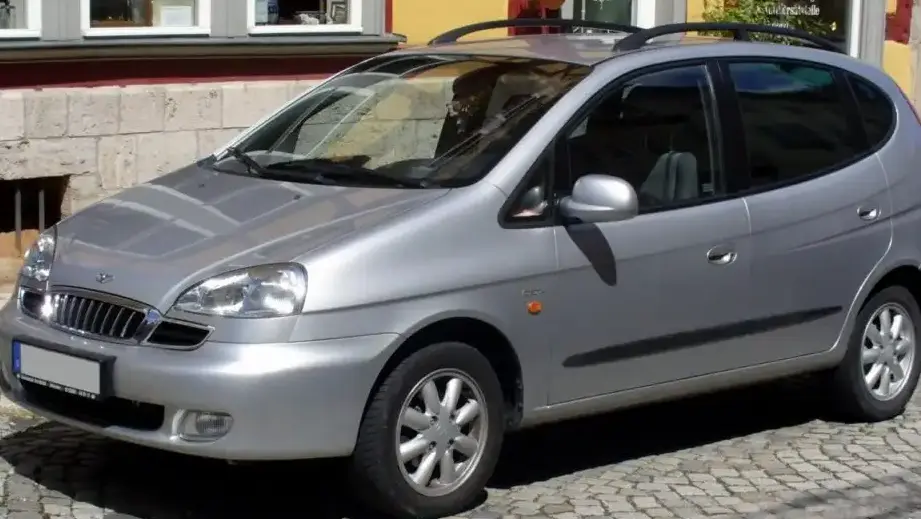
The Daewoo Rezzo, also known as the Daewoo Tacuma in some European markets, was a compact minivan produced by the South Korean automaker Daewoo from 2000 to 2008. The Rezzo (KLAU) 2.0 16V Automatic, introduced in 2000, represented a mid-range offering within the Rezzo lineup, positioned between the base 1.6L engine and potential higher-spec variants depending on the market. It aimed to provide a balance of practicality, space, and reasonable performance for family transportation. The Rezzo was a significant model for Daewoo, representing their attempt to enter the increasingly popular compact MPV segment, particularly in Europe where it saw moderate success.
Technical Specifications
| Brand | Daewoo |
| Model | Rezzo |
| Generation | Rezzo (KLAU) |
| Type (Engine) | 2.0 16V (136 Hp) Automatic |
| Start of production | 2000 year |
| End of production | 2008 year |
| Powertrain Architecture | Internal Combustion engine |
| Body type | Minivan |
| Seats | 5 |
| Doors | 5 |
| Fuel consumption (economy) – urban | 12 l/100 km (19.6 US mpg, 23.5 UK mpg, 8.3 km/l) |
| Fuel consumption (economy) – extra urban | 8 l/100 km (29.4 US mpg, 35.3 UK mpg, 12.5 km/l) |
| Fuel Type | Petrol (Gasoline) |
| Acceleration 0 – 100 km/h | 13.4 sec |
| Acceleration 0 – 62 mph | 13.4 sec |
| Acceleration 0 – 60 mph | 12.7 sec |
| Maximum speed | 185 km/h (114.95 mph) |
| Weight-to-power ratio | 9.3 kg/Hp, 107.1 Hp/tonne |
| Weight-to-torque ratio | 6.9 kg/Nm, 144.9 Nm/tonne |
| Power | 136 Hp @ 5600 rpm |
| Power per litre | 68.1 Hp/l |
| Torque | 184 Nm @ 4000 rpm (135.71 lb.-ft. @ 4000 rpm) |
| Engine layout | Front, Transverse |
| Engine displacement | 1998 cm3 (121.93 cu. in.) |
| Number of cylinders | 4 |
| Engine configuration | Inline |
| Cylinder Bore | 86 mm (3.39 in.) |
| Piston Stroke | 86 mm (3.39 in.) |
| Compression ratio | 9.5:1 |
| Number of valves per cylinder | 4 |
| Fuel injection system | Multi-port manifold injection |
| Engine aspiration | Naturally aspirated engine |
| Valvetrain | DOHC |
| Kerb Weight | 1270 kg (2799.87 lbs.) |
| Max. weight | 1745 kg (3847.07 lbs.) |
| Max load | 475 kg (1047.2 lbs.) |
| Trunk (boot) space – minimum | 455 l (16.07 cu. ft.) |
| Trunk (boot) space – maximum | 1165 l (41.14 cu. ft.) |
| Fuel tank capacity | 60 l (15.85 US gal, 13.2 UK gal) |
| Length | 4350 mm (171.26 in.) |
| Width | 1750 mm (68.9 in.) |
| Height | 1580 mm (62.2 in.) |
| Wheelbase | 2600 mm (102.36 in.) |
| Front track | 1474 mm (58.03 in.) |
| Rear (Back) track | 1480 mm (58.27 in.) |
| Drivetrain Architecture | The Internal combustion engine (ICE) drives the front wheels of the vehicle. |
| Drive wheel | Front wheel drive |
| Number of gears and type of gearbox | 4 gears, automatic transmission |
| Front suspension | Spring Strut |
| Rear suspension | Coil spring |
| Front brakes | Ventilated discs |
| Rear brakes | Drum |
| Assisting systems | ABS (Anti-lock braking system) |
| Steering type | Steering rack and pinion |
| Tires size | 195/60 R15 |
| Wheel rims size | 6.5J X 15 |
Powertrain & Engine Architecture
The Rezzo 2.0 Automatic was powered by Daewoo’s 1998cc inline-four cylinder engine. This engine, often identified by its internal codes, utilized a multi-port fuel injection system and a double overhead camshaft (DOHC) valvetrain. The 16-valve configuration contributed to its relatively respectable power output for its displacement. The engine produced 136 horsepower at 5600 rpm and 184 Nm (135.71 lb-ft) of torque at 4000 rpm. The automatic transmission was a conventional four-speed unit, designed to provide smooth, if not particularly sporty, gear changes. This transmission was chosen to appeal to buyers prioritizing ease of use over outright performance. The engine’s design was relatively simple and robust, aiming for reliability rather than cutting-edge technology.
Driving Characteristics
The 2.0L engine and four-speed automatic combination in the Rezzo delivered adequate, but not exhilarating, performance. Acceleration from 0-60 mph took around 12.7 seconds, and top speed was approximately 115 mph. The automatic transmission, while convenient, did detract from the engine’s potential, resulting in a noticeable delay in response compared to a manual transmission. Gear ratios were tuned for fuel efficiency and comfortable cruising rather than aggressive acceleration. In real-world driving, the Rezzo 2.0 Automatic felt best suited for city and highway driving, where its torque allowed for easy overtaking and merging. Compared to a potential manual version, the automatic traded some responsiveness for ease of driving, making it a popular choice for families.
Equipment & Trim Levels
The Rezzo 2.0 Automatic typically came equipped with a reasonable level of standard features. These generally included power windows, central locking, air conditioning, and an AM/FM radio. Depending on the market and optional packages, features like alloy wheels, a sunroof, and upgraded interior trim were available. Interior upholstery was typically cloth, with a focus on durability and practicality. The dashboard layout was functional and straightforward, prioritizing ease of use. Higher trim levels might have included features like a CD player, upgraded sound system, and additional safety equipment.
Chassis & Braking
The Rezzo utilized a front-wheel-drive layout with a relatively simple suspension setup. The front suspension employed MacPherson struts, while the rear featured a coil spring arrangement. Braking consisted of ventilated discs on the front wheels and drum brakes on the rear. Anti-lock Braking System (ABS) was standard, enhancing safety. The suspension was tuned for comfort, providing a reasonably smooth ride, although it wasn’t particularly sporty. The use of drum brakes on the rear was a cost-saving measure common in this class of vehicle.
Market Reception & Comparison
The Daewoo Rezzo 2.0 Automatic received mixed reviews. Critics generally praised its spacious interior and practicality, but noted its unremarkable performance and somewhat bland styling. Compared to other compact MPVs available at the time, such as the Renault Scenic or Opel Zafira, the Rezzo offered a more affordable price point but lacked the refinement and driving dynamics of its European competitors. Fuel economy was average for its class, and reliability was generally considered acceptable, although Daewoo’s reputation at the time was still developing. The 1.8L manual version offered better fuel economy and slightly improved performance, appealing to a different segment of buyers.
Legacy
The Daewoo Rezzo, despite its relatively short production run, remains a recognizable vehicle in many markets. The 2.0L engine and four-speed automatic transmission combination proved to be reasonably durable, and well-maintained examples can still be found on the used car market today. While not known for exceptional performance or luxury, the Rezzo offered a practical and affordable transportation solution for families. Its legacy lies in its contribution to Daewoo’s attempt to establish itself as a major player in the European compact MPV segment, and as a precursor to the Chevrolet Tacuma following General Motors’ acquisition of Daewoo.
