
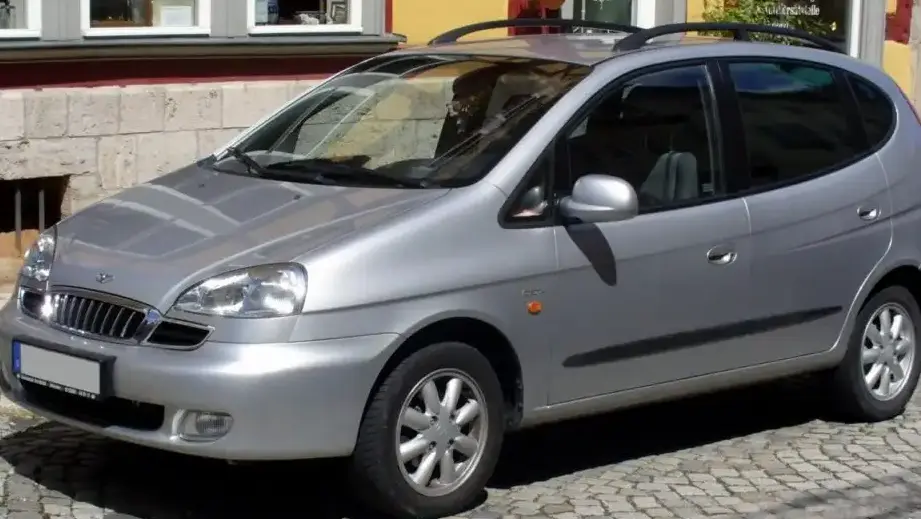
The Daewoo Rezzo 2.0i Automatic, designated as the KLAU, was a five-door minivan produced from 2001 to 2008. Positioned as a practical and affordable family vehicle, it represented Daewoo’s attempt to compete in the increasingly popular compact MPV segment. The Rezzo was primarily marketed in South Korea and select export markets, including parts of Europe and South America. It was based on the SsangYong Musso platform, a result of Daewoo’s strategic alliance with SsangYong Motor Company. This particular 2.0-liter, 105 horsepower configuration with an automatic transmission served as a mid-range offering within the Rezzo lineup, aiming for a balance between fuel efficiency and usability.
Technical Specifications
| Brand | Daewoo |
| Model | Rezzo |
| Generation | Rezzo (KLAU) |
| Type (Engine) | 2.0 i (105 Hp) Automatic |
| Start of production | 2001 |
| End of production | 2008 |
| Powertrain Architecture | Internal Combustion engine |
| Body type | Minivan |
| Seats | 5 |
| Doors | 5 |
| Fuel Type | Petrol (Gasoline) |
| Acceleration 0 – 100 km/h | 10.5 sec |
| Acceleration 0 – 62 mph | 10.5 sec |
| Acceleration 0 – 60 mph | 10 sec |
| Maximum speed | 180 km/h (111.85 mph) |
| Weight-to-power ratio | 12 kg/Hp, 83.3 Hp/tonne |
| Weight-to-torque ratio | 7.5 kg/Nm, 134.1 Nm/tonne |
| Power | 105 Hp @ 5000 rpm |
| Power per litre | 52.6 Hp/l |
| Torque | 169 Nm @ 2800 rpm (124.65 lb.-ft. @ 2800 rpm) |
| Engine layout | Front, Transverse |
| Engine displacement | 1998 cm3 (121.93 cu. in.) |
| Number of cylinders | 4 |
| Engine configuration | Inline |
| Cylinder Bore | 86 mm (3.39 in.) |
| Piston Stroke | 86 mm (3.39 in.) |
| Compression ratio | 8.8:1 |
| Number of valves per cylinder | 2 |
| Fuel injection system | Multi-port manifold injection |
| Engine aspiration | Naturally aspirated engine |
| Valvetrain | OHC |
| Kerb Weight | 1260 kg (2777.82 lbs.) |
| Trunk (boot) space – minimum | 347 l (12.25 cu. ft.) |
| Trunk (boot) space – maximum | 1425 l (50.32 cu. ft.) |
| Fuel tank capacity | 60 l (15.85 US gal | 13.2 UK gal) |
| Length | 4350 mm (171.26 in.) |
| Width | 1755 mm (69.09 in.) |
| Height | 1580 mm (62.2 in.) |
| Wheelbase | 2600 mm (102.36 in.) |
| Front track | 1476 mm (58.11 in.) |
| Rear (Back) track | 1480 mm (58.27 in.) |
| Drivetrain Architecture | The Internal combustion engine (ICE) drives the front wheels of the vehicle. |
| Drive wheel | Front wheel drive |
| Number of gears and type of gearbox | 4 gears, automatic transmission |
| Front suspension | Spring Strut |
| Rear suspension | Coil spring |
| Front brakes | Ventilated discs |
| Rear brakes | Drum |
| Assisting systems | ABS (Anti-lock braking system) |
| Steering type | Steering rack and pinion |
| Power steering | Hydraulic Steering |
| Tires size | 185/70 R14 |
Powertrain & Engine Architecture
The Rezzo 2.0i Automatic utilized a 1.998-liter inline-four cylinder engine. This engine, internally designated with various codes depending on the specific market, was a relatively simple design featuring a single overhead camshaft (OHC) and two valves per cylinder. Fuel delivery was managed by a multi-port fuel injection system, providing adequate, though not exceptional, performance. The engine produced 105 horsepower at 5000 rpm and 169 Nm (124.65 lb-ft) of torque at 2800 rpm. The automatic transmission was a conventional four-speed unit, chosen for its ease of use and suitability for urban driving conditions. While not known for its sportiness, the transmission provided smooth shifts and acceptable responsiveness for everyday driving. The engine’s design prioritized reliability and affordability over outright power.
Driving Characteristics
The 2.0-liter automatic Rezzo offered a comfortable, if uninspiring, driving experience. Acceleration from 0 to 60 mph took approximately 10 seconds, and top speed was around 112 mph. The four-speed automatic transmission, while smooth, lacked the responsiveness of more modern gearboxes or manual transmissions. This resulted in a noticeable delay during overtaking maneuvers. Compared to the available manual transmission, the automatic version felt noticeably slower. The gear ratios were tuned for fuel economy and low-speed drivability, rather than performance. The suspension, tuned for comfort, absorbed bumps reasonably well, but body roll was evident during cornering. Overall, the driving experience was geared towards practicality and ease of use, making it a suitable choice for families and drivers prioritizing comfort over performance.
Equipment & Trim Levels
The Rezzo 2.0i Automatic typically came equipped with a reasonable level of standard features. These included power windows, central locking, air conditioning, and an AM/FM radio. Higher trim levels offered options such as alloy wheels, a sunroof, and upgraded interior upholstery. The interior was functional and spacious, with seating for five passengers. The dashboard layout was straightforward and easy to use, although the materials used were generally of a lower quality. Safety features were relatively basic for the time, typically including ABS brakes and driver and passenger airbags. The Rezzo aimed to provide good value for money, offering a practical and well-equipped vehicle at an affordable price point.
Chassis & Braking
The Rezzo’s chassis was a conventional front-wheel-drive layout, utilizing a MacPherson strut suspension in the front and a coil spring suspension in the rear. The front brakes were ventilated discs, providing adequate stopping power, while the rear brakes were drums. The steering was rack and pinion with hydraulic power assistance, offering reasonable precision and ease of use. The suspension was tuned for comfort, prioritizing ride quality over handling. The tires were typically 185/70 R14, providing a good balance between grip and fuel efficiency. The overall chassis setup was designed to provide a comfortable and predictable driving experience, rather than sporty handling.
Market Reception & Comparison
The Daewoo Rezzo 2.0i Automatic received mixed reviews from automotive critics. It was generally praised for its spacious interior, affordability, and practicality. However, it was often criticized for its lack of performance, dated design, and relatively low build quality. Compared to other compact MPVs available at the time, such as the Renault Scenic or the Opel Zafira, the Rezzo offered a lower price point but lacked the refinement and features of its European competitors. Fuel economy was average for its class, and reliability was generally considered to be acceptable, although some owners reported issues with the automatic transmission. The Rezzo appealed to budget-conscious buyers seeking a practical and spacious family vehicle.
Legacy
The Daewoo Rezzo, while not a groundbreaking vehicle, served as an important model for Daewoo (later Chevrolet) in the compact MPV segment. The 2.0-liter automatic powertrain proved to be reasonably reliable, although regular maintenance was essential to prevent issues with the transmission. In the used car market, the Rezzo remains an affordable option for those seeking a practical and spacious vehicle. However, potential buyers should be aware of the vehicle’s age and potential maintenance requirements. The Rezzo’s legacy lies in its affordability and practicality, offering a functional and spacious vehicle for families on a budget. It represents a snapshot of Daewoo’s efforts to establish itself as a competitive player in the global automotive market.
