
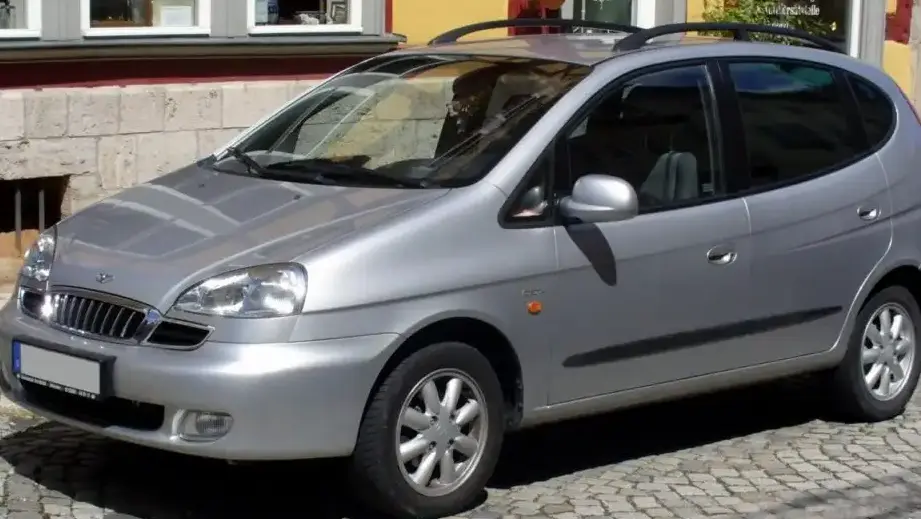
The Daewoo Rezzo, known as the Daewoo Tacuma in some European markets, was a compact minivan produced by the South Korean automaker Daewoo from 2001 to 2008. The KLAU designation refers to the specific body code for this generation. Positioned as a practical and affordable family vehicle, the Rezzo aimed to provide a spacious interior and versatile seating arrangements. This article focuses on the 2.0 i 16V variant, equipped with a 121 horsepower engine and a five-speed manual transmission, which represented a mid-range offering within the Rezzo lineup. It was designed to appeal to buyers needing more space than a traditional hatchback but seeking a more manageable size and price point than larger minivans.
Technical Specifications
| Brand | Daewoo |
| Model | Rezzo |
| Generation | Rezzo (KLAU) |
| Type (Engine) | 2.0 i 16V (121 Hp) |
| Start of production | 2001 |
| End of production | 2008 |
| Powertrain Architecture | Internal Combustion engine |
| Body type | Minivan |
| Seats | 5 |
| Doors | 5 |
| Fuel consumption (urban) | 12.9 l/100 km (18.2 US mpg, 21.9 UK mpg, 7.8 km/l) |
| Fuel consumption (extra urban) | 7.9 l/100 km (29.8 US mpg, 35.8 UK mpg, 12.7 km/l) |
| Fuel consumption (combined) | 9.7 l/100 km (24.2 US mpg, 29.1 UK mpg, 10.3 km/l) |
| Fuel Type | Petrol (Gasoline) |
| Acceleration 0 – 100 km/h | 10.5 sec |
| Acceleration 0 – 62 mph | 10.5 sec |
| Acceleration 0 – 60 mph | 10 sec |
| Maximum speed | 188 km/h (116.82 mph) |
| Weight-to-power ratio | 11.4 kg/Hp, 87.6 Hp/tonne |
| Weight-to-torque ratio | 7.8 kg/Nm, 127.4 Nm/tonne |
| Power | 121 Hp @ 5600 rpm |
| Power per litre | 60.6 Hp/l |
| Torque | 176 Nm @ 4000 rpm (129.81 lb.-ft. @ 4000 rpm) |
| Engine layout | Front, Transverse |
| Engine Model/Code | T20SED |
| Engine displacement | 1998 cm3 (121.93 cu. in.) |
| Number of cylinders | 4 |
| Engine configuration | Inline |
| Cylinder Bore | 86 mm (3.39 in.) |
| Piston Stroke | 86 mm (3.39 in.) |
| Compression ratio | 9.6:1 |
| Number of valves per cylinder | 4 |
| Fuel injection system | Multi-port manifold injection |
| Engine aspiration | Naturally aspirated engine |
| Valvetrain | DOHC |
| Engine oil capacity | 4 l (4.23 US qt | 3.52 UK qt) |
| Coolant capacity | 7.5 l (7.93 US qt | 6.6 UK qt) |
| Kerb Weight | 1381 kg (3044.58 lbs.) |
| Max. weight | 1862 kg (4105.01 lbs.) |
| Max load | 481 kg (1060.42 lbs.) |
| Trunk (boot) space – minimum | 347 l (12.25 cu. ft.) |
| Trunk (boot) space – maximum | 1425 l (50.32 cu. ft.) |
| Fuel tank capacity | 60 l (15.85 US gal | 13.2 UK gal) |
| Length | 4350 mm (171.26 in.) |
| Width | 1755 mm (69.09 in.) |
| Height | 1580 mm (62.2 in.) |
| Wheelbase | 2600 mm (102.36 in.) |
| Front track | 1476 mm (58.11 in.) |
| Rear track | 1480 mm (58.27 in.) |
| Drivetrain Architecture | Front wheel drive |
| Number of gears | 5 gears, manual transmission |
| Front suspension | Spring Strut |
| Rear suspension | Coil spring |
| Front brakes | Ventilated discs |
| Rear brakes | Disc |
| Assisting systems | ABS (Anti-lock braking system) |
| Steering type | Steering rack and pinion |
| Power steering | Hydraulic Steering |
| Tires size | 195/60 R15 H |
Powertrain & Engine Architecture
The Rezzo 2.0 i 16V was powered by Daewoo’s T20SED engine, a 1.998-liter inline-four cylinder gasoline engine. This engine featured a double overhead camshaft (DOHC) valvetrain with four valves per cylinder, contributing to its relatively high output for its displacement. The engine utilized a multi-point fuel injection system, delivering fuel directly to each intake port. The 121 horsepower and 176 Nm (129.81 lb-ft) of torque were respectable figures for a vehicle of this class in the early 2000s. The five-speed manual transmission was the standard offering for this trim level, providing drivers with a degree of control over the engine’s power delivery. The engine’s design prioritized reliability and affordability over outright performance, making it a suitable choice for everyday driving.
Driving Characteristics
The 2.0-liter engine and five-speed manual transmission combination in the Rezzo offered a balanced driving experience. Acceleration to 60 mph took approximately 10 seconds, and the vehicle had a top speed of around 117 mph. While not particularly sporty, the engine provided sufficient power for highway merging and overtaking maneuvers. The manual transmission allowed drivers to maximize engine efficiency and enjoy a more engaging driving experience compared to the available automatic option. The gear ratios were tuned for everyday usability, with a focus on providing adequate torque at lower speeds. Compared to the base 1.6-liter engine, the 2.0-liter offered a noticeable improvement in performance, while remaining more economical than potential higher-output variants that were not offered in the US market.
Equipment & Trim Levels
The Rezzo 2.0 i 16V typically came equipped with features such as power windows, power door locks, and air conditioning as standard. Interior upholstery was generally cloth, with a relatively simple and functional dashboard layout. Optional extras included an upgraded audio system, alloy wheels, and a sunroof. The Rezzo aimed to provide a good value proposition, offering a reasonable level of equipment for its price point. The interior space was a key selling point, with ample headroom and legroom for passengers in both the front and rear seats. The rear seats could be folded down to create a larger cargo area, enhancing the vehicle’s versatility.
Chassis & Braking
The Rezzo utilized a front-wheel-drive layout with a MacPherson strut suspension in the front and a coil spring suspension in the rear. This suspension setup provided a comfortable ride quality, suitable for everyday driving conditions. The front brakes were ventilated discs, while the rear brakes were solid discs, offering adequate stopping power for the vehicle’s weight. An anti-lock braking system (ABS) was included as standard, enhancing safety. The steering was rack and pinion with hydraulic power assistance, providing precise and responsive handling. The vehicle’s relatively lightweight construction contributed to its agility and maneuverability.
Market Reception & Comparison
The Daewoo Rezzo, while not a sales blockbuster, was generally well-received by critics for its spacious interior, practical design, and affordable price. It was often compared to other compact minivans and station wagons available at the time. The 2.0-liter engine and manual transmission combination was praised for its balance of performance and fuel economy. However, some critics noted that the interior materials were somewhat basic and that the overall driving experience lacked refinement. Compared to the base 1.6-liter engine, the 2.0-liter offered a significant improvement in performance, making it a more appealing option for drivers who frequently carried passengers or cargo. Fuel economy was competitive for its class, averaging around 24 mpg in combined driving.
Legacy
The Daewoo Rezzo, and the T20SED engine, have a reputation for being relatively reliable, provided they are properly maintained. Common issues include wear and tear on suspension components and potential oil leaks. The engine itself is generally considered durable, but regular oil changes and maintenance are essential. In the used car market, the Rezzo remains an affordable and practical option for buyers seeking a spacious and versatile vehicle. While it may not offer the same level of sophistication as more modern minivans, its simplicity and reliability make it a viable choice for those on a budget. The Rezzo represents a unique chapter in Daewoo’s history, showcasing the company’s commitment to providing affordable and practical transportation solutions.
