
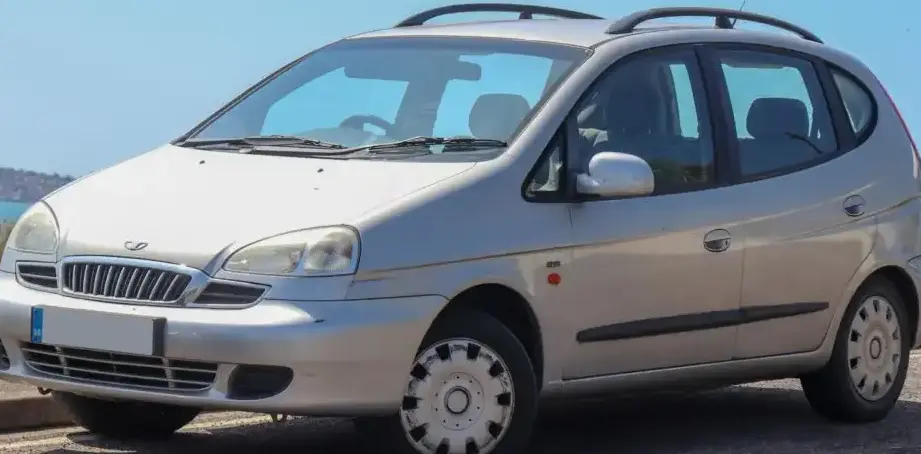
The Daewoo Tacuma 1.8 i, producing 101 horsepower, was a compact minivan marketed primarily in Europe and select other regions from 2000 to 2008. Positioned as an affordable and practical family vehicle, it represented Daewoo’s (later Chevrolet) attempt to compete in the growing multi-purpose vehicle (MPV) segment. This particular variant, with its 1.8-liter engine and automatic transmission, served as a mid-range offering within the Tacuma lineup, aiming for buyers who prioritized convenience and ease of driving over outright performance. The Tacuma was based on the GM Delta platform, shared with models like the Opel/Vauxhall Astra and Zafira, reflecting General Motors’ ownership of Daewoo at the time.
Technical Specifications
| Brand | Daewoo |
| Model | Tacuma |
| Generation | Tacuma |
| Type (Engine) | 1.8 i (101 Hp) |
| Start of production | 2000 year |
| End of production | 2008 year |
| Powertrain Architecture | Internal Combustion engine |
| Body type | Minivan |
| Seats | 5 |
| Doors | 5 |
| Fuel consumption (urban) | 12.5 l/100 km (18.8 US mpg) |
| Fuel consumption (extra urban) | 7.2 l/100 km (32.7 US mpg) |
| Fuel consumption (combined) | 9.3 l/100 km (25.3 US mpg) |
| Fuel Type | Petrol (Gasoline) |
| Acceleration 0 – 100 km/h | 12 sec |
| Acceleration 0 – 62 mph | 12 sec |
| Acceleration 0 – 60 mph | 11.4 sec |
| Maximum speed | 170 km/h (105.63 mph) |
| Weight-to-power ratio | 12.2 kg/Hp |
| Weight-to-torque ratio | 8.4 kg/Nm |
| Power | 101 Hp @ 5600 rpm |
| Torque | 146 Nm @ 3300 rpm (107.68 lb.-ft. @ 3300 rpm) |
| Engine layout | Front, Transverse |
| Engine Model/Code | F18S2 |
| Engine displacement | 1796 cm3 (109.6 cu. in.) |
| Number of cylinders | 4 |
| Engine configuration | Inline |
| Cylinder Bore | 84.8 mm (3.34 in.) |
| Piston Stroke | 79.5 mm (3.13 in.) |
| Compression ratio | 8.8:1 |
| Number of valves per cylinder | 4 |
| Fuel injection system | Multi-port manifold injection |
| Engine aspiration | Naturally aspirated engine |
| Valvetrain | OHC |
| Engine oil capacity | 3.75 l (3.96 US qt | 3.3 UK qt) |
| Kerb Weight | 1230 kg (2711.69 lbs.) |
| Max. weight | 1725 kg (3802.97 lbs.) |
| Max load | 495 kg (1091.29 lbs.) |
| Trunk (boot) space – minimum | 455 l (16.07 cu. ft.) |
| Trunk (boot) space – maximum | 1165 l (41.14 cu. ft.) |
| Fuel tank capacity | 60 l (15.85 US gal | 13.2 UK gal) |
| Length | 4350 mm (171.26 in.) |
| Width | 1755 mm (69.09 in.) |
| Height | 1580 mm (62.2 in.) |
| Wheelbase | 2600 mm (102.36 in.) |
| Front track | 1476 mm (58.11 in.) |
| Rear (Back) track | 1480 mm (58.27 in.) |
| Drivetrain Architecture | The Internal combustion engine (ICE) drives the front wheels of the vehicle. |
| Drive wheel | Front wheel drive |
| Number of gears and type of gearbox | 5 gears, automatic transmission |
| Front suspension | Spring Strut |
| Rear suspension | Coil spring |
| Front brakes | Disc |
| Rear brakes | Drum |
| Assisting systems | ABS (Anti-lock braking system) |
| Steering type | Steering rack and pinion |
| Power steering | Hydraulic Steering |
| Tires size | 195/60 R15 |
| Wheel rims size | 6J x 15 |
Powertrain & Engine Architecture
The heart of the Tacuma 1.8 i is the F18S2 engine, an inline four-cylinder gasoline engine displacing 1796 cc (109.6 cubic inches). This engine utilizes a single overhead camshaft (OHC) valvetrain with four valves per cylinder. Fuel delivery is managed by a multi-port fuel injection system, a common setup for engines of this era. The 8.8:1 compression ratio was a compromise between performance and the ability to run on readily available fuel grades. The engine’s 101 horsepower peak is reached at 5600 rpm, while its 146 Nm (107.68 lb-ft) of torque is available at 3300 rpm. Paired with this engine is a four-speed automatic transmission. This transmission, while providing convenience, was not known for its particularly quick shifts or fuel efficiency compared to manual alternatives.
Driving Characteristics
The 1.8-liter automatic Tacuma offered a comfortable, if not particularly exciting, driving experience. Acceleration from 0-60 mph took approximately 11.4 seconds, and top speed was around 105.63 mph. The automatic transmission, while smooth in normal driving, could feel sluggish when attempting quicker acceleration or overtaking maneuvers. The gear ratios were geared towards fuel economy and relaxed cruising rather than spirited performance. Compared to the five-speed manual version, the automatic suffered a noticeable performance deficit. The 1.8L engine provided adequate power for everyday driving, but felt strained when fully loaded with passengers and luggage, or when tackling steep inclines.
Equipment & Trim Levels
The 1.8 i automatic trim typically included features such as power steering, central locking, electric front windows, and an AM/FM radio. Air conditioning was often standard, but could be optional depending on the specific market. Interior upholstery was generally cloth, with a relatively basic dashboard layout. Optional extras included alloy wheels, a sunroof, and upgraded audio systems. The Tacuma aimed for practicality over luxury, so even in the mid-range 1.8 i trim, the interior was functional rather than opulent.
Chassis & Braking
The Tacuma utilized a front-wheel-drive layout with a MacPherson strut suspension in the front and a coil spring suspension in the rear. The front brakes were discs, providing adequate stopping power, while the rear brakes were drums, a cost-saving measure common in vehicles of this class. Anti-lock Braking System (ABS) was standard, enhancing safety. The suspension was tuned for comfort, providing a relatively soft ride, but this came at the expense of sharp handling. Stabilizer bars were present, but were relatively thin compared to those found in sportier vehicles.
Market Reception & Comparison
The Daewoo Tacuma 1.8 i automatic received mixed reviews. Critics generally praised its spacious interior, practicality, and affordability. However, the engine and automatic transmission combination were often criticized for being underpowered and lacking refinement. Fuel economy was considered average for its class. Compared to other MPVs available at the time, such as the Renault Scenic or Citroën Xsara Picasso, the Tacuma offered a more affordable entry point, but lacked the sophistication and driving dynamics of its European rivals. The manual transmission versions were generally favored by those seeking better performance and fuel efficiency.
Legacy
The Daewoo Tacuma, and specifically the 1.8 i automatic variant, has become a relatively affordable used car option. The F18S2 engine is generally considered reliable, although regular maintenance is crucial. Common issues include oil leaks and occasional sensor failures. The automatic transmission, while durable, can be prone to wear and tear with high mileage. Today, the Tacuma is often seen as a budget-friendly family vehicle, appreciated for its practicality and spaciousness. While it may not offer the prestige or performance of more modern MPVs, it remains a viable option for those seeking a simple, affordable, and reliable vehicle.
