
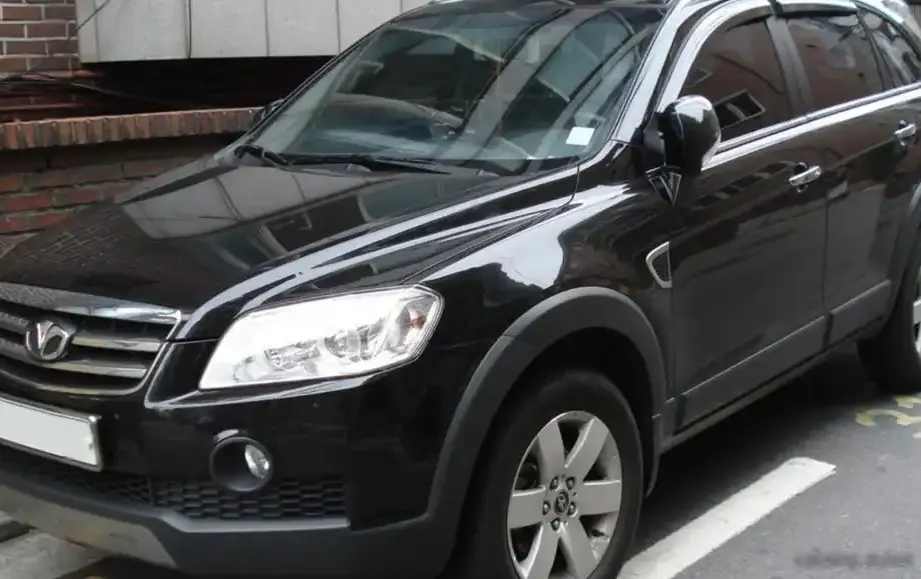
The Daewoo Winstorm 3.2i V6 24V Automatic, produced from 2006 to 2011, was a mid-size SUV representing Daewoo’s (later GM Daewoo and ultimately Chevrolet) attempt to enter the growing SUV market. Positioned as a relatively affordable seven-passenger vehicle, the Winstorm aimed to provide family transportation with a degree of versatility. It was based on the GM Theta platform, shared with vehicles like the Opel Antara and Chevrolet Captiva, and represented a significant step up in complexity and features compared to earlier Daewoo offerings. The 3.2i V6 Automatic trim was the top-of-the-line offering, providing the most power and a more refined driving experience within the Winstorm range.
Technical Specifications
| Brand | Daewoo |
| Model | Winstorm |
| Generation | Winstorm |
| Type (Engine) | 3.2i V6 24V (230 Hp) Automatic |
| Start of production | 2006 |
| End of production | 2011 |
| Powertrain Architecture | Internal Combustion engine |
| Body type | SUV |
| Seats | 7 |
| Doors | 5 |
| Fuel consumption (urban) | 16.4 l/100 km (14.3 US mpg) |
| Fuel consumption (extra urban) | 8.6 l/100 km (27.4 US mpg) |
| Fuel Type | Petrol (Gasoline) |
| Acceleration 0 – 100 km/h | 8.8 sec |
| Acceleration 0 – 62 mph | 8.8 sec |
| Acceleration 0 – 60 mph | 8.4 sec |
| Maximum speed | 204 km/h (126.76 mph) |
| Weight-to-power ratio | 7.9 kg/Hp |
| Weight-to-torque ratio | 5.9 kg/Nm |
| Power | 230 Hp @ 5750 rpm |
| Torque | 307 Nm @ 4000 rpm (226.43 lb.-ft. @ 4000 rpm) |
| Engine layout | Front, Longitudinal |
| Engine Model/Code | Z32SEE |
| Engine displacement | 3199 cm3 (195.21 cu. in.) |
| Number of cylinders | 6 |
| Engine configuration | Inline |
| Cylinder Bore | 89.9 mm (3.54 in.) |
| Piston Stroke | 84 mm (3.31 in.) |
| Compression ratio | 10:1 |
| Number of valves per cylinder | 4 |
| Fuel injection system | Multi-port manifold injection |
| Engine aspiration | Naturally aspirated engine |
| Engine oil capacity | 7.4 l (7.82 US qt | 6.51 UK qt) |
| Coolant capacity | 10 l (10.57 US qt | 8.8 UK qt) |
| Kerb Weight | 1810 kg (3990.37 lbs.) |
| Max. weight | 2440 kg (5379.28 lbs.) |
| Max load | 630 kg (1388.91 lbs.) |
| Trunk (boot) space – minimum | 465 l (16.42 cu. ft.) |
| Trunk (boot) space – maximum | 930 l (32.84 cu. ft.) |
| Fuel tank capacity | 65 l (17.17 US gal | 14.3 UK gal) |
| Length | 4635 mm (182.48 in.) |
| Width | 1850 mm (72.83 in.) |
| Height | 1720 mm (67.72 in.) |
| Wheelbase | 2705 mm (106.5 in.) |
| Front track | 1562 mm (61.5 in.) |
| Rear (Back) track | 1572 mm (61.89 in.) |
| Drive wheel | All wheel drive (4×4) |
| Number of gears and type of gearbox | 5 gears, automatic transmission |
| Front suspension | Independent, type McPherson with coil spring and anti-roll bar |
| Rear suspension | Coil spring |
| Front brakes | Disc |
| Rear brakes | Disc |
| Assisting systems | ABS (Anti-lock braking system) |
| Steering type | Steering rack and pinion |
| Power steering | Hydraulic Steering |
| Tires size | 215/70 R16 |
Powertrain & Engine Architecture
The heart of the Winstorm 3.2i was the Z32SEE engine, a 3.2-liter, naturally aspirated V6. This engine, while bearing a Daewoo designation, was heavily influenced by GM’s powertrain technology. It featured a 60-degree V-angle, four valves per cylinder, and a multi-port fuel injection system. The engine produced 230 horsepower at 5750 rpm and 307 Nm (226.43 lb-ft) of torque at 4000 rpm. The engine’s architecture was relatively conventional for the time, prioritizing smooth power delivery over outright performance. The automatic transmission was a five-speed unit, designed to provide comfortable shifting and adequate acceleration. While not a particularly advanced transmission, it was well-suited to the engine’s characteristics and the Winstorm’s intended role as a family vehicle.
Driving Characteristics
The Winstorm 3.2i Automatic offered a comfortable, if not particularly sporty, driving experience. The V6 engine provided sufficient power for everyday driving and highway cruising, with the automatic transmission offering smooth shifts. Acceleration from 0-60 mph took around 8.4 seconds, which was competitive for the class at the time. However, the Winstorm’s weight (approximately 3990 lbs) did impact its agility. Compared to the lower-powered 2.0-liter or 2.4-liter versions, the 3.2i offered a noticeable improvement in acceleration and overall responsiveness. The automatic transmission, while convenient, did result in some power loss compared to the available manual transmission. The all-wheel-drive system provided enhanced traction in inclement weather, making it a capable vehicle for a variety of conditions.
Equipment & Trim Levels
The 3.2i V6 Automatic trim was the most well-equipped version of the Winstorm. Standard features typically included air conditioning, power windows and locks, a CD player with multiple speakers, and alloy wheels. Higher-end models often included leather upholstery, a sunroof, and upgraded audio systems. Safety features such as ABS brakes and airbags were standard across the range. The interior design was functional and relatively spacious, with seating for up to seven passengers. The third-row seats were best suited for children or shorter adults. Optional extras included a navigation system and rear parking sensors.
Chassis & Braking
The Winstorm utilized a McPherson strut front suspension and a coil spring rear suspension. This setup provided a comfortable ride, but didn’t offer particularly sharp handling. The front and rear brakes were both disc brakes, providing adequate stopping power for the vehicle’s weight. ABS was standard, enhancing braking performance and stability. The Winstorm’s chassis was designed to prioritize ride comfort and practicality over sporty handling. Stabilizer bars were included to reduce body roll during cornering, but the vehicle still exhibited noticeable body lean.
Market Reception & Comparison
The Daewoo Winstorm 3.2i V6 Automatic received mixed reviews from automotive critics. While the engine was praised for its smooth power delivery, the Winstorm was often criticized for its somewhat dated interior design and lack of refinement compared to competitors from established brands. Fuel economy was also a concern, with the 3.2-liter V6 consuming a significant amount of gasoline. Compared to other SUVs in its class, such as the Honda CR-V or Toyota RAV4, the Winstorm offered a lower price point but lacked the same level of build quality and brand recognition. The 3.2i V6 Automatic was generally considered a better choice for drivers who prioritized power and comfort over fuel efficiency and sporty handling.
Legacy
The Daewoo Winstorm, and particularly the 3.2i V6 Automatic variant, has become a relatively uncommon sight on the roads today. While the Z32SEE engine is generally considered reliable, the Winstorm’s overall build quality and the Daewoo brand’s reputation have limited its long-term appeal. Parts availability can be a challenge, as Daewoo ceased to exist as an independent brand. However, for those seeking an affordable seven-passenger SUV with a powerful V6 engine, the Winstorm 3.2i can represent a unique and interesting option. Its legacy lies in being a transitional vehicle, representing Daewoo’s attempt to modernize its lineup and compete in the increasingly popular SUV segment before being absorbed into General Motors.
