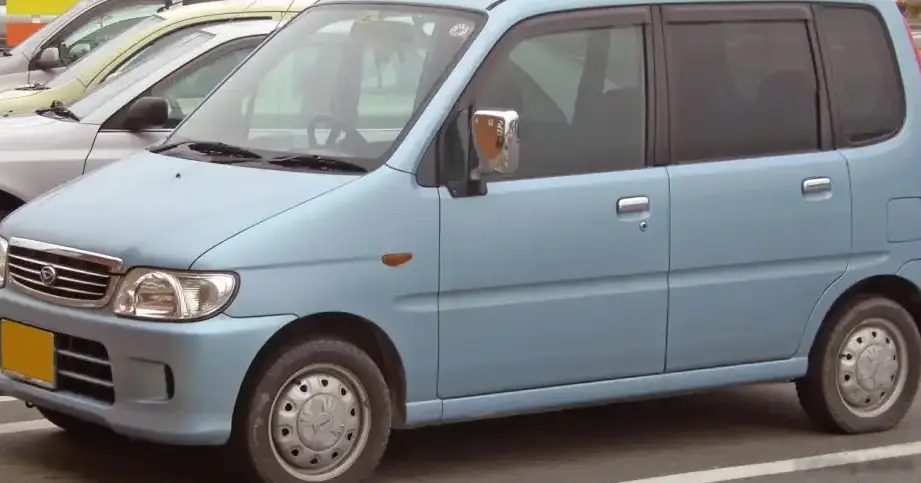
The Daihatsu Move (L9) 1.0 i 12V, produced between 1998 and 2003, represents a key iteration of Daihatsu’s popular kei car-based minivan. Positioned as an entry-level offering within the second generation Move (L900/L902 series), this variant catered to buyers seeking affordable and practical transportation. The L9 Move was primarily sold in the Japanese domestic market (JDM), where it found success due to its compact size, efficient engine, and relatively spacious interior for its class. This model played a significant role in solidifying Daihatsu’s reputation for building economical and cleverly designed vehicles.
Technical Specifications
| Brand | Daihatsu |
| Model | Move |
| Generation | Move (L9) |
| Type (Engine) | 1.0 i 12V (56 Hp) |
| Start of production | 1998 |
| End of production | 2003 |
| Powertrain Architecture | Internal Combustion engine |
| Body type | Minivan |
| Seats | 4 |
| Doors | 5 |
| Fuel consumption (urban) | 6.5 l/100 km (36.2 US mpg) |
| Fuel consumption (extra urban) | 4.5 l/100 km (52.3 US mpg) |
| Fuel Type | Petrol (Gasoline) |
| Acceleration 0 – 100 km/h | 12.8 sec |
| Acceleration 0 – 62 mph | 12.8 sec |
| Acceleration 0 – 60 mph | 12.2 sec |
| Maximum speed | 130 km/h (80.78 mph) |
| Weight-to-power ratio | 14.6 kg/Hp |
| Weight-to-torque ratio | 9.3 kg/Nm |
| Power | 56 Hp @ 5200 rpm |
| Power per litre | 56.6 Hp/l |
| Torque | 88 Nm @ 3600 rpm (64.91 lb.-ft. @ 3600 rpm) |
| Engine layout | Front, Transverse |
| Engine displacement | 989 cm3 (60.35 cu. in.) |
| Number of cylinders | 3 |
| Engine configuration | Inline |
| Cylinder Bore | 72 mm (2.83 in.) |
| Piston Stroke | 81 mm (3.19 in.) |
| Compression ratio | 10:1 |
| Number of valves per cylinder | 4 |
| Fuel injection system | Multi-port manifold injection |
| Engine aspiration | Naturally aspirated engine |
| Valvetrain | DOHC |
| Kerb Weight | 815 kg (1796.77 lbs.) |
| Trunk (boot) space – minimum | 260 l (9.18 cu. ft.) |
| Trunk (boot) space – maximum | 1150 l (40.61 cu. ft.) |
| Fuel tank capacity | 32 l (8.45 US gal | 7.04 UK gal) |
| Length | 3410 mm (134.25 in.) |
| Width | 1475 mm (58.07 in.) |
| Height | 1695 mm (66.73 in.) |
| Wheelbase | 2345 mm (92.32 in.) |
| Front track | 1310 mm (51.57 in.) |
| Rear (Back) track | 1280 mm (50.39 in.) |
| Minimum turning circle | 9.3 m (30.51 ft.) |
| Drivetrain Architecture | Front wheel drive |
| Number of gears and type of gearbox | 5 gears, manual transmission |
| Front suspension | Coil spring |
| Rear suspension | Coil spring |
| Front brakes | Disc |
| Rear brakes | Drum |
| Assisting systems | ABS (Anti-lock braking system) |
| Steering type | Steering rack and pinion |
| Power steering | Hydraulic Steering |
| Tires size | 155/65 R13 |
Powertrain & Engine Architecture
The heart of the L9 Move 1.0 i 12V is the Daihatsu HB10 engine, a 989cc inline-three cylinder petrol engine. This engine, designated as the HB10, utilizes a multi-point fuel injection system and a double overhead camshaft (DOHC) valvetrain. The 12-valve configuration (four valves per cylinder) contributes to improved breathing and efficiency. The engine’s relatively high compression ratio of 10:1 helps extract maximum power from its small displacement. The 56 horsepower peak is achieved at 5200 rpm, while the 88 Nm (64.91 lb-ft) of torque is delivered at 3600 rpm. This engine was known for its reliability and simplicity, though it wasn’t designed for outright performance. The standard transmission for this variant was a 5-speed manual, offering a direct connection to the engine.
Driving Characteristics
The 1.0L engine and manual transmission combination in the L9 Move provided adequate, though not exhilarating, performance. Acceleration from 0-60 mph took around 12.2 seconds, and the top speed was limited to 130 km/h (80.78 mph). The engine felt most comfortable in the mid-range, providing sufficient power for city driving and moderate highway cruising. Compared to higher-spec Move variants equipped with larger engines or automatic transmissions, the 1.0L manual offered a more engaging driving experience and slightly better fuel economy. The 5-speed manual allowed drivers to keep the engine in its optimal power band, maximizing efficiency and responsiveness. However, it lacked the convenience of an automatic transmission, which was available in other Move trims.
Equipment & Trim Levels
The 1.0 i 12V trim of the L9 Move was typically considered the base model. Standard features included power steering, air conditioning (often optional), and basic instrumentation. Interior upholstery was typically cloth, and the dashboard featured a simple, functional design. Optional extras included power windows, central locking, and a radio/cassette player. The interior space was maximized through clever packaging, offering reasonable headroom and legroom for passengers. The rear seats could be folded down to increase cargo capacity, making the Move a versatile vehicle for small families or individuals needing to transport larger items.
Chassis & Braking
The L9 Move utilized a front-engine, front-wheel-drive layout. Suspension consisted of coil springs all around, providing a comfortable ride quality. The front brakes were discs, while the rear brakes were drums – a common configuration for vehicles in this price range. Anti-lock Braking System (ABS) was available, enhancing safety by preventing wheel lockup during hard braking. The steering was a rack and pinion system with hydraulic power assistance, making it easy to maneuver in tight spaces. The relatively lightweight construction of the vehicle (815 kg / 1796.77 lbs) contributed to its nimble handling.
Market Reception & Comparison
The Daihatsu Move L9 1.0 i 12V was well-received in the Japanese market as an affordable and practical city car. Critics praised its fuel efficiency, compact size, and surprisingly spacious interior. Compared to other kei car-based minivans, the Move offered a good balance of features and value. The manual transmission version was favored by drivers who prioritized fuel economy and a more engaging driving experience. However, some reviewers noted the engine’s lack of power, particularly when fully loaded or driving uphill. The automatic transmission versions, while offering greater convenience, suffered from slightly reduced fuel economy and performance.
Legacy
The Daihatsu Move L9 1.0 i 12V, while not the most powerful or luxurious variant of the second-generation Move, remains a popular choice in the used car market in Japan. The HB10 engine is known for its durability and relatively low maintenance costs. Common issues are typically limited to wear and tear items such as brakes, suspension components, and exhaust systems. The L9 Move’s simple design and robust construction have contributed to its longevity, and many examples are still on the road today. It represents a significant example of Daihatsu’s engineering prowess in creating efficient and practical vehicles for the urban environment.