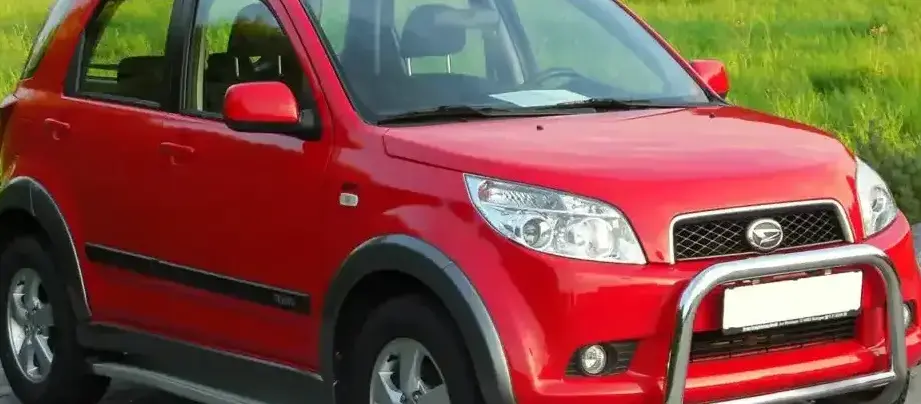
Technical Specifications
| Brand | Daihatsu |
| Model | Terios |
| Generation | Terios I (J100) |
| Type (Engine) | 1.3 i 16V 4WD (86 Hp) |
| Start of production | 1997 |
| End of production | 2006 |
| Powertrain Architecture | Internal Combustion engine |
| Body type | SUV |
| Seats | 5 |
| Doors | 5 |
| Fuel consumption (urban) | 9.4 l/100 km (25 US mpg, 30.1 UK mpg, 10.6 km/l) |
| Fuel consumption (extra urban) | 6.8 l/100 km (34.6 US mpg, 41.5 UK mpg, 14.7 km/l) |
| Fuel consumption (combined) | 7.7 l/100 km (30.5 US mpg, 36.7 UK mpg, 13 km/l) |
| Fuel Type | Petrol (Gasoline) |
| Acceleration 0 – 100 km/h | 16.1 sec |
| Acceleration 0 – 62 mph | 16.1 sec |
| Acceleration 0 – 60 mph | 15.3 sec |
| Maximum speed | 145 km/h (90.1 mph) |
| Weight-to-power ratio | 13.1 kg/Hp, 76.4 Hp/tonne |
| Weight-to-torque ratio | 9.4 kg/Nm, 106.7 Nm/tonne |
| Power | 86 Hp @ 6000 rpm |
| Power per litre | 66.3 Hp/l |
| Torque | 120 Nm @ 3200 rpm (88.51 lb.-ft. @ 3200 rpm) |
| Engine layout | Front, Longitudinal |
| Engine displacement | 1298 cm3 (79.21 cu. in.) |
| Number of cylinders | 4 |
| Engine configuration | Inline |
| Cylinder Bore | 72 mm (2.83 in.) |
| Piston Stroke | 79.7 mm (3.14 in.) |
| Compression ratio | 10:1 |
| Number of valves per cylinder | 4 |
| Fuel injection system | Multi-port manifold injection |
| Engine aspiration | Naturally aspirated engine |
| Valvetrain | DOHC |
| Kerb Weight | 1125 kg (2480.2 lbs.) |
| Max. weight | 1550 kg (3417.17 lbs.) |
| Max load | 425 kg (936.96 lbs.) |
| Trunk (boot) space – minimum | 205 l (7.24 cu. ft.) |
| Fuel tank capacity | 46 l (12.15 US gal, 10.12 UK gal) |
| Length | 3845 mm (151.38 in.) |
| Width | 1555 mm (61.22 in.) |
| Height | 1695 mm (66.73 in.) |
| Wheelbase | 2420 mm (95.28 in.) |
| Front track | 1315 mm (51.77 in.) |
| Rear (Back) track | 1310 mm (51.57 in.) |
| Minimum turning circle | 9.4 m (30.84 ft.) |
| Drive wheel | All wheel drive (4×4) |
| Number of gears | 5 gears, manual transmission |
| Front suspension | Wishbone |
| Rear suspension | Coil spring |
| Front brakes | Disc |
| Rear brakes | Drum |
| Steering type | Steering rack and pinion |
| Power steering | Hydraulic Steering |
| Tires size | 205/70 R15 S |
The Daihatsu Terios I, launched in 1997, was a pivotal model for the Japanese automaker, marking its entry into the burgeoning compact SUV segment. The J100 series, as it was internally designated, aimed to provide a practical and affordable all-wheel-drive vehicle for both urban and light off-road use. The 1.3 i 16V 4WD variant, producing 86 horsepower, served as a base model, offering a balance between fuel efficiency and capability. It was positioned as an entry-level option within the Terios range, appealing to buyers prioritizing affordability and practicality over outright performance. This model competed with vehicles like the Suzuki Jimny and early iterations of the Honda CR-V, though it generally occupied a more affordable price point.
Powertrain & Engine Architecture
At the heart of the Terios I 1.3 i 16V 4WD lies the Daihatsu K3-VE engine, a 1.3-liter (1298cc) inline-four cylinder gasoline engine. This engine utilizes a multi-point fuel injection system and a double overhead camshaft (DOHC) valvetrain, contributing to its relatively efficient operation. The engine code, often identified as K3-VE, is crucial for parts identification and maintenance. The 16-valve configuration enhances breathing and contributes to the engine’s 86 horsepower output at 6000 rpm and 120 Nm of torque at 3200 rpm. The engine is longitudinally mounted, a configuration common in rear-wheel-drive or all-wheel-drive vehicles. The Terios I 1.3 i 16V 4WD was exclusively offered with a five-speed manual transmission. This transmission was chosen for its simplicity and cost-effectiveness, aligning with the vehicle’s overall positioning as an affordable SUV. The 4WD system is a part-time system, allowing the driver to switch between two-wheel drive and four-wheel drive as needed.
Driving Characteristics
The driving experience in the Terios I 1.3 i 16V 4WD is characterized by its modest performance. With 86 horsepower and a relatively high weight-to-power ratio, acceleration is not a strong point. 0-60 mph takes approximately 15.3 seconds, and top speed is around 90 mph. The five-speed manual transmission requires frequent shifting to maintain momentum, especially when climbing hills or overtaking. However, the engine is reasonably responsive in the mid-range, making it suitable for everyday driving. The part-time four-wheel-drive system provides enhanced traction on loose surfaces, making it capable of handling mild off-road conditions. The suspension, featuring wishbone front suspension and coil springs in the rear, offers a comfortable ride on paved roads, though it can feel somewhat bouncy on rough terrain. The steering is light and easy to use, making it maneuverable in urban environments.
Equipment & Trim Levels
The Terios I 1.3 i 16V 4WD, as the base model, typically came equipped with basic amenities. Standard features generally included power steering, central locking, and a basic audio system. Interior upholstery was typically cloth, and the dashboard featured a functional, if somewhat spartan, design. Optional extras, depending on the market, could include air conditioning, power windows, and alloy wheels. Higher trim levels within the Terios range offered more luxurious features, such as upgraded upholstery, a more sophisticated audio system, and additional safety equipment. However, the 1.3 i 16V 4WD was intentionally kept relatively basic to maintain its affordability.
Chassis & Braking
The Terios I utilized a body-on-frame construction, a traditional approach for SUVs that provides robustness and off-road capability. The front suspension employed a wishbone design, while the rear suspension utilized coil springs. This setup offered a reasonable balance between ride comfort and handling. The braking system consisted of disc brakes on the front wheels and drum brakes on the rear wheels. While adequate for normal driving conditions, the braking performance was not particularly strong. The vehicle’s relatively light weight helped to mitigate this limitation. The tires, typically 205/70 R15, were chosen for their all-terrain capabilities and durability.
Market Reception & Comparison
The Daihatsu Terios I 1.3 i 16V 4WD was generally well-received as an affordable and practical SUV. Critics praised its compact dimensions, fuel efficiency, and four-wheel-drive capability. However, its modest performance and basic interior were often noted as drawbacks. Compared to other trims in the Terios lineup, such as those equipped with larger engines, the 1.3 i 16V 4WD offered lower running costs but sacrificed performance. Its fuel economy, averaging around 30.5 US mpg in combined driving, was a key selling point. Reliability was generally good, though maintenance costs could be higher due to the vehicle’s age and the potential for parts scarcity in some markets.
Legacy
The Daihatsu Terios I 1.3 i 16V 4WD has established a reputation as a reliable and affordable used car. While not known for its speed or luxury, it remains a popular choice for those seeking a practical and capable small SUV. The K3-VE engine is generally considered durable, though regular maintenance is essential to ensure its longevity. Today, finding well-maintained examples can be challenging, but the Terios I continues to appeal to enthusiasts and those seeking a simple, rugged, and affordable vehicle. Its legacy lies in its contribution to making four-wheel-drive capability accessible to a wider range of buyers.