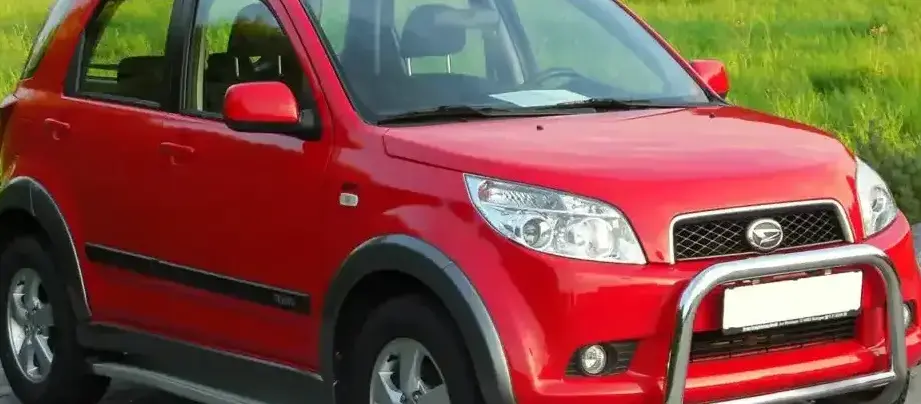
The Daihatsu Terios III, specifically the F800 series introduced with a facelift in June 2023, represents the latest iteration of Daihatsu’s popular compact SUV. This generation, positioned as a seven-seater, is primarily aimed at the Southeast Asian market, where affordable and practical family vehicles are in high demand. The 1.5-liter (104 hp) automatic variant occupies a central position within the Terios III lineup, offering a balance between fuel efficiency, ease of use, and passenger capacity. It serves as a key offering for buyers seeking a versatile vehicle for both urban commuting and occasional off-road excursions.
Technical Specifications
| Brand | Daihatsu |
| Model | Terios |
| Generation | Terios III (F800, facelift 2023) |
| Type (Engine) | 1.5 (104 Hp) Automatic |
| Start of production | June, 2023 |
| Powertrain Architecture | Internal Combustion engine |
| Body type | SUV |
| Seats | 7 |
| Doors | 5 |
| Fuel Type | Petrol (Gasoline) |
| Emission standard | Euro 4 |
| Weight-to-power ratio | 12.1 kg/Hp, 82.9 Hp/tonne |
| Weight-to-torque ratio | 9.2 kg/Nm, 108.4 Nm/tonne |
| Power | 104 Hp @ 6000 rpm |
| Power per litre | 69.5 Hp/l |
| Torque | 136 Nm @ 4200 rpm (100.31 lb.-ft. @ 4200 rpm) |
| Engine layout | Front, Transverse |
| Engine Model/Code | 2NR-VE |
| Engine displacement | 1496 cm3 (91.29 cu. in.) |
| Number of cylinders | 4 |
| Engine configuration | Inline |
| Cylinder Bore | 72.5 mm (2.85 in.) |
| Piston Stroke | 90.6 mm (3.57 in.) |
| Number of valves per cylinder | 4 |
| Fuel injection system | Multi-port manifold injection |
| Engine aspiration | Naturally aspirated engine |
| Valvetrain | DOHC, Dual VVT-i |
| Engine oil capacity | 3.5 l (3.7 US qt | 3.08 UK qt) |
| Coolant | 6 l (6.34 US qt | 5.28 UK qt) |
| Kerb Weight | 1255-1270 kg (2766.8 – 2799.87 lbs.) |
| Max. weight | 1870 kg (4122.64 lbs.) |
| Max load | 600-615 kg (1322.77 – 1355.84 lbs.) |
| Fuel tank capacity | 45 l (11.89 US gal | 9.9 UK gal) |
| Length | 4455 mm (175.39 in.) |
| Width | 1695 mm (66.73 in.) |
| Height | 1705 mm (67.13 in.) |
| Wheelbase | 2685 mm (105.71 in.) |
| Front track | 1445 mm (56.89 in.) |
| Rear (Back) track | 1460 mm (57.48 in.) |
| Ride height (ground clearance) | 220 mm (8.66 in.) |
| Minimum turning circle (turning diameter) | 10.4 m (34.12 ft.) |
| Drivetrain Architecture | The Internal combustion engine (ICE) drives the front wheels of the vehicle. |
| Drive wheel | Front wheel drive |
| Number of gears and type of gearbox | 4 gears, automatic transmission |
| Front suspension | Independent, type McPherson with coil spring and anti-roll bar |
| Rear suspension | Rigid axle suspension, Transverse stabilizer |
| Front brakes | Ventilated discs |
| Rear brakes | Drum |
| Assisting systems | ABS (Anti-lock braking system) |
| Steering type | Steering rack and pinion |
| Power steering | Electric Steering |
| Tires size | 215/65 R16; 215/60 R17 |
| Wheel rims size | 6.5J x 16; 6.5J x 17 |
INTRODUCTION
The Daihatsu Terios III, launched in 2023, builds upon the success of its predecessors, offering a practical and affordable seven-seater SUV. The facelifted model introduced in June 2023 brought subtle styling updates and refinements to the existing platform. The 1.5-liter automatic variant is a core component of the Terios III range, designed to appeal to families and individuals prioritizing convenience and fuel economy. It’s built on the DNGA (Daihatsu New Global Architecture) platform, a modular chassis designed to underpin a range of Daihatsu and Toyota vehicles, emphasizing cost-effectiveness and versatility. This variant is particularly popular in markets like Indonesia, Malaysia, and the Philippines.
Powertrain & Engine Architecture
At the heart of the Terios III 1.5 Automatic lies the 2NR-VE engine, a 1.5-liter inline-four cylinder gasoline engine. This engine utilizes a multi-point fuel injection system and is equipped with Dual VVT-i (Variable Valve Timing-intelligent) technology, optimizing valve timing for improved fuel efficiency and power delivery across the rev range. The 2NR-VE is known for its reliability and relatively simple design, contributing to lower maintenance costs. The engine produces 104 horsepower at 6000 rpm and 136 Nm (100.31 lb-ft) of torque at 4200 rpm. Paired with this engine is a four-speed automatic transmission. While not the most modern transmission in terms of gear count, it’s chosen for its robustness and cost-effectiveness. The transmission is tuned for smooth shifts and adequate acceleration, prioritizing drivability over outright performance.
Driving Characteristics
The Terios III 1.5 Automatic delivers a comfortable and predictable driving experience. The four-speed automatic transmission, while lacking the refinement of more modern units, provides smooth gear changes suitable for everyday driving. Acceleration is adequate for urban and highway use, but it’s not a particularly sporty vehicle. The 104 hp engine provides sufficient power for carrying a full load of passengers and luggage, but overtaking maneuvers require planning. The relatively tall gear ratios prioritize fuel economy over rapid acceleration. Compared to potential manual transmission versions (not widely available in all markets), the automatic offers greater convenience, especially in congested traffic. Compared to higher-spec Terios variants with potentially more powerful engines (if offered in certain regions), this 1.5L automatic prioritizes affordability and fuel efficiency over outright performance.
Equipment & Trim Levels
The Terios III 1.5 Automatic typically comes equipped with a range of standard features designed to enhance comfort and convenience. These often include air conditioning, power windows, power door locks, and a basic audio system with Bluetooth connectivity. Higher trim levels may add features such as alloy wheels, a touchscreen infotainment system, rear parking sensors, and a reverse camera. Interior upholstery is typically cloth, with a durable and practical design. Safety features generally include ABS (Anti-lock Braking System) and dual front airbags. Optional extras can vary by market but may include roof rails, side steps, and upgraded audio systems.
Chassis & Braking
The Terios III utilizes a McPherson strut suspension setup at the front, providing a comfortable ride and predictable handling. The rear suspension employs a rigid axle configuration with a transverse stabilizer bar, offering a balance between ride comfort and load-carrying capacity. The braking system consists of ventilated discs at the front and drum brakes at the rear. While the drum brakes at the rear are a cost-saving measure, they provide adequate stopping power for the vehicle’s weight and intended use. The electric power steering provides light and easy steering, making it maneuverable in urban environments.
Market Reception & Comparison
The Daihatsu Terios III 1.5 Automatic has been well-received in its target markets, particularly for its affordability, practicality, and seven-seater capacity. Critics have praised its spacious interior and comfortable ride. Fuel economy is a key selling point, with the 1.5-liter engine offering reasonable consumption figures. Compared to other trims in the Terios lineup, the 1.5 Automatic represents the sweet spot for many buyers, offering a good balance between price, performance, and features. It competes with other affordable seven-seater SUVs in the region, such as the Honda BR-V and the Toyota Rush, often undercutting them on price.
Legacy
The 2NR-VE engine has proven to be a reliable and durable unit in various Daihatsu and Toyota applications. The four-speed automatic transmission, while not cutting-edge, is known for its robustness. In the used car market, the Terios III 1.5 Automatic is expected to hold its value reasonably well due to its practicality and reputation for reliability. Maintenance costs are generally low, making it an attractive option for budget-conscious buyers. As Daihatsu continues to refine its DNGA platform, the Terios III is likely to remain a popular choice for families seeking an affordable and versatile SUV.