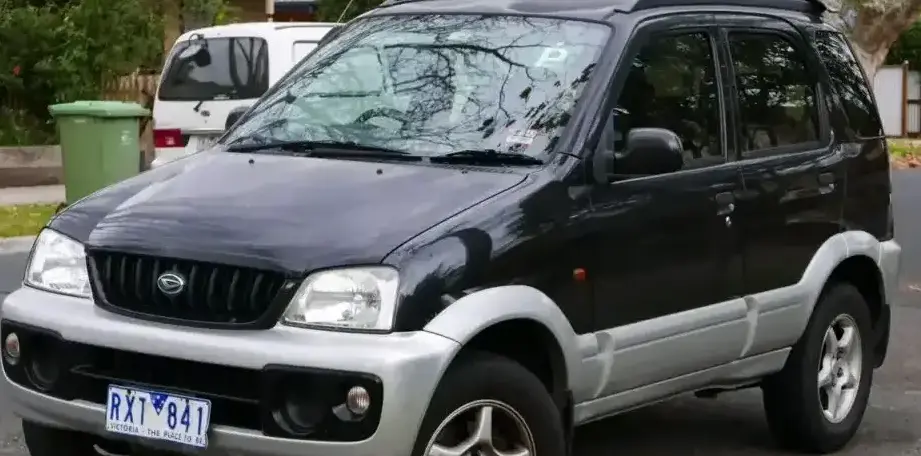
The Daihatsu Terios KID 0.7 i 12V CL, produced from 1998 to 2006, represents a unique entry in the compact SUV segment. This diminutive vehicle, part of the broader Terios family, was primarily aimed at the Japanese domestic market (JDM) and select export markets, offering a blend of affordability, practicality, and all-wheel-drive capability in a remarkably small package. The “KID” designation signified its kei car-inspired dimensions, fitting within Japan’s favorable tax and insurance brackets for smaller vehicles. This particular 0.7-liter variant, producing 60 horsepower, served as the entry point to the Terios KID lineup, prioritizing fuel efficiency and ease of use over outright performance.
Technical Specifications
| Brand | Daihatsu |
| Model | Terios |
| Generation | Terios KID |
| Type (Engine) | 0.7 i 12V CL (60 Hp) |
| Start of production | 1998 |
| End of production | 2006 |
| Powertrain Architecture | Internal Combustion engine |
| Body type | SUV |
| Seats | 5 |
| Doors | 5 |
| Fuel consumption (urban) | 10 l/100 km (23.5 US mpg) |
| Fuel consumption (extra urban) | 6 l/100 km (39.2 US mpg) |
| Fuel Type | Petrol (Gasoline) |
| Maximum speed | 135 km/h (83.89 mph) |
| Weight-to-power ratio | 16 kg/Hp |
| Weight-to-torque ratio | 11.4 kg/Nm |
| Power | 60 Hp @ 6800 rpm |
| Power per litre | 91 Hp/l |
| Torque | 84 Nm @ 4400 rpm (61.96 lb.-ft. @ 4400 rpm) |
| Engine layout | Front, Longitudinal |
| Engine displacement | 659 cm3 (40.21 cu. in.) |
| Number of cylinders | 3 |
| Engine configuration | Inline |
| Cylinder Bore | 68 mm (2.68 in.) |
| Piston Stroke | 60.5 mm (2.38 in.) |
| Compression ratio | 10.9:1 |
| Number of valves per cylinder | 4 |
| Fuel injection system | Multi-port manifold injection |
| Engine aspiration | Naturally Aspirated |
| Valvetrain | DOHC |
| Kerb Weight | 960 kg (2116.44 lbs.) |
| Max. weight | 1180 kg (2601.45 lbs.) |
| Max load | 220 kg (485.02 lbs.) |
| Trunk (boot) space – minimum | 129 l (4.56 cu. ft.) |
| Trunk (boot) space – maximum | 410 l (14.48 cu. ft.) |
| Fuel tank capacity | 40 l (10.57 US gal) |
| Length | 3395 mm (133.66 in.) |
| Width | 1475 mm (58.07 in.) |
| Height | 1675 mm (65.94 in.) |
| Wheelbase | 2420 mm (95.28 in.) |
| Front track | 1275 mm (50.2 in.) |
| Rear (Back) track | 1280 mm (50.39 in.) |
| Minimum turning circle | 9.4 m (30.84 ft.) |
| Drive wheel | All wheel drive (4×4) |
| Number of gears | 5 |
| Gearbox type | Manual transmission |
| Front suspension | Coil spring |
| Rear suspension | Coil spring |
| Front brakes | Disc |
| Rear brakes | Drum |
| Steering type | Steering rack and pinion |
| Power steering | Hydraulic |
| Tires size | 175/80 R15 S |
Powertrain & Engine Architecture
The heart of the Terios KID 0.7 i CL is the ED-20 engine, a 659cc inline-three cylinder gasoline engine. This engine, while modest in displacement, featured a double overhead camshaft (DOHC) valvetrain operating four valves per cylinder. This configuration, combined with multi-point fuel injection, allowed Daihatsu to extract a respectable 60 horsepower at 6800 rpm and 84 Nm (62 lb-ft) of torque at 4400 rpm. The engine’s longitudinal mounting facilitated the implementation of an all-wheel-drive system. The five-speed manual transmission was the standard offering for this trim level, providing a direct connection between the engine and the wheels. The transmission was chosen to maximize fuel economy and provide adequate performance for the vehicle’s intended use.
Driving Characteristics
The 0.7-liter Terios KID, with its limited horsepower and torque, wasn’t designed for rapid acceleration. Performance was best described as adequate for urban driving and light off-road excursions. The five-speed manual transmission allowed drivers to keep the engine in its optimal power band, but spirited driving required frequent gear changes. The all-wheel-drive system provided enhanced traction on slippery surfaces, making it a capable vehicle for navigating snowy or unpaved roads. Compared to the later 1.3-liter variants, the 0.7-liter model felt noticeably slower, particularly when fully loaded. However, its lighter weight and simpler mechanicals contributed to improved fuel economy.
Equipment & Trim Levels
The “CL” trim level represented a basic specification within the Terios KID range. Standard features typically included power steering, central locking, and basic instrumentation. Interior appointments were functional rather than luxurious, with durable cloth upholstery and a straightforward dashboard layout. Air conditioning and power windows were often optional extras. The focus was on providing a practical and affordable vehicle, rather than a feature-rich one. The small size of the vehicle meant interior space was at a premium, but the clever design maximized usability.
Chassis & Braking
The Terios KID utilized a body-on-frame construction, providing a robust and durable chassis. Suspension consisted of coil springs all around, offering a comfortable ride quality for its class. Front brakes were discs, providing adequate stopping power, while the rear brakes were drums, a cost-saving measure common in this segment. The steering system employed a rack and pinion setup with hydraulic assistance, offering precise and responsive handling. The relatively narrow tires (175/80 R15) contributed to fuel efficiency and ride comfort, but limited grip during aggressive cornering.
Market Reception & Comparison
The Terios KID 0.7 i CL was well-received in its target markets, particularly in Japan, where its compact size and affordable price point resonated with consumers. Critics praised its practicality, fuel efficiency, and all-wheel-drive capability. However, the limited power output was a common criticism, especially when compared to larger or more powerful SUVs. Compared to the 1.3-liter Terios KID variants, the 0.7-liter model offered significantly better fuel economy but lacked the performance needed for highway driving or carrying heavy loads. It was often seen as an ideal city car or a first vehicle for young drivers.
Legacy
The Daihatsu Terios KID 0.7 i CL, while not a performance icon, holds a significant place in automotive history as a pioneering example of a compact, affordable SUV. Its robust mechanicals and simple design have contributed to its longevity, and well-maintained examples are still found on the road today. The ED-20 engine, while not known for its complexity, is generally considered reliable, provided it receives regular maintenance. In the used car market, the 0.7-liter Terios KID remains a popular choice for those seeking a practical, fuel-efficient, and capable small SUV, particularly in regions where its compact size is an advantage.