
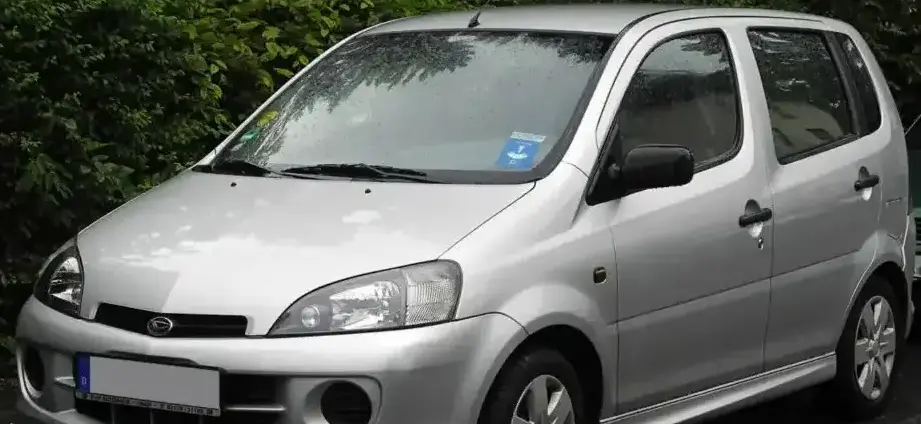
The Daihatsu YRV 1.3 i 16V, produced between 2001 and 2005, was a compact, five-door minivan primarily marketed in Europe and Japan. Representing the second generation of the YRV (Young Recreational Vehicle) line, this variant occupied the entry-level position within the range, offering an affordable and practical option for small families or individuals seeking a versatile vehicle. It was positioned below the more powerful 1.5-liter versions and served as a more economical alternative to larger MPVs available at the time. The YRV was a key model for Daihatsu in Europe, showcasing their expertise in building small, efficient vehicles.
Technical Specifications
| Brand | Daihatsu |
| Model | YRV |
| Generation | YRV |
| Type (Engine) | 1.3 i 16V (87 Hp) |
| Start of production | 2001 |
| End of production | 2005 |
| Powertrain Architecture | Internal Combustion engine |
| Body type | Minivan |
| Seats | 5 |
| Doors | 5 |
| Fuel consumption (urban) | 7.8 l/100 km (30.2 US mpg) |
| Fuel consumption (extra urban) | 5.1 l/100 km (46.1 US mpg) |
| Fuel consumption (combined) | 6 l/100 km (39.2 US mpg) |
| Fuel Type | Petrol (Gasoline) |
| Acceleration 0 – 100 km/h | 10.3 sec |
| Acceleration 0 – 62 mph | 10.3 sec |
| Acceleration 0 – 60 mph | 9.8 sec |
| Maximum speed | 175 km/h (108.74 mph) |
| Weight-to-power ratio | 11.1 kg/Hp |
| Weight-to-torque ratio | 8 kg/Nm |
| Power | 87 Hp @ 6000 rpm |
| Torque | 120 Nm @ 3200 rpm (88.51 lb.-ft. @ 3200 rpm) |
| Engine layout | Front, Longitudinal |
| Engine Model/Code | K3-VE |
| Engine displacement | 1298 cm3 (79.21 cu. in.) |
| Number of cylinders | 4 |
| Engine configuration | Inline |
| Cylinder Bore | 72 mm (2.83 in.) |
| Piston Stroke | 79.7 mm (3.14 in.) |
| Compression ratio | 10:1 |
| Number of valves per cylinder | 4 |
| Fuel injection system | Multi-port manifold injection |
| Engine aspiration | Naturally aspirated |
| Valvetrain | DOHC |
| Engine oil capacity | 3.6 l (3.8 US qt | 3.17 UK qt) |
| Coolant capacity | 4 l (4.23 US qt | 3.52 UK qt) |
| Kerb Weight | 965 kg (2127.46 lbs.) |
| Max. weight | 1400 kg (3086.47 lbs.) |
| Max load | 435 kg (959.01 lbs.) |
| Trunk (boot) space – minimum | 240 l (8.48 cu. ft.) |
| Trunk (boot) space – maximum | 1076 l (38 cu. ft.) |
| Fuel tank capacity | 40 l (10.57 US gal | 8.8 UK gal) |
| Length | 3765 mm (148.23 in.) |
| Width | 1620 mm (63.78 in.) |
| Height | 1550 mm (61.02 in.) |
| Wheelbase | 2355 mm (92.72 in.) |
| Front track | 1395 mm (54.92 in.) |
| Rear track | 1365 mm (53.74 in.) |
| Minimum turning circle | 8.8 m (28.87 ft.) |
| Drivetrain | Front wheel drive |
| Number of gears | 5 |
| Gearbox type | Manual transmission |
| Front suspension | Spring Strut |
| Rear suspension | Coil spring |
| Front brakes | Ventilated discs |
| Rear brakes | Drum |
| Assisting systems | ABS (Anti-lock braking system) |
| Steering type | Steering rack and pinion |
| Power steering | Hydraulic |
| Tires size | 165/65 R14 T |
| Wheel rims size | 5J x 14 |
Powertrain & Engine Architecture
The YRV 1.3 i 16V was powered by the Daihatsu K3-VE engine, a 1.3-liter, inline-four cylinder gasoline engine. This engine featured a double overhead camshaft (DOHC) valvetrain with four valves per cylinder, contributing to its relatively efficient operation. The K3-VE utilized a multi-point fuel injection system, delivering fuel directly to each intake port. The engine produced 87 horsepower at 6000 rpm and 120 Nm (88.51 lb-ft) of torque at 3200 rpm. The engine’s longitudinal mounting was a notable design choice, influencing the drivetrain layout. The engine was paired with a five-speed manual transmission, which was the standard offering for this variant. While an automatic transmission was available in some markets, the manual was favored for its improved fuel economy and driver engagement.
Driving Characteristics
The 1.3-liter engine, coupled with the five-speed manual transmission, provided adequate, though not exhilarating, performance. Acceleration from 0 to 60 mph took approximately 9.8 seconds, and the top speed was around 108.74 mph. The gear ratios were tuned for fuel efficiency and everyday usability rather than outright speed. The engine felt responsive enough for urban driving and highway cruising, but overtaking maneuvers required careful planning. Compared to the 1.5-liter versions, the 1.3L felt noticeably less powerful, particularly when fully loaded with passengers and luggage. The manual transmission offered precise shifts, enhancing the driving experience, while the relatively light weight of the YRV contributed to its nimble handling.
Equipment & Trim Levels
The YRV 1.3 i 16V typically came equipped with basic, yet functional, features. Standard equipment included power steering, central locking, electric front windows, and an adjustable steering column. Interior upholstery was typically cloth, with a simple, durable design. Optional extras included air conditioning, alloy wheels, and a radio/CD player. The dashboard layout was straightforward and easy to use, prioritizing practicality over luxury. Trim levels were relatively limited, with most models offering a similar level of equipment. The focus was on providing a cost-effective and reliable vehicle.
Chassis & Braking
The YRV featured a front-wheel-drive layout with a MacPherson strut suspension in the front and a coil spring suspension in the rear. The front brakes were ventilated discs, providing adequate stopping power, while the rear brakes were drums. ABS (Anti-lock Braking System) was standard, enhancing safety. The suspension was tuned for comfort, providing a relatively smooth ride over uneven surfaces. The YRV’s compact size and light weight contributed to its agile handling. Stabilizer bars were present, but relatively thin, reflecting the vehicle’s focus on affordability.
Market Reception & Comparison
The Daihatsu YRV 1.3 i 16V was generally well-received as an affordable and practical small MPV. Critics praised its fuel efficiency, compact size, and versatile interior. However, some reviewers noted its lack of power compared to larger or more expensive MPVs. Compared to the 1.5-liter YRV variants, the 1.3L offered better fuel economy but sacrificed performance. It competed with other small MPVs such as the Renault Modus and the Fiat Multipla, offering a similar level of practicality at a competitive price point. Its reliability was generally considered good, although maintenance costs could be slightly higher due to the vehicle’s Japanese origin and potential parts availability issues in some markets.
Legacy
The Daihatsu YRV 1.3 i 16V has proven to be a relatively reliable vehicle in the used car market. The K3-VE engine is known for its durability, although regular maintenance is essential. Parts availability can be a challenge in some regions, but many components are still available through specialist suppliers. Today, the YRV is often sought after by those looking for an affordable, economical, and practical small MPV. While not a performance car, its versatility and reliability have ensured its continued presence on the roads, making it a fondly remembered vehicle for those who owned one.
