
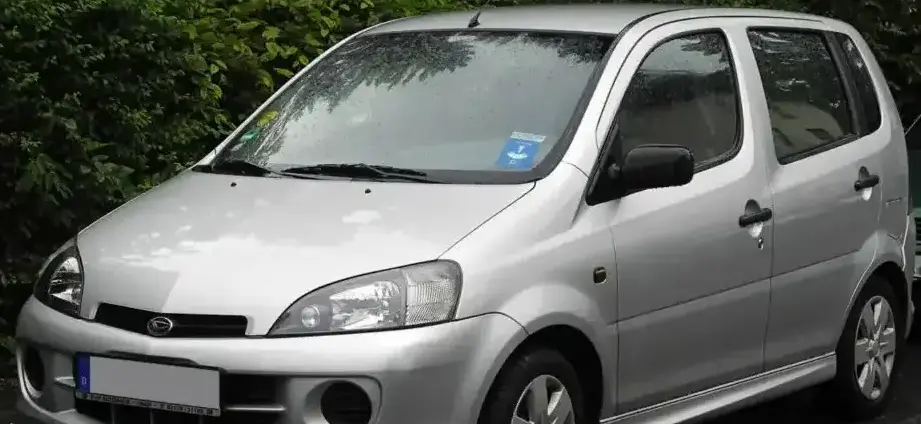
The Daihatsu YRV 1.3 i 16V, produced from 2000 to 2005, represents a unique offering in the subcompact minivan segment. This particular variant, equipped with a 1.3-liter 16-valve engine producing 90 horsepower and paired with a 4-speed automatic transmission, was primarily marketed in Europe and Japan as an affordable and practical city car. The YRV (Youthful Revolutionary Vehicle) aimed to blend the spaciousness of a small MPV with the maneuverability of a hatchback, appealing to young families and individuals seeking versatile transportation. It was built on the P10 series platform, shared with other Daihatsu and Toyota models.
Technical Specifications
| Brand | Daihatsu |
| Model | YRV |
| Generation | YRV |
| Type (Engine) | 1.3 i 16V (90 Hp) 2WD Automatic |
| Start of production | 2000 year |
| End of production | 2005 year |
| Powertrain Architecture | Internal Combustion engine |
| Body type | Minivan |
| Seats | 5 |
| Doors | 5 |
| Fuel consumption (urban) | 6.9 l/100 km (34.1 US mpg, 40.9 UK mpg, 14.5 km/l) |
| Fuel consumption (extra urban) | 4.9 l/100 km (48 US mpg, 57.6 UK mpg, 20.4 km/l) |
| Fuel consumption (combined) | 5.6 l/100 km (42 US mpg, 50.4 UK mpg, 17.9 km/l) |
| Fuel Type | Petrol (Gasoline) |
| Acceleration 0 – 100 km/h | 15.4 sec |
| Acceleration 0 – 62 mph | 15.4 sec |
| Acceleration 0 – 60 mph | 14.6 sec |
| Maximum speed | 150 km/h (93.21 mph) |
| Weight-to-power ratio | 9.7 kg/Hp |
| Weight-to-torque ratio | 7.1 kg/Nm |
| Power | 90 Hp @ 6000 rpm |
| Power per litre | 69.4 Hp/l |
| Torque | 123 Nm @ 4400 rpm (90.72 lb.-ft. @ 4400 rpm) |
| Engine layout | Front, Longitudinal |
| Engine displacement | 1297 cm3 (79.15 cu. in.) |
| Number of cylinders | 4 |
| Engine configuration | Inline |
| Cylinder Bore | 72 mm (2.83 in.) |
| Piston Stroke | 79.7 mm (3.14 in.) |
| Compression ratio | 10:1 |
| Number of valves per cylinder | 4 |
| Fuel injection system | Multi-port manifold injection |
| Engine aspiration | Naturally aspirated engine |
| Valvetrain | DOHC |
| Kerb Weight | 875 kg (1929.04 lbs.) |
| Max. weight | 1360 kg (2998.29 lbs.) |
| Max load | 485 kg (1069.24 lbs.) |
| Trunk (boot) space – minimum | 238 l (8.4 cu. ft.) |
| Trunk (boot) space – maximum | 1026 l (36.23 cu. ft.) |
| Fuel tank capacity | 40 l (10.57 US gal | 8.8 UK gal) |
| Length | 3765 mm (148.23 in.) |
| Width | 1620 mm (63.78 in.) |
| Height | 1550 mm (61.02 in.) |
| Wheelbase | 2355 mm (92.72 in.) |
| Front track | 1395 mm (54.92 in.) |
| Rear (Back) track | 1365 mm (53.74 in.) |
| Minimum turning circle | 8.8 m (28.87 ft.) |
| Drivetrain Architecture | The Internal combustion engine (ICE) drives the front wheels of the vehicle. |
| Drive wheel | Front wheel drive |
| Number of gears | 4 gears, automatic transmission |
| Front suspension | Spring Strut |
| Rear suspension | Coil spring |
| Front brakes | Ventilated discs |
| Rear brakes | Drum |
| Assisting systems | ABS (Anti-lock braking system) |
| Steering type | Steering rack and pinion |
| Power steering | Hydraulic Steering |
| Tires size | 165/65 R14 |
| Wheel rims size | 14 |
Powertrain & Engine Architecture
The heart of the YRV 1.3 i is the Daihatsu K3-VE engine, a 1.3-liter (1297 cc) inline-four cylinder gasoline engine. This engine utilizes a multi-point fuel injection system and a double overhead camshaft (DOHC) valvetrain with four valves per cylinder. The engine code, K3-VE, is crucial for identifying specific parts and maintenance requirements. While not a powerhouse, the K3-VE was known for its relative reliability and fuel efficiency. The 4-speed automatic transmission, a common unit in Daihatsu and Toyota vehicles of the era, was chosen for its simplicity and cost-effectiveness. It’s a conventional hydraulic automatic, lacking the more advanced electronic controls found in later transmissions. The engine is longitudinally mounted, driving the front wheels.
Driving Characteristics
The 90 horsepower and 123 Nm (90.72 lb-ft) of torque delivered by the 1.3-liter engine and automatic transmission resulted in modest, but adequate, performance. Acceleration from 0-60 mph took around 14.6 seconds, and top speed was limited to 150 km/h (93.21 mph). The automatic transmission, while providing convenience, did detract from the overall responsiveness. Gear changes were not particularly quick or smooth, and the transmission tended to hunt for gears on inclines. Compared to the manual transmission versions of the YRV, the automatic offered less driver engagement and slightly reduced fuel economy. However, it was the preferred choice for drivers prioritizing ease of use, especially in congested urban environments.
Equipment & Trim Levels
The YRV 1.3 i Automatic typically came with a fairly basic level of equipment, reflecting its position as an entry-level model. Standard features generally included power steering, central locking, electric front windows, and an AM/FM radio. Air conditioning was often an optional extra, as were alloy wheels and a more sophisticated audio system. Interior upholstery was typically cloth, and the dashboard featured a simple, functional design. Higher trim levels, available in some markets, added features like a sunroof, upgraded interior trim, and body-colored bumpers.
Chassis & Braking
The YRV’s chassis featured a MacPherson strut front suspension and a coil spring rear suspension. The front brakes were ventilated discs, providing adequate stopping power, while the rear brakes were drums, a cost-saving measure common in this class of vehicle. ABS (Anti-lock Braking System) was often included as standard equipment, enhancing safety. The relatively lightweight construction of the YRV (875 kg / 1929.04 lbs) helped to offset the modest engine output, contributing to reasonable handling characteristics. Stabilizer bars were present, but relatively thin, reflecting the car’s focus on comfort rather than sporty handling.
Market Reception & Comparison
The Daihatsu YRV 1.3 i Automatic was generally well-received as a practical and affordable city car. Critics praised its spacious interior, good fuel economy (around 42 US mpg combined), and ease of driving. However, the engine was often criticized for being underpowered, particularly when fully loaded or on hilly terrain. Compared to other subcompact MPVs of the time, such as the Renault Modus or the Fiat Multipla, the YRV offered a more conventional and less quirky design. Its reliability was generally considered good, although the automatic transmission could be prone to wear and tear if not properly maintained.
Legacy
The Daihatsu YRV, while not a mainstream success in many markets, established a reputation for practicality and reliability. The 1.3-liter engine and 4-speed automatic transmission combination proved to be reasonably durable, and many examples are still on the road today. In the used car market, the YRV 1.3 i Automatic remains an affordable option for those seeking a small, economical, and versatile vehicle. However, potential buyers should be aware of the potential for transmission issues and the relatively slow acceleration. The YRV represents a unique chapter in Daihatsu’s history, showcasing their ability to create innovative and practical vehicles for a specific niche market.
