
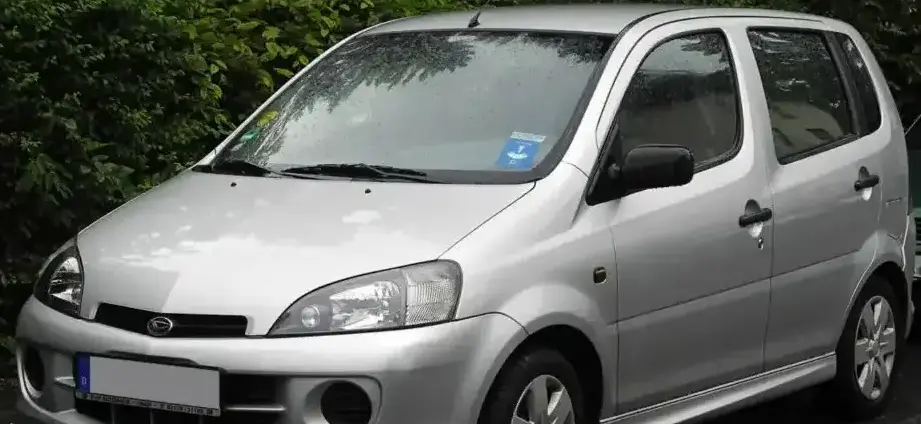
Technical Specifications
| Brand | Daihatsu |
| Model | YRV |
| Generation | YRV |
| Type (Engine) | 1.3 i 16V Turbo (140 Hp) |
| Start of production | 2000 year |
| End of production | 2005 year |
| Powertrain Architecture | Internal Combustion engine |
| Body type | Minivan |
| Seats | 5 |
| Doors | 5 |
| Fuel Type | Petrol (Gasoline) |
| Weight-to-power ratio | 6.7 kg/Hp, 148.9 Hp/tonne |
| Weight-to-torque ratio | 5.3 kg/Nm, 188.3 Nm/tonne |
| Power | 140 Hp @ 6400 rpm |
| Power per litre | 107.9 Hp/l |
| Torque | 177 Nm @ 3200 rpm (130.55 lb.-ft. @ 3200 rpm) |
| Engine layout | Front, Transverse |
| Engine displacement | 1298 cm3 (79.21 cu. in.) |
| Number of cylinders | 4 |
| Engine configuration | Inline |
| Cylinder Bore | 72 mm (2.83 in.) |
| Piston Stroke | 79.7 mm (3.14 in.) |
| Compression ratio | 10:1 |
| Number of valves per cylinder | 4 |
| Fuel injection system | Multi-port manifold injection |
| Engine aspiration | Turbocharger |
| Valvetrain | OHC |
| Kerb Weight | 940 kg (2072.35 lbs.) |
| Trunk (boot) space – minimum | 165 l (5.83 cu. ft.) |
| Trunk (boot) space – maximum | 1075 l (37.96 cu. ft.) |
| Fuel tank capacity | 40 l (10.57 US gal | 8.8 UK gal) |
| Length | 3765 mm (148.23 in.) |
| Width | 1625 mm (63.98 in.) |
| Height | 1565 mm (61.61 in.) |
| Wheelbase | 2370 mm (93.31 in.) |
| Front track | 1380 mm (54.33 in.) |
| Rear (Back) track | 1365 mm (53.74 in.) |
| Minimum turning circle | 8.8 m (28.87 ft.) |
| Drivetrain Architecture | The Internal combustion engine (ICE) drives the front wheels of the vehicle. |
| Drive wheel | Front wheel drive |
| Number of gears and type of gearbox | 5 gears, manual transmission |
| Front suspension | Coil spring |
| Rear suspension | Coil spring |
| Front brakes | Ventilated discs |
| Rear brakes | Drum |
| Assisting systems | ABS (Anti-lock braking system) |
| Steering type | Steering rack and pinion |
| Power steering | Hydraulic Steering |
| Tires size | 175/60R14 |
The Daihatsu YRV 1.3 i 16V Turbo, produced between 2000 and 2005, represents a unique offering within the compact MPV (Multi-Purpose Vehicle) segment. Positioned as a slightly more performance-oriented variant of the second-generation YRV (often referred to as the P200 series), this model aimed to provide a blend of practicality, fuel efficiency, and spirited driving. The YRV, in general, was primarily marketed in Japan and Europe, offering a smaller, more maneuverable alternative to larger MPVs like the Renault Scenic or Opel Zafira. The 1.3L Turbo model, while not a high-volume seller, distinguished itself with its turbocharged engine, offering a noticeable power upgrade over the naturally aspirated versions.
Powertrain & Engine Architecture
The heart of the YRV 1.3 i 16V Turbo is the K3-VE engine, a 1.3-liter inline-four cylinder gasoline engine equipped with a turbocharger and intercooler. This engine, part of Daihatsu’s ‘KD’ engine family, utilizes a single overhead camshaft (OHC) valvetrain with four valves per cylinder. The multi-port fuel injection system delivers fuel directly into the intake ports, optimizing combustion. The turbocharger, a key component, significantly boosts power output compared to the naturally aspirated 1.3-liter engine found in other YRV models. The engine code ‘K3-VE’ is crucial for identifying specific parts and maintenance requirements. The five-speed manual transmission was the only gearbox option available with this engine, providing drivers with direct control over the power delivery. The transmission’s gear ratios were tuned to maximize the turbocharger’s effectiveness, providing good acceleration in the lower gears and reasonable cruising ability at highway speeds.
Driving Characteristics
The 140 horsepower and 177 Nm (130.55 lb-ft) of torque delivered by the turbocharged engine provided a noticeable performance advantage over the base YRV models. While not a sports car, the YRV 1.3 Turbo offered brisk acceleration and a surprisingly engaging driving experience for a compact MPV. The turbocharger did exhibit some lag at lower RPMs, but once spooled up, it provided a strong surge of power. The five-speed manual transmission allowed drivers to keep the engine in its optimal power band. Compared to the naturally aspirated versions, the turbo model felt significantly more capable when fully loaded with passengers and luggage. The relatively lightweight construction of the YRV further enhanced its agility and responsiveness.
Equipment & Trim Levels
The YRV 1.3 i 16V Turbo typically came with a reasonably well-equipped specification, although trim levels varied depending on the market. Standard features generally included power steering, central locking, electric front windows, and an adjustable steering column. Air conditioning was often standard, but sometimes offered as an option. Interior upholstery was typically cloth, with a functional and durable design. Optional extras could include alloy wheels, a CD player, and upgraded interior trim. The dashboard layout was straightforward and user-friendly, prioritizing practicality over luxury.
Chassis & Braking
The YRV’s chassis featured a MacPherson strut front suspension and a coil spring rear suspension. This setup provided a comfortable ride quality, although it wasn’t particularly sporty. The front brakes were ventilated discs, offering adequate stopping power, while the rear brakes were drums. ABS (Anti-lock Braking System) was standard, enhancing safety. The steering utilized a rack and pinion system with hydraulic power assistance, providing precise and responsive steering feel. The relatively narrow tires (175/60R14) contributed to fuel efficiency but limited grip in demanding driving situations.
Market Reception & Comparison
The YRV 1.3 i 16V Turbo received generally positive reviews from automotive critics, who praised its performance, fuel efficiency, and practicality. However, some critics noted the turbo lag and the somewhat basic interior. Compared to the naturally aspirated YRV models, the turbo version offered a significant performance upgrade, but at a slightly higher price point. It competed with other small MPVs like the Fiat Multipla and the Citroën Berlingo, but offered a more compact and maneuverable alternative. Fuel economy was competitive for its class, and the YRV proved to be a relatively reliable vehicle.
Legacy
The Daihatsu YRV 1.3 i 16V Turbo, while not a mainstream success, has gained a cult following among enthusiasts who appreciate its unique blend of practicality and performance. The K3-VE engine, when properly maintained, is known for its durability. Today, finding a well-maintained example can be challenging, but they represent an interesting and affordable option for those seeking a compact and versatile MPV with a bit of extra punch. Parts availability can be an issue in some regions, but a dedicated online community exists to support owners. The YRV 1.3 Turbo remains a testament to Daihatsu’s engineering ingenuity and its commitment to offering innovative and affordable vehicles.
