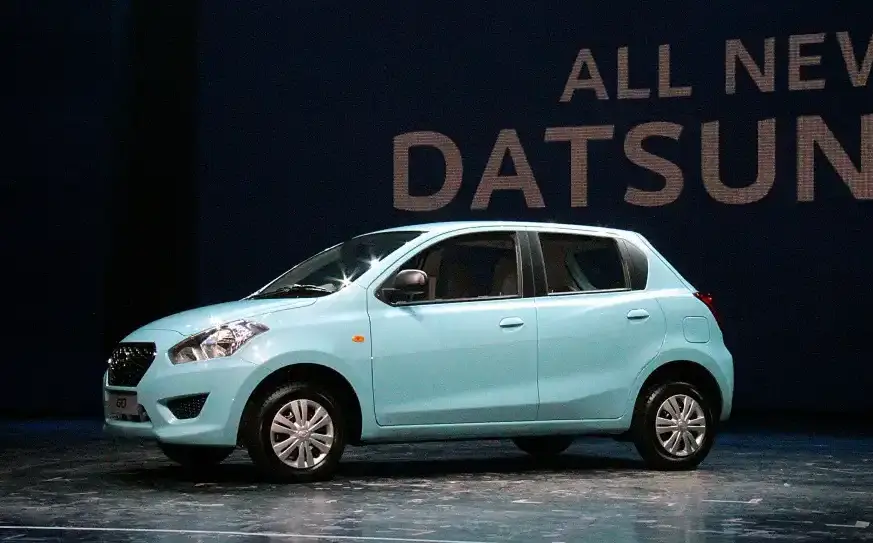
The Datsun GO I 1.2 (68 Hp) is a subcompact hatchback produced from 2013 to 2018, primarily targeted at emerging markets, particularly India, Russia, and South Africa. Representing Datsun’s re-entry into the automotive market after a long hiatus, the GO aimed to provide affordable and practical transportation. This specific 1.2-liter, 68 horsepower variant served as the entry point into the GO lineup, emphasizing fuel efficiency and low running costs over outright performance. It was built on the V-Platform shared with the Nissan Micra (March) and positioned as a budget-friendly alternative to more established competitors.
Technical Specifications
| Brand | Datsun |
| Model | GO |
| Generation | GO I |
| Type (Engine) | 1.2 (68 Hp) |
| Start of production | 2013 |
| End of production | 2018 |
| Powertrain Architecture | Internal Combustion engine |
| Body type | Hatchback |
| Seats | 5 |
| Doors | 5 |
| Fuel Type | Petrol (Gasoline) |
| Power | 68 Hp @ 5000 rpm |
| Power per litre | 56.8 Hp/l |
| Torque | 104 Nm @ 4000 rpm / 76.71 lb.-ft. @ 4000 rpm |
| Engine layout | Front, Transverse |
| Engine Model/Code | HR12DE |
| Engine displacement | 1198 cm3 / 73.11 cu. in. |
| Number of cylinders | 3 |
| Engine configuration | Inline |
| Cylinder Bore | 78 mm / 3.07 in. |
| Piston Stroke | 83.6 mm / 3.29 in. |
| Number of valves per cylinder | 4 |
| Engine aspiration | Naturally aspirated engine |
| Valvetrain | DOHC |
| Engine oil capacity | 3.4 l / 3.59 US qt | 2.99 UK qt |
| Trunk (boot) space – minimum | 265 l / 9.36 cu. ft. |
| Fuel tank capacity | 35 l / 9.25 US gal | 7.7 UK gal |
| Length | 3785 mm / 149.02 in. |
| Width | 1635 mm / 64.37 in. |
| Height | 1485 mm / 58.46 in. |
| Wheelbase | 2450 mm / 96.46 in. |
| Front track | 1440 mm / 56.69 in. |
| Rear (Back) track | 1445 mm / 56.89 in. |
| Ride height (ground clearance) | 170 mm / 6.69 in. |
| Minimum turning circle (turning diameter) | 9.2 m / 30.18 ft. |
| Drivetrain Architecture | The Internal combustion engine (ICE) drives the front wheels of the vehicle. |
| Drive wheel | Front wheel drive |
| Number of gears and type of gearbox | 5 gears, manual transmission |
| Front suspension | Independent type McPherson |
| Rear suspension | Torsion |
| Front brakes | Ventilated discs |
| Rear brakes | Drum |
| Tires size | 155/70 R13 |
| Wheel rims size | 5.5J x 13 |
Powertrain & Engine Architecture
The Datsun GO 1.2 is powered by the HR12DE, a 1.2-liter inline-three cylinder engine. This engine utilizes a double overhead camshaft (DOHC) valvetrain with four valves per cylinder, contributing to improved breathing and efficiency. The HR12DE is a naturally aspirated engine, meaning it doesn’t employ turbocharging or supercharging. Fuel delivery is managed by a multi-point fuel injection system. The engine’s design prioritizes fuel economy and reliability over high performance. The 5-speed manual transmission was the only transmission option available for this variant. The gearbox was chosen for its simplicity and cost-effectiveness, aligning with the GO’s overall budget-focused approach.
Driving Characteristics
The 68 horsepower output of the HR12DE engine in the Datsun GO 1.2 results in modest acceleration. The car is best suited for urban driving and shorter commutes. The 5-speed manual transmission offers a reasonable spread of gears, allowing the driver to keep the engine in its optimal power band. However, overtaking maneuvers on highways require careful planning. Compared to potential higher-spec versions (which were never offered), the 1.2L model feels noticeably less responsive. The gear ratios are tuned for fuel efficiency, meaning the engine can feel strained when pushed hard. The lightweight nature of the GO helps mitigate the lack of power to some extent, providing a relatively nimble feel in city traffic.
Equipment & Trim Levels
The Datsun GO 1.2 was offered with a relatively basic level of equipment, reflecting its position as an entry-level vehicle. Standard features typically included power steering, air conditioning (often optional), and basic instrumentation. Interior upholstery was typically cloth, with a functional but spartan design. Safety features were also limited, often including only driver and passenger airbags and seatbelts. Optional extras could include a radio/CD player and power windows. The trim levels were generally minimal, with the focus being on providing a basic, reliable mode of transportation at the lowest possible price point.
Chassis & Braking
The Datsun GO I utilizes a McPherson strut independent suspension system at the front, providing a reasonable level of ride comfort. The rear suspension employs a torsion beam setup, which is a cost-effective solution for maintaining rear wheel alignment. The front brakes are ventilated discs, offering adequate stopping power for the vehicle’s weight and performance. However, the rear brakes are drums, which are less effective than disc brakes and can be prone to fading under heavy use. The relatively small 155/70 R13 tires contribute to a comfortable ride but offer limited grip.
Market Reception & Comparison
The Datsun GO 1.2 was generally well-received in its target markets as an affordable and practical option. Critics praised its fuel efficiency and low running costs, but also noted its lack of refinement and limited features. Compared to competitors like the Maruti Suzuki Alto and Hyundai i10, the GO offered a similar level of affordability but often lagged behind in terms of interior quality and features. Fuel economy was a strong point, consistently achieving figures in the range of 5.0-5.5 liters per 100 kilometers (approximately 47-51 mpg). Reliability was generally considered good, although some owners reported minor issues with the engine and electrical systems.
Legacy
The Datsun GO I 1.2, while not a groundbreaking vehicle, played a significant role in re-establishing the Datsun brand in emerging markets. The HR12DE engine proved to be a relatively reliable and fuel-efficient powerplant, and the GO’s simple design contributed to its low maintenance costs. In the used car market, the GO 1.2 remains an affordable option for budget-conscious buyers. However, potential buyers should be aware of its limited features and modest performance. The GO paved the way for subsequent Datsun models and helped to build a foundation for the brand’s future growth, even though the Datsun brand was eventually discontinued again in 2020.