
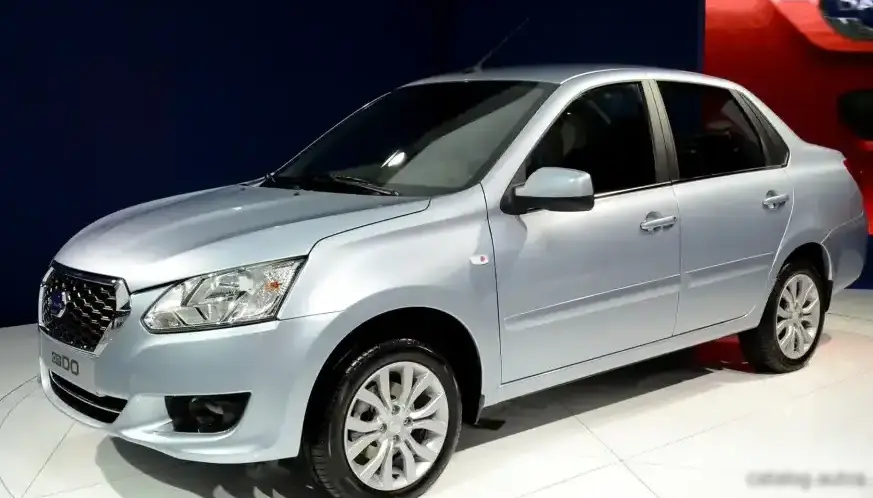
The Datsun on-DO 1.6 (106 hp) is a subcompact sedan produced by the Russian subsidiary of Datsun, a brand revived by Nissan in 2013. Introduced in 2017, the on-DO was designed to offer affordable transportation in the Russian market, filling a gap left by the discontinuation of the Lada L-series. This particular 1.6-liter, 106 horsepower variant represented a mid-range offering within the on-DO lineup, positioned above the base 1.6-liter 87 hp model and below potential future, higher-specification trims. The on-DO was built on a modified version of the Renault Logan platform, reflecting the close partnership between Renault-Nissan and AvtoVAZ, the Russian automaker behind the Lada brand.
Technical Specifications
| Brand | Datsun |
| Model | on-DO |
| Generation | on-DO |
| Type (Engine) | 1.6 (106 Hp) |
| Start of production | 2017 |
| Powertrain Architecture | Internal Combustion engine |
| Body type | Sedan |
| Seats | 5 |
| Doors | 4 |
| Fuel consumption (urban) | 8.8 l/100 km (26.7 US mpg) |
| Fuel consumption (extra urban) | 5.6 l/100 km (42 US mpg) |
| Fuel consumption (combined) | 6.6 l/100 km (35.6 US mpg) |
| Fuel Type | Petrol (Gasoline) |
| Acceleration 0 – 100 km/h | 10.5 sec |
| Acceleration 0 – 62 mph | 10.5 sec |
| Acceleration 0 – 60 mph | 10 sec |
| Maximum speed | 184 km/h (114.33 mph) |
| Weight-to-power ratio | 10.9 kg/Hp |
| Weight-to-torque ratio | 7.8 kg/Nm |
| Power | 106 Hp @ 5800 rpm |
| Power per litre | 66.4 Hp/l |
| Torque | 148 Nm @ 4200 rpm (109.16 lb.-ft. @ 4200 rpm) |
| Engine layout | Front, Transverse |
| Engine displacement | 1596 cm3 (97.39 cu. in.) |
| Number of cylinders | 4 |
| Engine configuration | Inline |
| Cylinder Bore | 82 mm (3.23 in.) |
| Piston Stroke | 75.6 mm (2.98 in.) |
| Compression ratio | 10.6:1 |
| Number of valves per cylinder | 2 |
| Fuel injection system | Multi-port manifold injection |
| Engine aspiration | Naturally aspirated engine |
| Kerb Weight | 1160 kg (2557.36 lbs.) |
| Max. weight | 1560 kg (3439.21 lbs.) |
| Max load | 400 kg (881.85 lbs.) |
| Trunk (boot) space – minimum | 530 l (18.72 cu. ft.) |
| Fuel tank capacity | 50 l (13.21 US gal | 11 UK gal) |
| Length | 4337 mm (170.75 in.) |
| Width | 1700 mm (66.93 in.) |
| Height | 1500 mm (59.06 in.) |
| Wheelbase | 2476 mm (97.48 in.) |
| Ride height (ground clearance) | 174 mm (6.85 in.) |
| Drivetrain Architecture | The Internal combustion engine (ICE) drives the front wheels of the vehicle. |
| Drive wheel | Front wheel drive |
| Number of gears and type of gearbox | 5 gears, manual transmission |
| Front brakes | Ventilated discs |
| Rear brakes | Drum |
| Assisting systems | ABS (Anti-lock braking system) |
| Tires size | 185/60 R14 |
| Wheel rims size | 5.5J x 14 ET35 |
Powertrain & Engine Architecture
The Datsun on-DO 1.6 utilized the HR16DE engine, a 1.6-liter inline-four cylinder gasoline engine. This engine, a member of Nissan’s HR engine family, featured multi-point fuel injection and a dual overhead camshaft (DOHC) valvetrain with two valves per cylinder. The HR16DE was known for its relatively simple design and focus on reliability rather than outright performance. The 106 horsepower output was achieved through a combination of optimized engine mapping and a slightly higher compression ratio compared to the lower-powered 87 hp version. The engine was transversely mounted in the front of the vehicle, driving the front wheels. The on-DO 1.6 was exclusively offered with a five-speed manual transmission. While an automated manual transmission (AMT) was available on some on-DO models, it was not paired with the 106 hp engine.
Driving Characteristics
The on-DO 1.6, with its 106 hp and five-speed manual transmission, offered a noticeable improvement in performance over the base 87 hp model. Acceleration from 0 to 60 mph took approximately 10 seconds, making it adequate for everyday driving situations. The five-speed gearbox allowed for reasonable control over engine RPMs, although the shift quality was often criticized as being somewhat notchy. The power delivery was linear, with peak torque arriving at 4200 rpm. While not a sporty vehicle, the on-DO 1.6 provided sufficient power for highway merging and overtaking maneuvers. The relatively light weight of the vehicle (around 2557 lbs) helped to offset the modest horsepower figure.
Equipment & Trim Levels
The Datsun on-DO 1.6 was typically offered in a single, well-equipped trim level. Standard features included power front windows, central locking, power steering, and an audio system with USB connectivity. Air conditioning was often included as standard, or available as an affordable option. Interior upholstery was typically cloth, with a simple and functional dashboard layout. Optional extras included alloy wheels, fog lights, and a more advanced audio system. The focus was on providing essential features at an affordable price point, rather than luxury or advanced technology.
Chassis & Braking
The on-DO’s chassis was based on a modified Renault Logan platform, featuring a MacPherson strut front suspension and a torsion beam rear suspension. The front brakes were ventilated discs, providing adequate stopping power, while the rear brakes were drums. ABS (Anti-lock Braking System) was standard equipment. The suspension tuning prioritized ride comfort over sporty handling, resulting in a relatively soft and compliant ride quality. The steering was hydraulically assisted, providing light and easy steering feel.
Market Reception & Comparison
The Datsun on-DO 1.6 was generally well-received in the Russian market as an affordable and reliable sedan. Critics praised its spacious interior and decent fuel economy (around 35.6 US mpg combined). However, the on-DO was often criticized for its basic interior materials, somewhat unrefined driving experience, and the notchy feel of the manual transmission. Compared to the base 87 hp model, the 1.6-liter version offered a significant improvement in performance, making it a more appealing option for drivers who frequently traveled on highways or carried passengers. It competed primarily with other budget-oriented sedans such as the Lada Vesta and Hyundai Solaris.
Legacy
The Datsun on-DO, including the 1.6-liter variant, enjoyed moderate success in the Russian market. While not a groundbreaking vehicle, it provided a reliable and affordable transportation option for many Russian consumers. The HR16DE engine proved to be relatively durable and maintenance costs were generally low. As of today, used on-DO 1.6 models are available on the Russian used car market at very affordable prices. The on-DO’s legacy lies in its role as a budget-friendly sedan that helped to revive the Datsun brand in Russia, and provided a practical and economical choice for drivers seeking basic transportation.
