
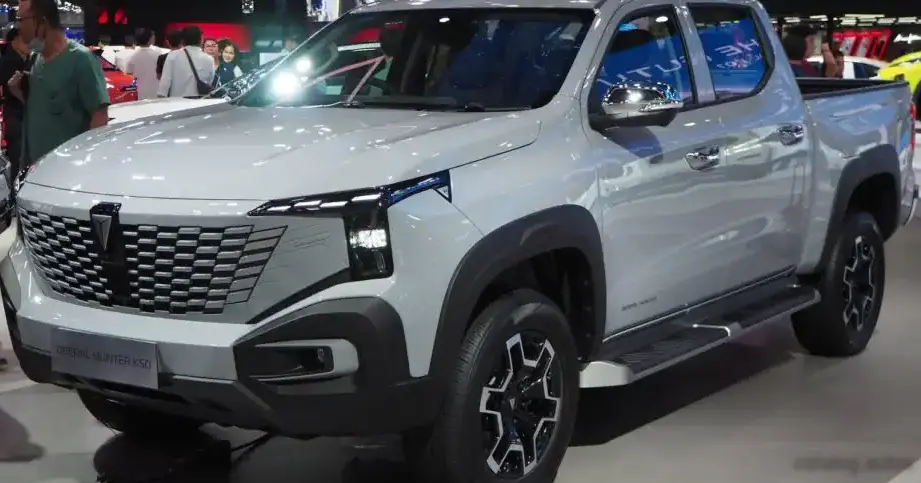
The Deepal Hunter K50 2.0 T-GDI 31.18 kWh (272 Hp) REEV AWD, launched in March 2025, represents a novel approach to the pickup truck segment. Positioned as a Range Extender Electric Vehicle (REEV), the Hunter K50 blends the utility of a traditional pickup with the efficiency and performance of a plug-in hybrid system. It’s part of Deepal’s expanding lineup, aiming to capture a growing market segment interested in both capability and reduced emissions. The K50 is a four-door, five-seat pickup designed to appeal to buyers seeking a versatile vehicle for both work and leisure. It utilizes a unique powertrain configuration where the internal combustion engine solely functions as a generator for the electric drive system, offering a distinct driving experience compared to conventional hybrids.
Technical Specifications
| Brand | Deepal |
| Model | Hunter K50 |
| Generation | Hunter K50 |
| Type (Engine) | 2.0 T-GDI 31.18 kWh (272 Hp) REEV AWD |
| Start of production | March, 2025 |
| Powertrain Architecture | PHEV (Plug-in Hybrid Electric Vehicle) |
| Body type | Pick-up |
| Seats | 5 |
| Doors | 4 |
| Fuel Type | Petrol / electricity |
| Acceleration 0 – 100 km/h | 7.9 sec |
| Acceleration 0 – 62 mph | 7.9 sec |
| Acceleration 0 – 60 mph | 7.5 sec |
| Maximum speed | 160 km/h (99.42 mph) |
| Gross battery capacity | 31.18 kWh |
| Battery technology | Lithium iron phosphate (LiFePO4) |
| Battery location | Below the floor |
| All-electric range (NEDC) | 131 km (81.4 mi) |
| Electric motor power (Front) | 95 Hp |
| Electric motor Torque (Front) | 150 Nm (110.63 lb.-ft.) |
| Electric motor location (Front) | Front axle, Transverse |
| Electric motor type (Front) | Synchronous |
| Electric motor power (Rear) | 177 Hp |
| Electric motor Torque (Rear) | 320 Nm (236.02 lb.-ft.) |
| Electric motor location (Rear) | Rear axle, Transverse |
| Electric motor type (Rear) | Synchronous |
| System power | 272 Hp |
| System torque | 470 Nm (346.65 lb.-ft.) |
| Power (ICE) | 190 Hp |
| Torque (ICE) | 390 Nm (287.65 lb.-ft.) |
| Engine layout | Front, Longitudinal |
| Engine displacement | 1998 cm3 (121.93 cu. in.) |
| Number of cylinders | 4 |
| Engine configuration | Inline |
| Fuel injection system | Direct injection |
| Engine aspiration | Turbocharger, Intercooler |
| Valvetrain | DOHC, VVT |
| Fuel tank capacity | 70 l (18.49 US gal | 15.4 UK gal) |
| Permitted trailer load with brakes (12%) | 2500 kg (5511.56 lbs.) |
| Length | 5380 mm (211.81 in.) |
| Width | 1980 mm (77.95 in.) |
| Height | 1875 mm (73.82 in.) |
| Wheelbase | 3180 mm (125.2 in.) |
| Front track | 1610 mm (63.39 in.) |
| Rear track | 1630 mm (64.17 in.) |
| Ride height (ground clearance) | 220 mm (8.66 in.) |
| Minimum turning circle | 13.5 m (44.29 ft.) |
| Wading depth | 600 mm (23.62 in.) |
Powertrain & Engine Architecture
The Deepal Hunter K50’s powertrain is its defining feature. It employs a 2.0-liter turbocharged gasoline engine (designated as a T-GDI) that doesn’t directly drive the wheels. Instead, it functions solely as a generator, charging the 31.18 kWh Lithium Iron Phosphate (LiFePO4) battery pack. This battery powers two electric motors – one driving the front axle and the other driving the rear axle, resulting in an all-wheel-drive configuration. The front motor produces 95 horsepower and 150 Nm of torque, while the rear motor delivers 177 horsepower and 320 Nm of torque. Combined, the system generates 272 horsepower and 470 Nm of torque. The gasoline engine itself produces 190 horsepower and 390 Nm of torque. The use of LiFePO4 chemistry for the battery pack is notable for its improved thermal stability and longer lifespan compared to traditional Lithium-ion batteries. The engine features direct injection, a turbocharger with intercooling, and a Double Overhead Camshaft (DOHC) valvetrain with Variable Valve Timing (VVT) for optimized efficiency and performance.
Driving Characteristics
The Hunter K50’s driving experience is significantly different from that of a conventional pickup. Because the gasoline engine doesn’t directly power the wheels, there’s no traditional engine-transmission interaction. Acceleration from 0 to 60 mph is quoted at 7.5 seconds, and 0-100 km/h takes 7.9 seconds, which is competitive for a vehicle of this size and type. The instant torque delivery of the electric motors provides brisk acceleration, particularly in the lower and mid-range. The all-wheel-drive system enhances traction and stability, especially in adverse conditions. In pure electric mode, the K50 offers a range of 131 km (81.4 miles) based on the NEDC standard. When the battery is depleted, the gasoline engine seamlessly kicks in to act as a generator, extending the range considerably. The lack of a traditional multi-gear transmission contributes to a smooth and refined driving experience.
Equipment & Trim Levels
Details regarding specific trim levels and standard equipment for the Hunter K50 are still emerging, but it is expected to offer a comprehensive suite of features. Standard equipment likely includes a modern infotainment system with a large touchscreen display, digital instrument cluster, automatic climate control, and a range of advanced driver-assistance systems (ADAS). Available options may include leather upholstery, premium audio system, panoramic sunroof, and enhanced off-road capabilities with features like a locking rear differential and increased ground clearance. The interior design is expected to be functional and durable, reflecting the truck’s intended use.
Chassis & Braking
The Hunter K50 utilizes a robust chassis designed to handle the demands of pickup truck duty. The front suspension features a coil spring, double wishbone configuration with a transverse stabilizer bar, while the rear suspension employs an independent multi-link setup, also with a stabilizer bar. This suspension setup aims to provide a balance between ride comfort and handling performance. The braking system consists of disc brakes on all four wheels, complemented by ABS (Anti-lock Braking System) for enhanced safety. The vehicle rides on 18-inch wheels with 265/60 R18 tires, providing adequate grip and durability.
Market Reception & Comparison
As a relatively new entrant to the market, the Deepal Hunter K50 faces competition from established pickup truck brands as well as emerging electric and hybrid pickup models. Its unique REEV powertrain sets it apart, offering a blend of electric driving and extended range without the limitations of a purely battery-electric vehicle. Early reviews suggest that the K50 offers a compelling combination of performance, efficiency, and practicality. Fuel economy figures will vary depending on driving conditions and usage patterns, but the REEV system is expected to deliver significantly better fuel efficiency than a conventional gasoline-powered pickup. Reliability data is still limited, but Deepal is expected to leverage its expertise in electric vehicle technology to ensure the long-term durability of the powertrain.
Legacy
The Deepal Hunter K50 represents a significant step towards the electrification of the pickup truck segment. Its innovative REEV powertrain and focus on practicality and efficiency position it as a potential game-changer in the market. The long-term success of the K50 will depend on its reliability, affordability, and ability to meet the evolving needs of pickup truck buyers. If it proves to be a durable and capable vehicle, the Hunter K50 could pave the way for a new generation of electric and hybrid pickups.
