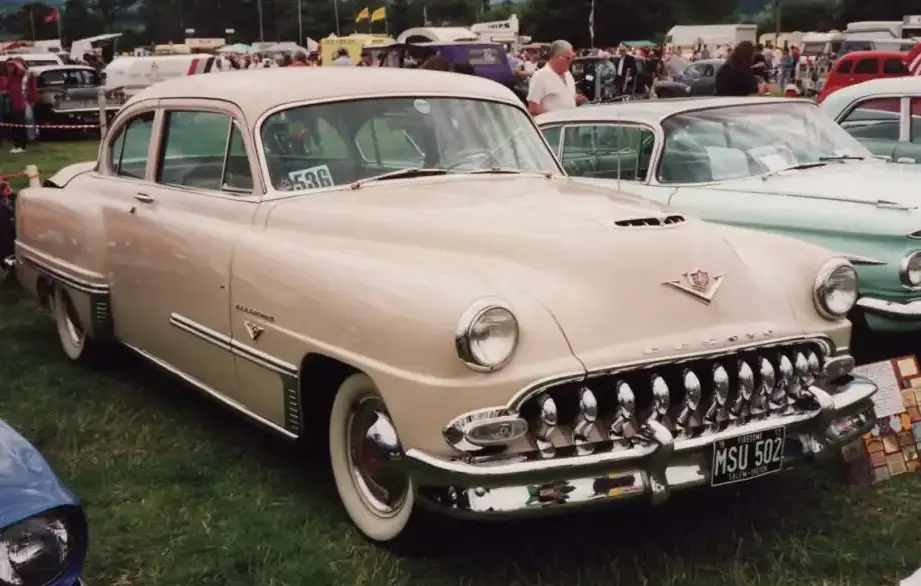
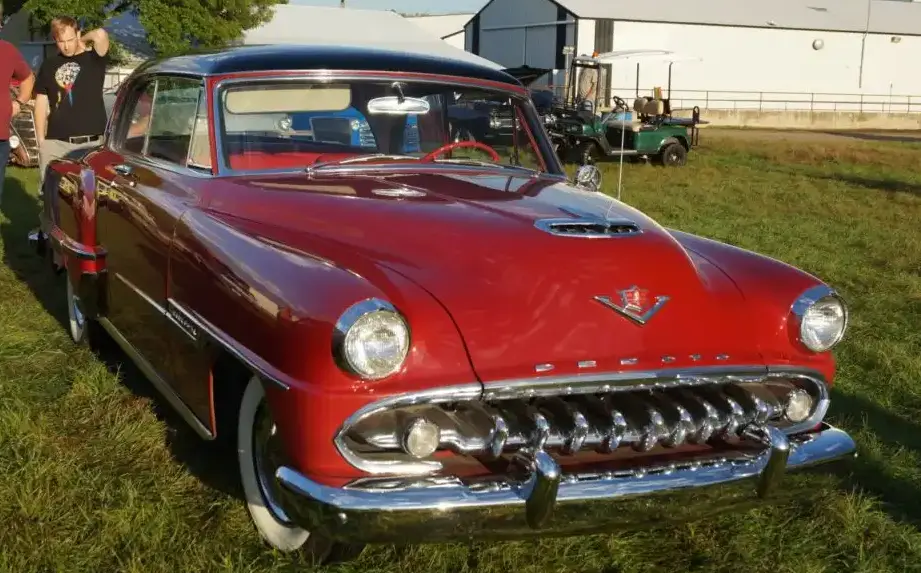
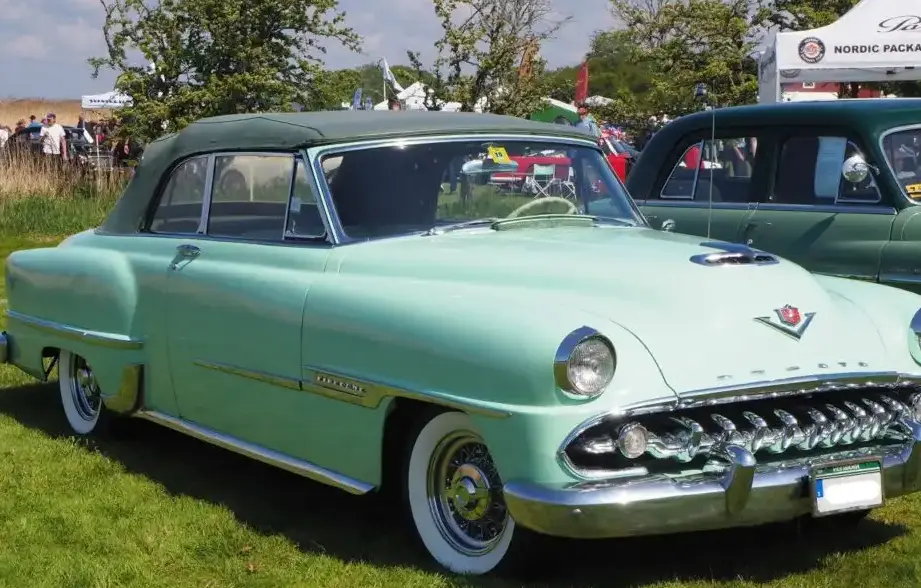
The DeSoto Firedome All-Steel Station Wagon, specifically the facelifted 1954 model, represents a significant offering from the DeSoto division of Chrysler Corporation during the early 1950s. Produced for the 1953 and 1954 model years, this station wagon was a key part of DeSoto’s attempt to capture a share of the growing family car market in post-war America. The “All-Steel” designation was a prominent selling point, highlighting the vehicle’s modern construction compared to earlier body-on-frame designs utilizing wood framing. This particular variant featured a 4.5-liter V8 engine producing 170 horsepower, positioned as a mid-range offering within the Firedome lineup.
Technical Specifications
| Brand | DeSoto |
| Model | Firedome |
| Generation | Firedome All-Steel Station Wagon (facelift 1954) |
| Type (Engine) | 4.5 V8 (170 Hp) |
| Start of production | 1953 |
| End of production | 1954 |
| Powertrain Architecture | Internal Combustion engine |
| Body type | Station wagon (estate) |
| Seats | 6 |
| Doors | 5 |
| Fuel Type | Petrol (Gasoline) |
| Power | 170 Hp @ 4400 rpm |
| Power per litre | 37.6 Hp/l |
| Torque | 346 Nm @ 2400 rpm |
| Torque (lb.-ft.) | 255.2 lb.-ft. @ 2400 rpm |
| Engine Model/Code | S19-1001 |
| Engine displacement | 4524 cm3 |
| Engine displacement (cu. in.) | 276.07 cu. in. |
| Number of cylinders | 8 |
| Engine configuration | V-engine |
| Cylinder Bore | 92.075 mm |
| Cylinder Bore (in.) | 3.63 in. |
| Piston Stroke | 84.931 mm |
| Piston Stroke (in.) | 3.34 in. |
| Compression ratio | 7.5:1 |
| Number of valves per cylinder | 2 |
| Fuel injection system | Carburettor |
| Engine aspiration | Naturally aspirated engine |
| Valvetrain | OHV |
| Engine oil capacity | 4.7 l |
| Engine oil capacity (US qt) | 4.97 US qt |
| Engine oil capacity (UK qt) | 4.14 UK qt |
| Coolant capacity | 21.8 l |
| Coolant capacity (US qt) | 23.04 US qt |
| Coolant capacity (UK qt) | 19.18 UK qt |
| Length | 5439 mm |
| Length (in.) | 214.13 in. |
| Width | 1972 mm |
| Width (in.) | 77.64 in. |
| Height | 1632 mm |
| Height (in.) | 64.25 in. |
| Wheelbase | 3188 mm |
| Wheelbase (in.) | 125.51 in. |
| Front track | 1403 mm |
| Front track (in.) | 55.24 in. |
| Rear track | 1514 mm |
| Rear track (in.) | 59.61 in. |
| Drag coefficient (Cd) | 0.6 |
| Minimum turning circle | 13.1 m |
| Minimum turning circle (ft) | 42.98 ft. |
| Drivetrain Architecture | Rear wheel drive |
| Number of gears | 3 |
| Gearbox type | Manual transmission |
| Front suspension | Independent coil spring |
| Rear suspension | Leaf spring |
| Front brakes | Drum, 305 mm |
| Rear brakes | Drum, 305 mm |
| Steering type | Worm-reduction unit |
| Power steering | Hydraulic Steering |
Powertrain & Engine Architecture
The heart of the 1954 DeSoto Firedome station wagon was the S19-1001 4.5-liter (276.07 cubic inch) V8 engine. This engine featured a cast iron block and cylinder heads, with a 7.5:1 compression ratio. It utilized a single Carter carburetor for fuel delivery and an overhead valve (OHV) valvetrain. The engine’s design was relatively conventional for the era, prioritizing durability and ease of maintenance. The 170 horsepower output was achieved at 4400 rpm, while peak torque of 346 Nm (255.2 lb.-ft.) arrived at 2400 rpm. This engine was paired with a standard three-speed manual transmission, providing a direct connection to the rear wheels. While an automatic transmission was offered on other Firedome models, the 170 hp version was exclusively available with the manual gearbox.
Driving Characteristics
The 170 hp Firedome station wagon, equipped with the three-speed manual transmission, offered a driving experience that was typical of large American cars of the 1950s. Acceleration was adequate for the time, but not particularly brisk. The engine delivered usable torque at lower rpm, making it suitable for everyday driving and hauling passengers or cargo. The manual transmission required deliberate shifting, and the gear ratios were spaced to prioritize fuel economy and cruising comfort rather than outright performance. Compared to the higher-output V8 options available in other Firedome models, this variant felt less powerful, especially when fully loaded. However, the manual transmission provided a more engaging driving experience than the optional automatic.
Equipment & Trim Levels
The Firedome station wagon, even in its base 170 hp configuration, was reasonably well-equipped for the early 1950s. Standard features included a spacious interior with seating for six passengers, a large cargo area accessible through the rear tailgate, and a heater. Interior upholstery was typically cloth and vinyl, with a focus on durability. The dashboard featured a straightforward layout with basic instrumentation, including a speedometer, fuel gauge, and temperature gauge. Optional extras included a radio, whitewall tires, and various trim enhancements. The station wagon trim level generally aligned with the base Firedome models, lacking the more luxurious appointments found on the higher-end DeSoto models.
Chassis & Braking
The Firedome station wagon utilized a body-on-frame construction, providing a robust and durable chassis. The front suspension featured independent coil springs, offering a relatively comfortable ride. The rear suspension employed leaf springs, which were common for station wagons and other vehicles designed to carry heavy loads. Braking was accomplished via drum brakes on all four wheels, measuring 305 mm in diameter. Steering was handled by a worm-reduction unit, and hydraulic power steering was available as an option, making maneuvering the large station wagon easier. The chassis was designed to provide a stable and predictable driving experience, even when fully loaded with passengers and cargo.
Market Reception & Comparison
The 1954 DeSoto Firedome station wagon was generally well-received by critics and consumers. It was praised for its spacious interior, durable construction, and comfortable ride. However, the 170 hp engine and manual transmission combination was often seen as a compromise, particularly when compared to the more powerful V8 options and automatic transmissions available on other DeSoto models. Fuel economy was typical for the era, averaging around 15-20 miles per gallon. Reliability was generally good, although maintenance requirements were higher than those of more modern vehicles. Compared to competitors like the Ford Country Squire and Chevrolet Bel Air station wagons, the Firedome offered a similar level of features and performance, but often at a slightly higher price point.
Legacy
The DeSoto Firedome All-Steel Station Wagon, particularly the 1954 model, holds a significant place in automotive history as a representative of the classic American station wagon. While DeSoto as a brand ultimately disappeared in 1961, the Firedome station wagon remains a popular choice among collectors and enthusiasts. The 4.5-liter V8 engine, while not the most powerful of its time, proved to be relatively durable and reliable. Today, well-maintained examples of the 1954 Firedome station wagon are sought after for their classic styling, spacious interiors, and nostalgic appeal. The manual transmission variant, while less common, is particularly valued by enthusiasts who appreciate its engaging driving experience.