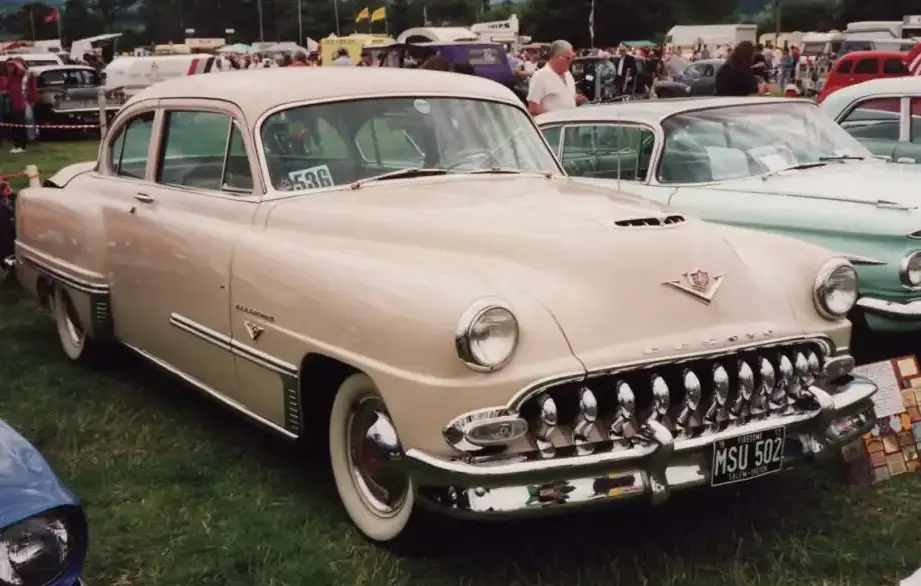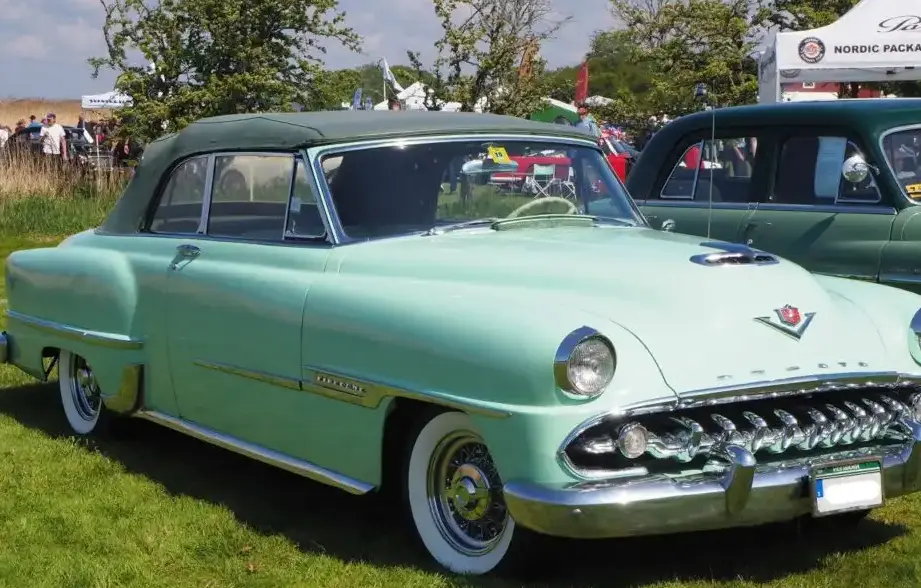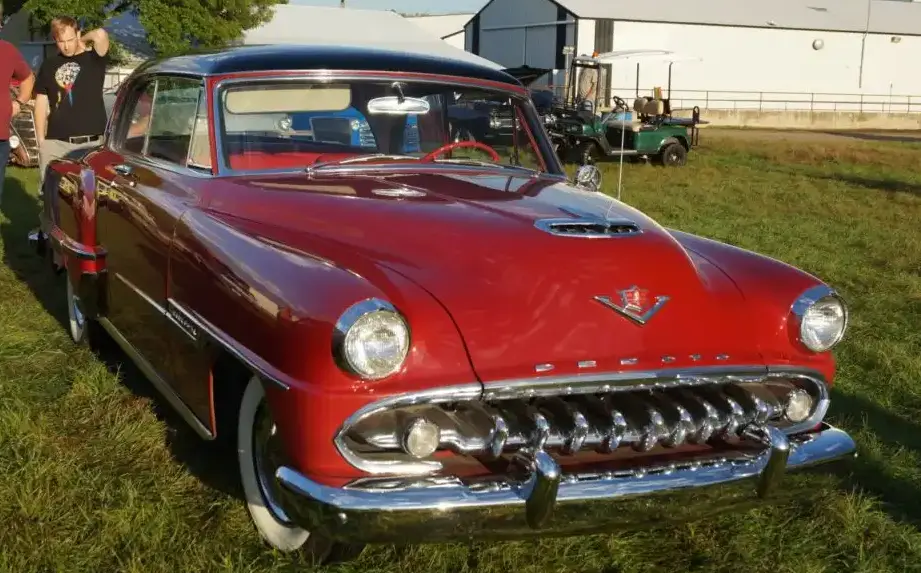
The DeSoto Firedome Club Coupe, particularly the facelifted 1954 model, represents a significant chapter in the history of the DeSoto division of Chrysler Corporation. Produced from 1953 to 1954, the Firedome occupied a middle ground in the DeSoto lineup, positioned above the entry-level Deluxe and below the more luxurious Firesweep. The 1954 facelift brought updated styling cues, contributing to the car’s appeal during a period of rapidly evolving automotive design. This specific configuration, featuring a 4.5-liter V8 engine producing 170 horsepower coupled with a PowerFlite automatic transmission, was a popular choice for buyers seeking a balance of performance and convenience.
Technical Specifications
| Brand | DeSoto |
| Model | Firedome |
| Generation | Firedome Club Coupe (facelift 1954) |
| Type (Engine) | 4.5 V8 (170 Hp) PowerFlite |
| Start of production | 1953 |
| End of production | 1954 |
| Powertrain Architecture | Internal Combustion engine |
| Body type | Coupe |
| Seats | 6 |
| Doors | 2 |
| Fuel Type | Petrol (Gasoline) |
| Power | 170 Hp @ 4400 rpm |
| Power per litre | 37.6 Hp/l |
| Torque | 346 Nm @ 2400 rpm |
| Torque (lb.-ft.) | 255.2 lb.-ft. @ 2400 rpm |
| Engine Model/Code | S19-1001 |
| Engine displacement | 4524 cm3 |
| Engine displacement (cu. in.) | 276.07 cu. in. |
| Number of cylinders | 8 |
| Engine configuration | V-engine |
| Cylinder Bore | 92.075 mm |
| Cylinder Bore (in.) | 3.63 in. |
| Piston Stroke | 84.931 mm |
| Piston Stroke (in.) | 3.34 in. |
| Compression ratio | 7.5:1 |
| Number of valves per cylinder | 2 |
| Fuel injection system | Carburettor |
| Engine aspiration | Naturally aspirated engine |
| Valvetrain | OHV |
| Engine oil capacity | 4.7 l |
| Engine oil capacity (US qt) | 4.97 US qt |
| Engine oil capacity (UK qt) | 4.14 UK qt |
| Coolant capacity | 21.8 l |
| Coolant capacity (US qt) | 23.04 US qt |
| Coolant capacity (UK qt) | 19.18 UK qt |
| Fuel tank capacity | 64 l |
| Fuel tank capacity (US gal) | 16.91 US gal |
| Fuel tank capacity (UK gal) | 14.08 UK gal |
| Length | 5448 mm |
| Length (in.) | 214.49 in. |
| Width | 1969 mm |
| Width (in.) | 77.52 in. |
| Height | 1632 mm |
| Height (in.) | 64.25 in. |
| Wheelbase | 3188 mm |
| Wheelbase (in.) | 125.51 in. |
| Front track | 1403 mm |
| Front track (in.) | 55.24 in. |
| Rear track | 1438 mm |
| Rear track (in.) | 56.61 in. |
| Front overhang | 940 mm |
| Front overhang (in.) | 37.01 in. |
| Rear overhang | 1321 mm |
| Rear overhang (in.) | 52.01 in. |
| Ride height (ground clearance) | 178 mm |
| Ride height (ground clearance) (in.) | 7.01 in. |
| Drag coefficient (Cd) | 0.6 |
| Minimum turning circle | 12.8 m |
| Minimum turning circle (ft.) | 41.99 ft. |
| Approach angle | 23° |
| Departure angle | 17° |
| Ramp-over angle | 15° |
| Drivetrain Architecture | Rear wheel drive |
| Number of gears | 2 |
| Gearbox type | automatic transmission PowerFlite |
| Front suspension | Independent coil spring |
| Rear suspension | Leaf spring |
| Front brakes | Drum, 305 mm |
| Rear brakes | Drum, 305 mm |
| Steering type | Worm-reduction unit |
| Power steering | Hydraulic Steering |
Powertrain & Engine Architecture
The heart of the 1954 DeSoto Firedome Club Coupe was the DeSoto S19-1001 4.5-liter (276.07 cubic inch) V8 engine. This engine, a product of Chrysler’s engineering prowess, featured a cast iron block and aluminum cylinder heads. It utilized a conventional overhead valve (OHV) configuration with two valves per cylinder. Fuel delivery was managed by a Carter carburetor, a common setup for the era. The engine produced 170 horsepower at 4400 rpm and 346 Nm (255.2 lb.-ft.) of torque at 2400 rpm. This output was considered respectable for the time, providing adequate power for cruising and passing maneuvers. The PowerFlite automatic transmission, a two-speed unit, was the standard transmission offering for this model. It was a relatively new design for Chrysler, offering smoother shifts compared to earlier automatics, though it lacked the sophistication of later multi-speed transmissions.
Driving Characteristics
The combination of the 170 hp V8 and the PowerFlite automatic transmission resulted in a driving experience geared towards comfort and ease of use. The PowerFlite’s two gear ratios meant acceleration wasn’t particularly brisk, especially when compared to Firedomes equipped with a manual transmission. However, the automatic transmission provided a relaxed driving experience, particularly well-suited for city driving and highway cruising. The relatively high gear ratios prioritized torque delivery at lower speeds, making the car feel responsive around town. The leaf spring rear suspension, while providing a comfortable ride, could exhibit some bounce over uneven surfaces. Steering was accomplished through a hydraulic power steering system, making the large coupe relatively easy to maneuver.
Equipment & Trim Levels
The 1954 Firedome Club Coupe came standard with a range of features considered desirable for the period. These included a spacious interior upholstered in cloth and vinyl, a full-width bench seat, and a generously sized trunk. Standard exterior features included chrome trim, whitewall tires, and a two-tone paint scheme. Optional extras included a radio, heater, power windows, and upgraded upholstery materials. The Firedome trim level generally offered a more refined interior compared to the base DeSoto Deluxe, with more extensive use of chrome and brighter interior finishes.
Chassis & Braking
The Firedome Club Coupe utilized a body-on-frame construction, typical of American automobiles of the 1950s. The chassis featured an independent coil spring suspension at the front, providing a relatively comfortable ride. The rear suspension employed a traditional leaf spring setup. Braking duties were handled by drum brakes on all four wheels, measuring 305 mm in diameter. While adequate for the time, the drum brakes lacked the stopping power and fade resistance of later disc brake systems. The steering system was a worm-reduction unit, assisted by hydraulic power steering, making the car relatively easy to maneuver despite its size.
Market Reception & Comparison
The 1954 DeSoto Firedome Club Coupe was generally well-received by automotive critics and consumers. It was praised for its stylish design, comfortable ride, and reliable V8 engine. However, some critics noted the PowerFlite automatic transmission’s limited number of gears and its impact on acceleration. Compared to other DeSoto models, the Firedome offered a step up in terms of features and refinement compared to the Deluxe, while remaining more affordable than the top-of-the-line Firesweep. Fuel economy, while not a primary concern for buyers in the 1950s, was typical for a large American V8-powered car of the era.
Legacy
The 1954 DeSoto Firedome Club Coupe, while not a groundbreaking vehicle, represents a significant example of mid-century American automotive design and engineering. The S19-1001 V8 engine proved to be a durable and reliable powerplant, and many examples remain on the road today. The PowerFlite automatic transmission, while not as sophisticated as later automatics, provided a comfortable and convenient driving experience. Today, the Firedome Club Coupe is a popular choice among classic car enthusiasts, appreciated for its styling, historical significance, and relative affordability. Parts availability can be a challenge, but a dedicated community of DeSoto owners and restorers helps to keep these classic cars running for generations to come.