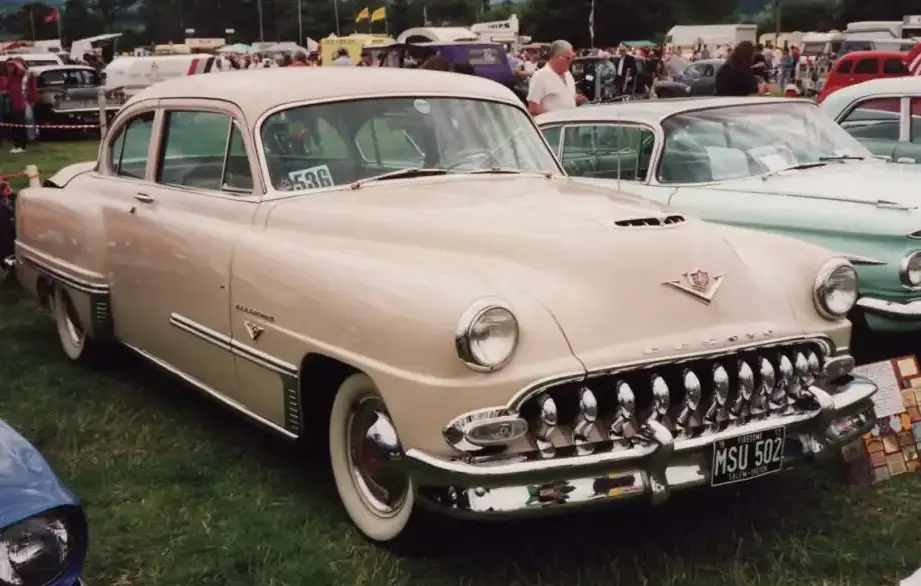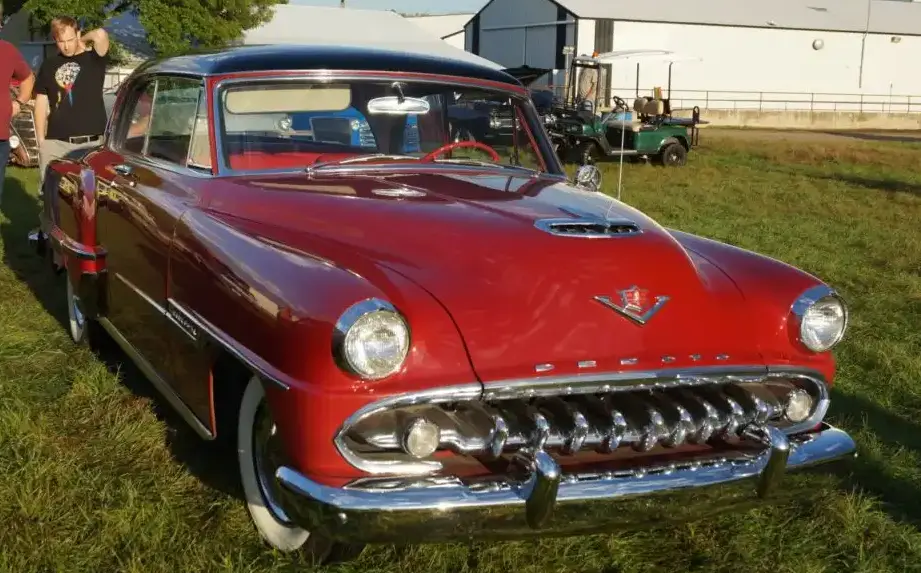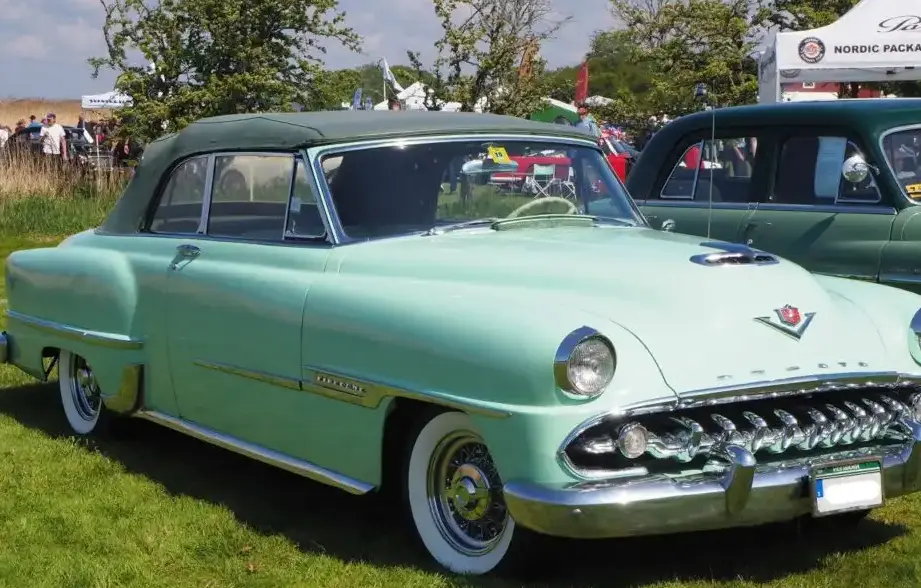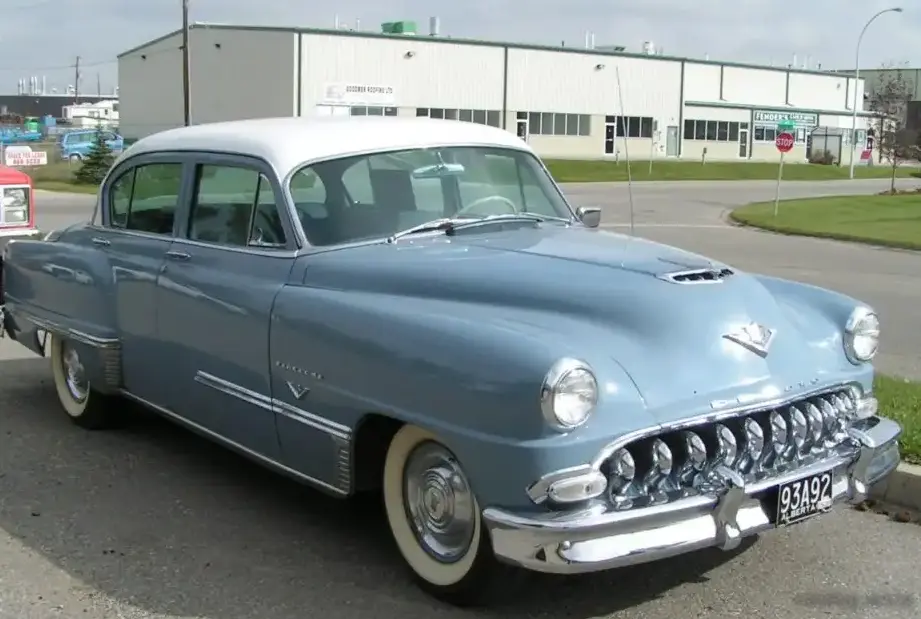
The DeSoto Firedome Four-Door Sedan, particularly the facelifted 1953 model, represents a significant chapter in the history of the DeSoto division of Chrysler Corporation. Produced from 1952 through 1953, the Firedome was positioned as DeSoto’s full-size offering, aiming to bridge the gap between the more affordable Plymouth and the luxury-oriented Chrysler models. The 1953 facelift brought updated styling cues, reflecting the design trends of the early 1950s, and solidified the Firedome’s place in the American automotive landscape. This specific variant, equipped with the 4.5-liter V8 engine producing 160 horsepower, was a mainstay of the Firedome lineup, offering a balance of power and practicality for the American family.
Technical Specifications
| Brand | DeSoto |
| Model | Firedome |
| Generation | Firedome Four-Door Sedan (facelift 1953) |
| Type (Engine) | 4.5 V8 (160 Hp) |
| Start of production | 1952 |
| End of production | 1953 |
| Powertrain Architecture | Internal Combustion engine |
| Body type | Sedan |
| Seats | 6 |
| Doors | 4 |
| Fuel Type | Petrol (Gasoline) |
| Power | 160 Hp @ 4400 rpm |
| Power per litre | 35.4 Hp/l |
| Torque | 339 Nm @ 2000 rpm / 250.03 lb.-ft. @ 2000 rpm |
| Engine Model/Code | S16-1001 |
| Engine displacement | 4524 cm3 / 276.07 cu. in. |
| Number of cylinders | 8 |
| Engine configuration | V-engine |
| Cylinder Bore | 92.075 mm / 3.63 in. |
| Piston Stroke | 84.931 mm / 3.34 in. |
| Compression ratio | 7.1:1 |
| Number of valves per cylinder | 2 |
| Fuel injection system | Carburettor |
| Engine aspiration | Naturally aspirated engine |
| Engine oil capacity | 4.7 l / 4.97 US qt | 4.14 UK qt |
| Coolant | 21.7 l / 22.93 US qt | 19.09 UK qt |
| Fuel tank capacity | 64 l / 16.91 US gal | 14.08 UK gal |
| Length | 5420 mm / 213.39 in. |
| Width | 1963 mm / 77.28 in. |
| Height | 1588 mm / 62.52 in. |
| Wheelbase | 3188 mm / 125.51 in. |
| Front track | 1430 mm / 56.3 in. |
| Rear (Back) track | 1513 mm / 59.57 in. |
| Drag coefficient (Cd) | 0.6 |
| Minimum turning circle (turning diameter) | 13 m / 42.65 ft. |
| Drivetrain Architecture | The Internal combustion engine (ICE) drives the rear wheels of the vehicle. |
| Drive wheel | Rear wheel drive |
| Number of gears and type of gearbox | 3 gears, manual transmission |
| Front suspension | Independent coil spring |
| Rear suspension | Leaf spring |
| Front brakes | Drum, 305 mm |
| Rear brakes | Drum, 305 mm |
Powertrain & Engine Architecture
The heart of the 1953 DeSoto Firedome was the S16-1001 4.5-liter (276.07 cubic inch) V8 engine. This engine, a product of Chrysler’s engineering prowess, featured a cast iron block and aluminum cylinder heads. It utilized a conventional overhead valve (OHV) configuration with two valves per cylinder. Fuel delivery was managed by a Carter carburetor, a common setup for the era. The 7.1:1 compression ratio was typical for the time, balancing performance with the availability of regular gasoline. The engine produced 160 horsepower at 4400 rpm and 339 Nm (250.03 lb-ft) of torque at 2000 rpm. The standard transmission was a three-speed manual, although a Mopar TorqueFlite automatic transmission was offered as an option. The engine’s design prioritized durability and smooth operation, characteristics valued by American car buyers in the 1950s.
Driving Characteristics
The 1953 Firedome with the 4.5L V8 and three-speed manual transmission offered a driving experience typical of full-size American cars of the period. Acceleration was adequate, but not particularly sporty, with the focus being on comfortable cruising. The 3-speed manual gearbox provided a direct connection to the engine, allowing drivers to utilize the engine’s torque effectively. Compared to later, more powerful DeSoto models, the 160 hp Firedome felt less energetic, especially when fully loaded with passengers. However, it provided a more engaging driving experience than the automatic transmission equipped models. The relatively low compression ratio and carburetor setup meant the engine was relatively tolerant of lower octane fuels, a practical consideration for the time.
Equipment & Trim Levels
The 1953 Firedome was reasonably well-equipped for its time, offering features considered standard on full-size American cars. Standard interior appointments included a cloth and vinyl bench seat, a basic instrument panel with speedometer, fuel gauge, and ammeter, and a steering wheel. Exterior features included full wheel covers, chrome bumpers, and a two-tone paint scheme, which was a popular styling trend. Optional extras included a radio, heater, power steering, and whitewall tires. The Firedome’s interior was designed for comfort and spaciousness, accommodating up to six passengers. The trim level was generally consistent across the Firedome range, with variations primarily coming from optional equipment choices.
Chassis & Braking
The Firedome rode on a traditional body-on-frame chassis. Front suspension utilized independent coil springs, providing a relatively comfortable ride. The rear suspension employed leaf springs, a common design for rear-wheel-drive cars of the era. Braking was accomplished via drum brakes on all four wheels, measuring 305mm in diameter. While adequate for the time, the drum brakes lacked the stopping power of later disc brake systems. Steering was manual, although power steering was available as an option. The chassis was designed for durability and to provide a stable platform for the relatively heavy V8 engine and spacious body.
Market Reception & Comparison
The 1953 DeSoto Firedome was generally well-received by automotive critics and consumers. It was praised for its comfortable ride, spacious interior, and reliable V8 engine. However, some critics noted that its styling was somewhat conservative compared to some of its competitors. Compared to other DeSoto models, such as the higher-trim Firesweep, the Firedome offered a more affordable entry point into the DeSoto lineup. It competed directly with other full-size American cars from Ford, Chevrolet, and Plymouth. Fuel economy was typical for the era, averaging around 15-18 miles per gallon. Reliability was generally good, although maintenance costs could be higher due to the V8 engine and its associated components.
Legacy
The 1953 DeSoto Firedome, while not a groundbreaking vehicle, represents a significant piece of American automotive history. It embodies the design and engineering philosophies of the early 1950s, prioritizing comfort, spaciousness, and reliability. Today, the Firedome is a popular choice among classic car enthusiasts, particularly those interested in preserving a piece of American automotive heritage. The 4.5L V8 engine, while not particularly high-performance by modern standards, is known for its durability and relative simplicity. Parts availability can be a challenge, but a dedicated community of DeSoto enthusiasts helps to keep these classic cars on the road. The Firedome’s legacy lies in its representation of a bygone era of American automotive design and engineering.