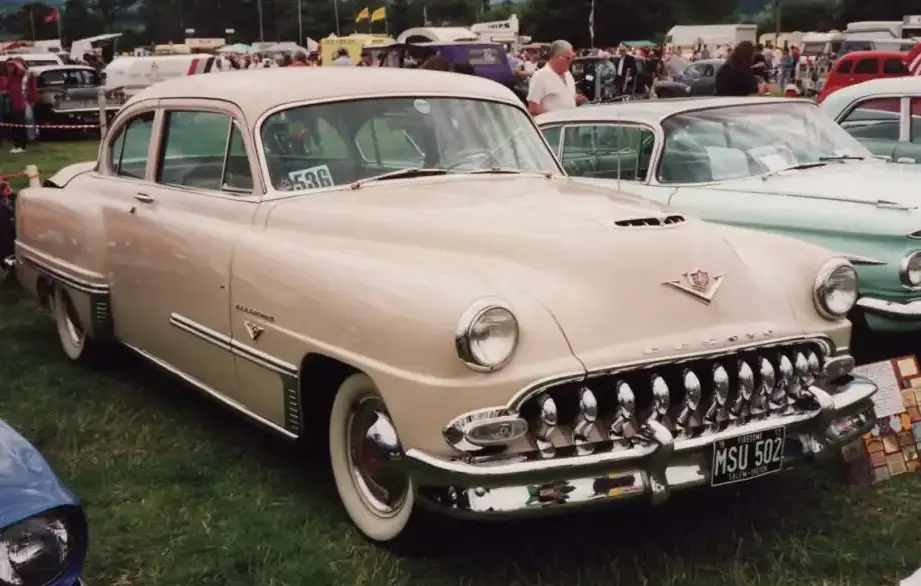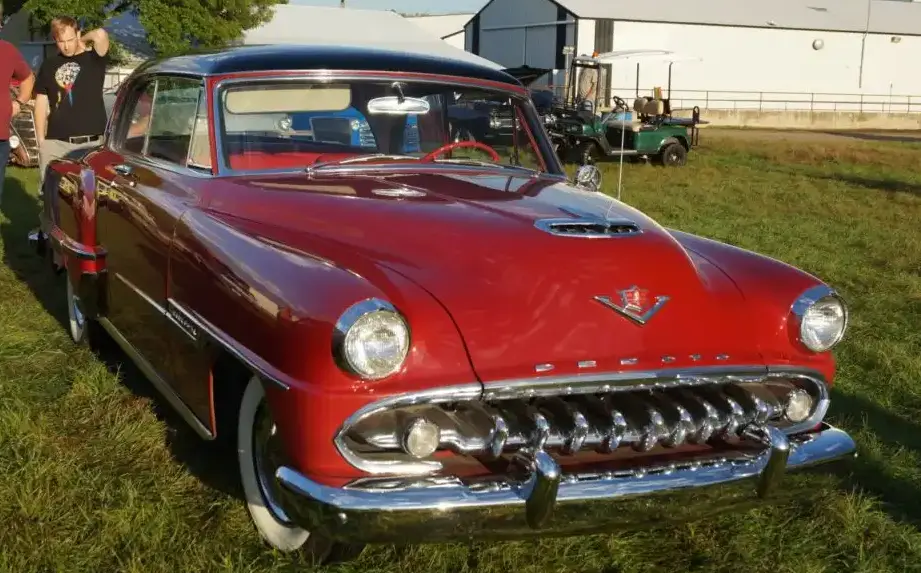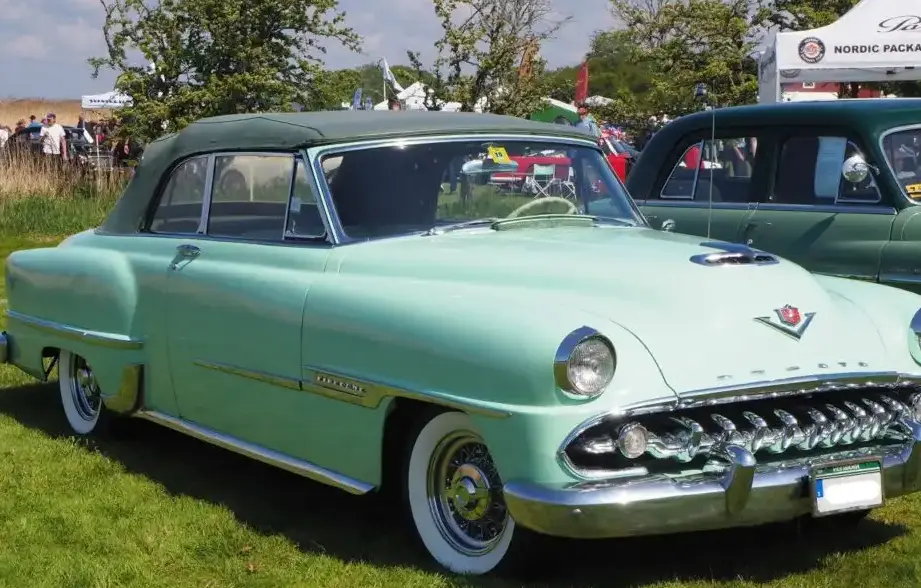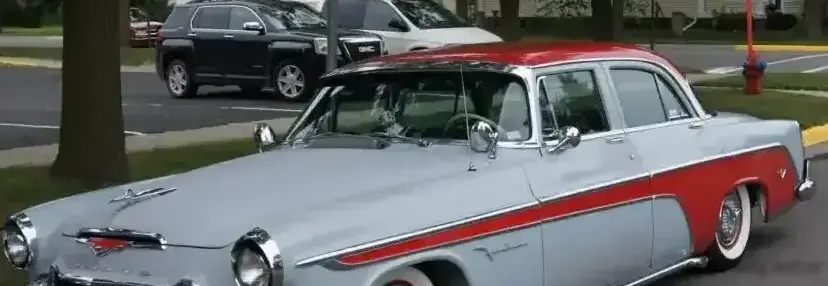
The DeSoto Firedome II Four-Door Sedan, powered by a 4.8-liter V8 engine and equipped with a PowerFlite automatic transmission, represented a significant offering in the mid-1950s American automotive landscape. Produced for the 1954 and 1955 model years, this vehicle was part of the second generation of the Firedome line, a nameplate that had debuted in 1952. The Firedome II aimed to provide a balance of style, comfort, and performance within the DeSoto range, positioned as a step up from the entry-level DeSoto Deluxe but below the more luxurious DeSoto Adventurer. It competed directly with similar offerings from Buick, Oldsmobile, and Mercury, appealing to buyers seeking a full-size American sedan with modern features.
Technical Specifications
| Brand | DeSoto |
| Model | Firedome |
| Generation | Firedome II Four-Door Sedan |
| Type (Engine) | 4.8 V8 (185 Hp) PowerFlite |
| Start of production | 1954 |
| End of production | 1955 |
| Powertrain Architecture | Internal Combustion engine |
| Body type | Sedan |
| Seats | 6 |
| Doors | 4 |
| Fuel Type | Petrol (Gasoline) |
| Power | 185 Hp @ 4400 rpm |
| Power per litre | 38.8 Hp/l |
| Torque | 332 Nm @ 2800 rpm / 244.87 lb.-ft. @ 2800 rpm |
| Engine Model/Code | S21-1001 |
| Engine displacement | 4769 cm3 / 291.02 cu. in. |
| Number of cylinders | 8 |
| Engine configuration | V-engine |
| Cylinder Bore | 94.49 mm / 3.72 in. |
| Piston Stroke | 84.931 mm / 3.34 in. |
| Compression ratio | 7.5:1 |
| Number of valves per cylinder | 2 |
| Fuel injection system | Carburettor |
| Engine aspiration | Naturally aspirated engine |
| Valvetrain | OHV |
| Engine oil capacity | 4.7 l / 4.97 US qt | 4.14 UK qt |
| Coolant | 21.8 l / 23.04 US qt | 19.18 UK qt |
| Fuel tank capacity | 76 l / 20.08 US gal | 16.72 UK gal |
| Length | 5535 mm / 217.91 in. |
| Width | 1989 mm / 78.31 in. |
| Height | 1539 mm / 60.59 in. |
| Wheelbase | 3200 mm / 125.98 in. |
| Front track | 1529 mm / 60.2 in. |
| Rear (Back) track | 1514 mm / 59.61 in. |
| Front overhang | 930 mm / 36.61 in. |
| Rear overhang | 1405 mm / 55.31 in. |
| Ride height (ground clearance) | 160 mm / 6.3 in. |
| Minimum turning circle (turning diameter) | 13.4 m / 43.96 ft. |
| Approach angle | 21° |
| Departure angle | 12° |
| Ramp-over (brakeover) angle | 11° |
| Drivetrain Architecture | The Internal combustion engine (ICE) drives the rear wheels of the vehicle. |
| Drive wheel | Rear wheel drive |
| Number of gears and type of gearbox | 2 gears, automatic transmission PowerFlite |
| Front suspension | Independent coil spring |
| Rear suspension | Leaf spring |
| Front brakes | Drum, 305 mm |
| Rear brakes | Drum, 305 mm |
| Steering type | Worm-reduction unit |
| Power steering | Hydraulic Steering |
Powertrain & Engine Architecture
The heart of the Firedome II was the DeSoto S21-1001 4.8-liter (291 cubic inch) V8 engine. This engine featured a cast iron block and cylinder heads, with a 7.5:1 compression ratio. It utilized a single Carter carburetor for fuel delivery and an overhead valve (OHV) valvetrain. The engine produced 185 horsepower at 4400 rpm and 332 Nm (244.87 lb-ft) of torque at 2800 rpm. The PowerFlite automatic transmission, a two-speed unit, was the standard transmission offering. This transmission, while providing ease of use, was not known for its performance or efficiency compared to contemporary automatic transmissions from other manufacturers. It was a relatively simple design, relying on a fluid coupling and planetary gearsets.
Driving Characteristics
The combination of the 185 hp V8 and the two-speed PowerFlite transmission resulted in a driving experience focused on smooth, comfortable cruising rather than outright acceleration. The PowerFlite’s limited number of gears meant that the engine often operated at higher rpm, contributing to a noticeable level of engine noise. While adequate for highway driving, the Firedome II felt somewhat sluggish during acceleration, especially when compared to models equipped with manual transmissions or higher-output engines. The rear-wheel-drive configuration and leaf spring rear suspension provided a stable ride, but also contributed to a somewhat firm and less refined experience compared to vehicles with more modern suspension designs.
Equipment & Trim Levels
The Firedome II Four-Door Sedan came reasonably well-equipped for its time. Standard features included a spacious interior with seating for six passengers, a heater, and a basic set of gauges. Upholstery was typically cloth, though optional upgrades to leather were available. The dashboard featured a straightforward design with a prominent speedometer and fuel gauge. Optional extras included power steering (a popular choice), power brakes, a radio, and whitewall tires. The trim level was generally consistent across the Firedome II line, with variations primarily limited to exterior paint colors and interior upholstery choices.
Chassis & Braking
The Firedome II utilized a body-on-frame construction, typical of American cars of the era. The front suspension was independent, employing coil springs, while the rear suspension relied on a traditional leaf spring setup. Brakes were drum brakes on all four wheels, measuring 305 mm in diameter. Steering was accomplished via a worm-reduction unit, and power steering was available as an option. The chassis was designed for durability and comfort, prioritizing a smooth ride over sporty handling. The relatively heavy weight of the vehicle, combined with the drum brakes, meant that stopping distances were longer than those of more modern vehicles.
Market Reception & Comparison
The DeSoto Firedome II received generally positive reviews from automotive journalists of the time. It was praised for its stylish design, spacious interior, and comfortable ride. However, the PowerFlite transmission was often criticized for its lack of responsiveness and efficiency. Compared to other DeSoto models, the Firedome II offered a good balance of features and price. The higher-end DeSoto Adventurer provided more luxury and a more powerful engine, while the DeSoto Deluxe offered a more affordable entry point. In terms of reliability, the Firedome II was generally considered to be on par with its competitors, though the PowerFlite transmission could be prone to issues if not properly maintained.
Legacy
The DeSoto Firedome II, while not a groundbreaking vehicle, represents a significant chapter in American automotive history. It embodies the styling and engineering philosophies of the mid-1950s, offering a glimpse into a time when large, comfortable, and stylish cars were highly sought after. Today, the Firedome II is a popular choice among classic car enthusiasts, particularly those interested in preserving a piece of American automotive heritage. The 4.8-liter V8 engine, while not particularly powerful by modern standards, is relatively simple to maintain and rebuild. The PowerFlite transmission, however, can be a source of challenges for restorers, as parts availability is limited. Well-maintained examples of the Firedome II are increasingly valuable in the used car market, appealing to collectors and enthusiasts alike.