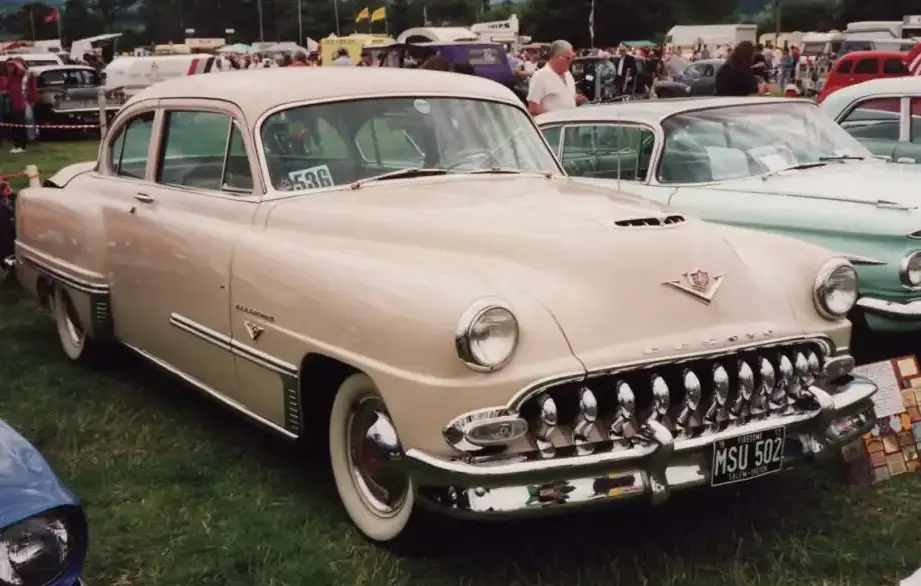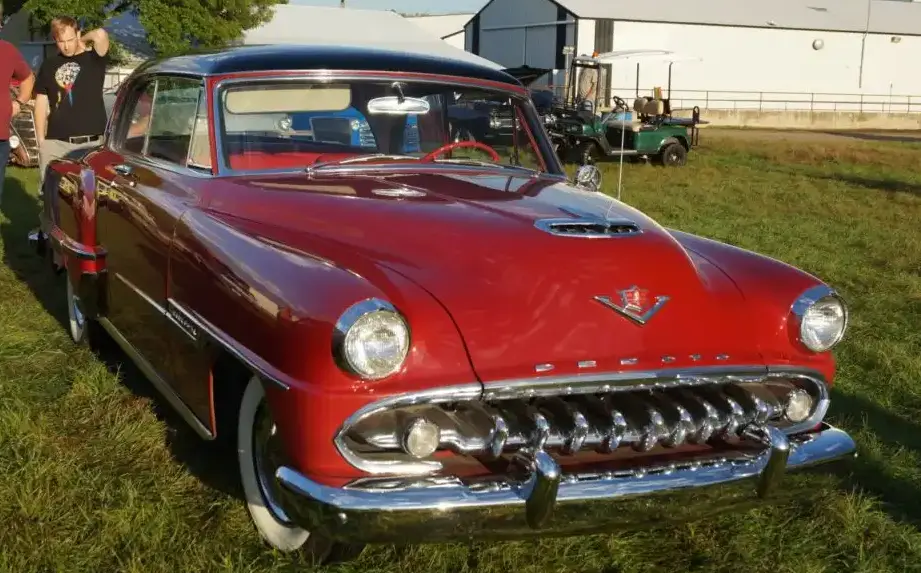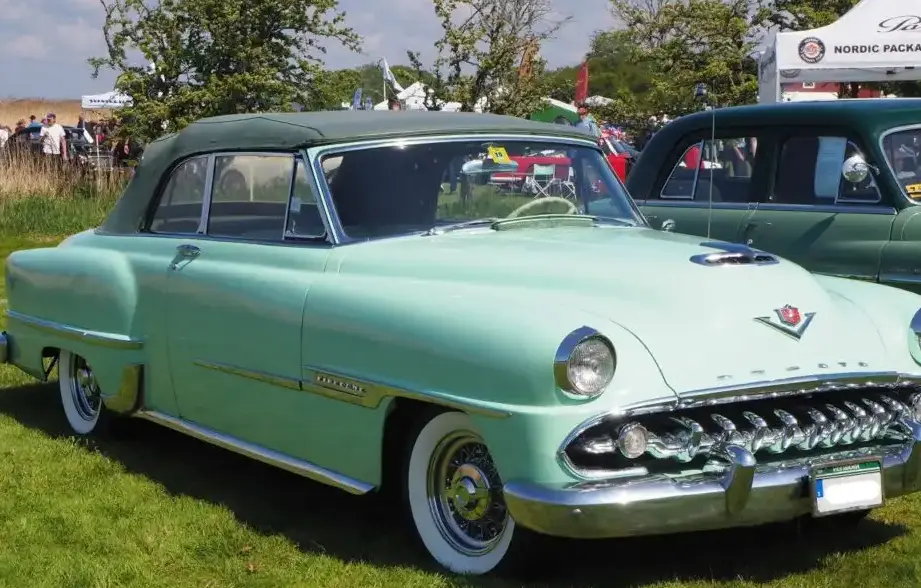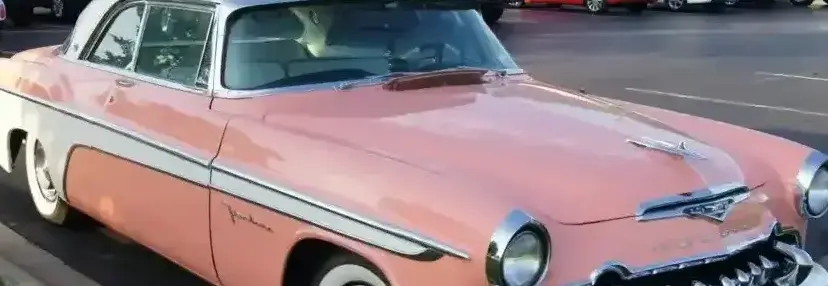
The DeSoto Firedome II Sportsman, powered by a 4.8-liter V8 engine producing 185 horsepower, represented a significant offering in the American automotive landscape of 1954 and 1955. Positioned as a stylish and relatively affordable coupe within the DeSoto lineup, the Firedome II Sportsman aimed to capture buyers seeking a blend of performance and comfort. It was part of the broader Firedome II generation, which represented a mid-cycle refresh of the original Firedome introduced in 1952. The “Sportsman” designation denoted the two-door coupe body style, differentiating it from the four-door sedan and other body configurations available within the Firedome range.
Technical Specifications
| Brand | DeSoto |
| Model | Firedome |
| Generation | Firedome II Sportsman |
| Type (Engine) | 4.8 V8 (185 Hp) |
| Start of production | 1954 |
| End of production | 1955 |
| Powertrain Architecture | Internal Combustion engine |
| Body type | Coupe |
| Seats | 6 |
| Doors | 2 |
| Fuel Type | Petrol (Gasoline) |
| Power | 185 Hp @ 4400 rpm |
| Power per litre | 38.8 Hp/l |
| Torque | 332 Nm @ 2800 rpm |
| Torque (lb-ft) | 244.87 lb.-ft. @ 2800 rpm |
| Engine Model/Code | S21-1001 |
| Engine displacement | 4769 cm3 |
| Engine displacement (cu. in.) | 291.02 cu. in. |
| Number of cylinders | 8 |
| Engine configuration | V-engine |
| Cylinder Bore | 94.49 mm |
| Cylinder Bore (in.) | 3.72 in. |
| Piston Stroke | 84.931 mm |
| Piston Stroke (in.) | 3.34 in. |
| Compression ratio | 7.5:1 |
| Number of valves per cylinder | 2 |
| Fuel injection system | Carburettor |
| Engine aspiration | Naturally aspirated engine |
| Valvetrain | OHV |
| Engine oil capacity | 4.7 l |
| Engine oil capacity (US qt) | 4.97 US qt |
| Engine oil capacity (UK qt) | 4.14 UK qt |
| Coolant capacity | 21.8 l |
| Coolant capacity (US qt) | 23.04 US qt |
| Coolant capacity (UK qt) | 19.18 UK qt |
| Fuel tank capacity | 76 l |
| Fuel tank capacity (US gal) | 20.08 US gal |
| Fuel tank capacity (UK gal) | 16.72 UK gal |
| Length | 5535 mm |
| Length (in.) | 217.91 in. |
| Width | 1989 mm |
| Width (in.) | 78.31 in. |
| Height | 1539 mm |
| Height (in.) | 60.59 in. |
| Wheelbase | 3200 mm |
| Wheelbase (in.) | 125.98 in. |
| Front track | 1529 mm |
| Front track (in.) | 60.2 in. |
| Rear track | 1514 mm |
| Rear track (in.) | 59.61 in. |
| Front overhang | 930 mm |
| Front overhang (in.) | 36.61 in. |
| Rear overhang | 1405 mm |
| Rear overhang (in.) | 55.31 in. |
| Ride height (ground clearance) | 160 mm |
| Ride height (ground clearance) (in.) | 6.3 in. |
| Minimum turning circle | 13.4 m |
| Minimum turning circle (ft.) | 43.96 ft. |
| Approach angle | 21° |
| Departure angle | 12° |
| Ramp-over angle | 11° |
| Drivetrain Architecture | Rear wheel drive |
| Drive wheel | Rear wheel drive |
| Number of gears | 3 |
| Gearbox type | Manual transmission |
| Front suspension | Independent coil spring |
| Rear suspension | Leaf spring |
| Front brakes | Drum, 305 mm |
| Rear brakes | Drum, 305 mm |
| Steering type | Worm-reduction unit |
| Power steering | Hydraulic Steering |
Powertrain & Engine Architecture
The heart of the Firedome II Sportsman was the DeSoto S21-1001 4.8-liter (291.02 cubic inch) V8 engine. This engine featured a cast iron block and aluminum cylinder heads, a relatively advanced design for the early 1950s. It utilized a conventional overhead valve (OHV) valvetrain with two valves per cylinder. Fuel delivery was managed by a Carter carburetor, typical for the era. The 7.5:1 compression ratio was a compromise between performance and the fuel quality available at the time. The engine’s robust construction and relatively simple design contributed to its durability. The three-speed manual transmission was the standard offering for the Sportsman, providing a direct connection between the engine and the rear wheels.
Driving Characteristics
The 185 horsepower and 244.87 lb-ft of torque provided by the 4.8-liter V8 were respectable for the mid-1950s, offering brisk acceleration for its time. However, the Firedome II Sportsman wasn’t designed to be a sports car in the modern sense. The three-speed manual transmission, while providing driver control, had relatively wide gear ratios. This meant that while the car could accelerate adequately, it wasn’t particularly refined at highway speeds. Compared to other DeSoto models with higher horsepower engines, the Sportsman offered a more economical driving experience, albeit with a noticeable trade-off in outright performance. The leaf spring rear suspension provided a comfortable ride on typical roads, but it wasn’t as sophisticated as the independent suspension found on some competing models.
Equipment & Trim Levels
The Firedome II Sportsman was positioned as a mid-range offering within the DeSoto lineup. Standard features included a spacious interior with seating for six passengers, a full-width bench seat, and a basic instrument panel. Interior upholstery typically consisted of cloth and vinyl. Optional extras included a radio, heater, whitewall tires, and various trim enhancements. The exterior styling featured generous chrome accents, a hallmark of American automobiles of the period. The Sportsman’s two-door coupe body style offered a more youthful and sporty appearance compared to the more conservative four-door sedan.
Chassis & Braking
The Firedome II Sportsman utilized a body-on-frame construction, common for American cars of the era. The front suspension employed independent coil springs, providing a degree of ride comfort and handling. The rear suspension relied on a traditional leaf spring setup, which was robust and relatively inexpensive to maintain. Braking duties were handled by drum brakes on all four wheels, measuring 305 mm in diameter. While adequate for the time, the drum brakes lacked the stopping power and fade resistance of modern disc brake systems. The steering system was a worm-reduction unit, assisted by hydraulic power steering, making it relatively easy to maneuver at low speeds.
Market Reception & Comparison
The DeSoto Firedome II Sportsman received generally positive reviews from automotive journalists of the time. Critics praised its stylish design, comfortable interior, and respectable performance. However, some reviewers noted that the car lacked the refinement and handling of some of its competitors, such as the Buick and Oldsmobile models. The Firedome II Sportsman offered a good value proposition for buyers seeking a spacious and comfortable coupe. Its fuel economy was typical for a V8-powered car of the 1950s, and its reliability was generally considered to be good. Compared to higher-trim DeSoto models, the Sportsman offered a more affordable entry point into the DeSoto brand.
Legacy
The DeSoto Firedome II Sportsman, while not a groundbreaking vehicle, represents a significant chapter in American automotive history. The 4.8-liter V8 engine proved to be a durable and reliable powerplant, and many examples are still on the road today. The car’s classic styling and spacious interior continue to appeal to collectors and enthusiasts. In the used car market, well-maintained Firedome II Sportsman models command a moderate price, reflecting their historical significance and relative rarity. The car serves as a reminder of a bygone era of American automotive design and engineering.